The Blood-Brain Barrier: Transforming the Future of CNS Drug Development
Nov 04, 2026
Table of Contents
The human brain is guarded by one of biology’s most selective security systems, and it turns away nearly every large-molecule drug that tries to get in. Cracking the blood-brain barrier (BBB) has become one of the most competitive races in modern biotech, with the first approved transferrin-receptor “shuttle” biologic now on the market and multibillion-dollar licensing deals reshaping the field.
The blood-brain barrier is a highly selective, dynamic interface between the circulating blood and the central nervous system (CNS). It is not a single wall. It is a living, multicellular structure built into the walls of the brain’s blood vessels, and it decides which nutrients, ions, hormones, cells, and drugs are allowed into brain tissue and which are kept out. The barrier’s core is the brain microvascular endothelial cell. Unlike endothelial cells elsewhere in the body, these cells are joined by tight junctions made of proteins such as claudin-5, occludin, and zonula occludens-1. They also have very few pinocytotic vesicles, so little can slip through the cells by non-specific uptake. Together, these features seal the gaps between cells and sharply limit “paracellular” leakage.
Downloads
Click Here To Get the Article in PDF

Recent Articles
- Snippet
- Epilepsy: Understanding the Condition Beyond the Seizures
- Collagen Matrix FDA 510(k) approval for Fibrillar Collagen Wound Dressing; Roche’s cancer diagnos...
- Fosun-BioNTech’s COVID-19 vaccine; Multiple Sclerosis research update; Vosoritide nabs FDA ...
- Tetra, Shionogi sign deal; Amgen remunerates; Gilead’s fibrotic disease deal
The endothelium does not work alone. Pericytes wrap around the vessel wall and help regulate blood flow and barrier integrity. Astrocyte end-feet ensheath the capillaries and send signals that keep the barrier tight. A specialized basement membrane, along with neurons and microglia nearby, completes what scientists call the neurovascular unit. This cellular partnership is why the BBB is best understood as an active organ-like system rather than a passive filter.
Three layers of defense make the BBB so effective:
- A physical barrier: tight junctions block diffusion between cells.
- A transport barrier: specific carriers, such as GLUT1 for glucose and LAT1 for large neutral amino acids, bring in what the brain needs, while receptor-mediated systems import iron, insulin, and other cargo.
- A metabolic and efflux barrier: enzymes and pumps such as P-glycoprotein (P-gp) and breast cancer resistance protein (BCRP) break down or eject unwanted molecules before they reach neurons.
As a rule of thumb, only small, lipophilic molecules below roughly 400 to 500 daltons cross the BBB by passive diffusion, and even many of those are pumped back out. Nearly everything larger needs a dedicated route, which is exactly why this structure matters so much for medicine.
More Than a Wall: How the BBB Keeps the Brain Stable and Safe
The brain accounts for approximately 2% of total body weight yet consumes nearly 20% of the body’s energy, making it one of the most metabolically demanding organs. Its neuronal activity relies on electrical signals that are highly sensitive to the surrounding chemical environment, where even minor fluctuations in potassium, glutamate, or pH can disrupt signaling. The blood-brain barrier (BBB) plays a fundamental physiological role in preserving this delicate environment by maintaining central nervous system (CNS) homeostasis. Through tightly regulated ion and nutrient transport, the BBB maintains a stable extracellular fluid composition distinct from blood plasma, preventing fluctuations in circulating potassium, hormones, amino acids, and neurotransmitter-like molecules such as glutamate from triggering inappropriate neuronal firing. It also contributes to metabolic waste removal through coordinated efflux transport mechanisms and the brain’s clearance systems.
Beyond maintaining chemical stability, the BBB facilitates the delivery of essential fuels and building blocks, including glucose, amino acids, vitamins, and iron, which cannot freely diffuse into the brain and instead rely on specialized transporters and receptor-mediated mechanisms to ensure adequate supply. At the same time, the barrier provides protection against potentially harmful substances by restricting the entry of most bacteria, viruses, circulating toxins, and numerous xenobiotics, while efflux pumps serve as an additional defense by actively expelling foreign compounds that penetrate the endothelial cells. The BBB also regulates immune surveillance within the CNS, traditionally considered an immune-privileged environment, by selectively limiting the passage of immune cells, antibodies, and inflammatory mediators into brain tissue, thereby helping prevent excessive neuroinflammation while permitting controlled immune activity.
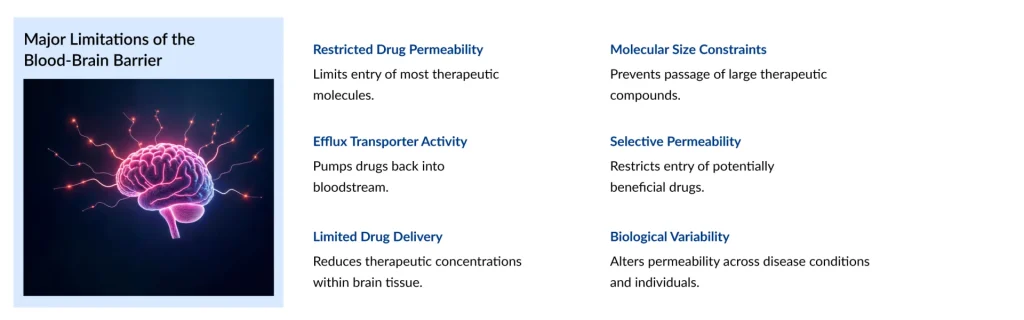
However, this protective function presents a significant therapeutic challenge, as the same mechanisms that safeguard the brain also restrict the entry of most therapeutic molecules. This inherent trade-off between neuroprotection and drug delivery represents a central obstacle in CNS drug development and has become increasingly important as emerging research highlights the frequency with which BBB dysfunction and disruption occur across neurological diseases.
When the Gate Cracks: BBB Breakdown in Brain Disease
BBB dysfunction is no longer treated as a side effect of neurological disease. In many conditions, it is an early driver, an amplifier of damage, or both. Damage can take several forms: loosened tight junctions, pericyte loss, disrupted astrocyte signaling, altered transporter expression, or overactive efflux pumps. Each of these changes how the brain handles toxins, immune cells, and drugs.
Alzheimer’s disease: Imaging and post-mortem studies point to early capillary damage and pericyte loss, even before major cognitive decline. Amyloid-beta clearance across the BBB, which relies on transporters such as LRP1, appears to weaken, while influx via RAGE may increase. Reduced glucose transport through GLUT1 further starves neurons. People who carry the APOE4 risk allele show signs of faster BBB breakdown, which has made the barrier a prime target for early detection and intervention.
Parkinson’s disease: Evidence of barrier leakiness, reduced P-gp function, and neuroinflammation in affected regions suggests the BBB is compromised. Misfolded alpha-synuclein and inflammatory signals may cross a weakened barrier more easily, feeding a cycle of damage.
Multiple sclerosis: MS is a textbook case of BBB failure. Autoreactive immune cells breach the barrier and attack myelin, and the resulting focal leakage is visible on MRI as gadolinium-enhancing lesions. Many MS therapies work in part by limiting immune-cell entry across the BBB.
Epilepsy: Seizures can disrupt the barrier, and a leaky BBB may in turn lower the threshold for further seizures, for example through albumin-triggered signaling in astrocytes. In drug-resistant epilepsy, overexpression of efflux transporters such as P-gp is thought to keep antiseizure drugs from reaching therapeutic levels in the brain.
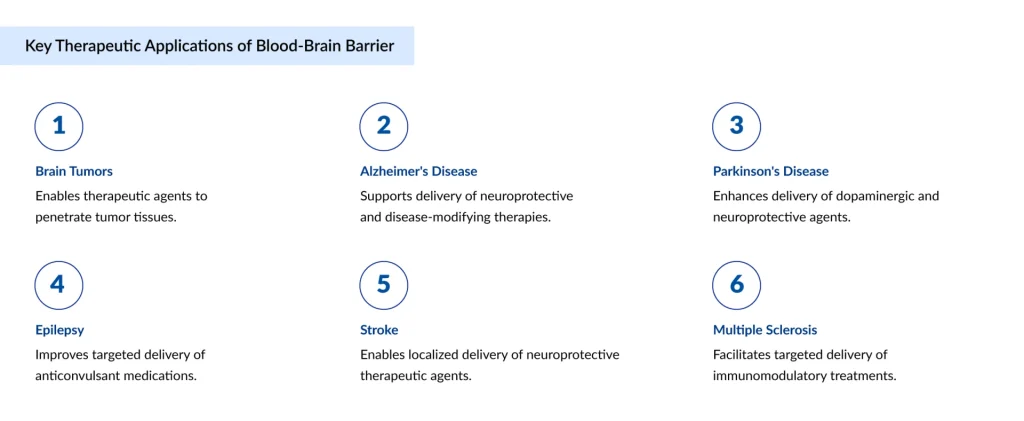
Glioblastoma: Glioblastoma creates a “blood-tumor barrier” that is leaky and uneven. The tumor core may be permeable, but infiltrating cells at the margins often sit behind a largely intact BBB, shielding them from chemotherapy and other agents. This heterogeneity is a major reason that delivery, not just drug potency, limits treatment.
Stroke: Ischemia and reperfusion break down the barrier within hours, driving brain edema and raising the risk of hemorrhagic transformation. Barrier integrity is therefore a key factor in deciding which patients can safely receive clot-busting therapy and how they recover.
Traumatic brain injury (TBI): Mechanical forces tear and stress cerebral vessels, producing immediate and sometimes persistent BBB leakage. Chronic barrier dysfunction after TBI is linked to ongoing neuroinflammation and may contribute to long-term neurodegeneration.
The pattern is consistent: when the BBB fails, neurons are exposed to blood-borne proteins, inflammatory cells, and toxins that they were never meant to meet. Yet in an ironic twist, a damaged barrier is rarely open enough, or open in the right places, to let drugs through reliably.
The Billion-Dollar Roadblock: Why the BBB Frustrates Drug Developers
For pharma and biotech teams, the BBB is arguably the single biggest reason CNS drug development carries higher attrition and longer timelines than many other therapeutic areas. Brain disorders affect hundreds of millions of people worldwide, yet the barrier excludes the vast majority of small-molecule drugs and virtually all large-molecule therapeutics from reaching their targets at effective concentrations.
The challenge is particularly pronounced for the therapeutic modalities increasingly central to modern drug discovery. Monoclonal antibodies, which typically have a molecular weight of approximately 150 kDa, exhibit negligible passive penetration across the blood-brain barrier (BBB), with brain exposure following intravenous administration generally estimated at only 0.1%–0.2% of circulating blood levels. Roche has further highlighted that less than 1% of certain anti-amyloid antibodies reach the central nervous system (CNS). Similarly, peptides and proteins, including enzymes used in lysosomal storage disease therapies, growth factors, and neuropeptides, are generally too large or hydrophilic to cross the BBB efficiently and are additionally susceptible to enzymatic degradation.
Gene therapies face comparable limitations, as viral vectors such as adeno-associated viruses (AAVs) substantially exceed the barrier’s size constraints, while most naturally occurring AAV capsids demonstrate limited brain penetration following systemic administration, necessitating high dosing regimens, direct intracranial delivery, or the development of engineered capsids with enhanced BBB permeability. Oligonucleotide-based therapeutics, including antisense oligonucleotides (ASOs) and small interfering RNAs (siRNAs), also encounter significant delivery challenges due to their high molecular weight and negatively charged structures, which restrict their ability to cross the BBB and have consequently led to the widespread adoption of direct cerebrospinal fluid administration for many such therapies.
The consequences ripple through the entire pipeline. A compound may look excellent in a cell assay and fail because too little reaches neurons. Raising the dose to compensate can drive peripheral toxicity or, in the case of anti-amyloid antibodies, increase the risk of side effects such as amyloid-related imaging abnormalities (ARIA). Efflux pumps such as P-gp can quietly undermine promising small molecules. And animal models do not always predict human BBB behavior, so a candidate that crosses in a mouse can disappoint in patients.
The result is a familiar and costly pattern: strong biology, weak delivery, and late-stage clinical failure.
Why the Old Playbook Falls Short: The Limits of Conventional CNS Delivery
For decades, developers have relied on a limited set of strategies to overcome the blood–brain barrier, each offering meaningful advantages while presenting inherent limitations. Chemical optimization of small molecules, such as reducing molecular size, increasing lipophilicity, or lowering polarity, can enhance passive permeability across the BBB. However, these modifications restrict the available chemical space, potentially compromise potency or selectivity, and remain largely inapplicable to biologics, while efflux pumps may continue to expel the drug from the brain. Prodrug approaches and carrier-mediated delivery offer another workaround, wherein drugs are engineered to mimic endogenous nutrients and exploit existing transport mechanisms, as exemplified by levodopa’s utilization of amino acid transporters. Nevertheless, these strategies are difficult to generalize and remain applicable to a relatively small subset of molecules. Increasing systemic drug doses to achieve higher brain concentrations is another conventional approach, but it frequently results in off-target toxicity and narrower safety margins.
Similarly, intrathecal and intracerebroventricular administration bypass the BBB by delivering therapeutics directly into the cerebrospinal fluid and have been employed for certain antisense oligonucleotides; however, these methods are invasive, often require repeated procedures, and provide limited penetration into deeper brain tissues. Convection-enhanced delivery and direct intracranial injection enable localized and targeted drug administration but necessitate neurosurgical intervention, carry risks of infection and bleeding, and generally expose only a restricted volume of brain tissue. Osmotic BBB disruption, such as through mannitol administration, offers an alternative by temporarily opening the barrier, although its broad and non-selective nature may permit the entry of toxins and unwanted proteins alongside therapeutics, increasing the risk of seizures and neurological injury.
Collectively, these approaches highlight a fundamental challenge characterized by unavoidable trade-offs: conventional strategies are either restricted in the range of therapeutics they can accommodate, too invasive for widespread or repeated application, or insufficiently selective to ensure safety in chronic neurological conditions. Addressing these limitations represents the central objective of emerging BBB delivery technologies, which aim to achieve more efficient, targeted, and safer transport of therapeutics into the brain.
Big Pharma Is Betting on the Brain: Deals, Trials and Firsts
Blood-brain barrier (BBB) delivery has evolved from a niche academic challenge into a strategic priority for the biopharmaceutical industry, driven by three major trends: clinical validation, platform-based dealmaking, and an expanding range of therapeutic modalities. A landmark milestone came on March 25, 2026, when the FDA granted accelerated approval to Denali Therapeutics’ tividenofusp alfa (AVLAYAH) for the neurologic manifestations of Hunter syndrome (MPS II) in pediatric patients. The therapy combines the enzyme iduronate-2-sulfatase with a transferrin receptor-targeting transport vehicle and represents the first FDA-approved product specifically addressing the neurologic complications of Hunter syndrome. It is also being positioned as the first approved medicine in a new class of biotherapeutics leveraging transferrin receptor-mediated transport to cross the BBB, providing important regulatory proof of concept for the broader shuttle technology landscape.
Meanwhile, Alzheimer’s disease is emerging as a major proving ground for BBB delivery platforms, with Roche advancing trontinemab, its Brainshuttle-enabled bispecific anti-amyloid antibody, through clinical development. In a Phase 1b/2a study, trontinemab reduced amyloid levels below the 24-centiloid threshold in 81% of participants (21 of 26) receiving the 3.6 mg/kg dose after 28 weeks. Roche subsequently initiated two Phase III studies, TRONTIER 1 and TRONTIER 2, each enrolling approximately 800 patients with early Alzheimer’s disease across 18 countries, alongside a third trial targeting individuals at elevated risk of developing the disease before symptom onset. The company has estimated that its Brainshuttle platform could achieve 50-fold or greater improvements in brain exposure compared with conventional anti-amyloid antibodies, although definitive clinical outcomes are anticipated around 2028.
Collectively, these developments highlight the growing attractiveness of platform-based business models, in which partners contribute therapeutic cargo while shuttle technology owners capture milestone payments across multiple programs. The commercial landscape is also expanding beyond antibodies to encompass enzymes, siRNA, and antisense oligonucleotides, demonstrating that BBB shuttles are no longer limited to antibody-based therapeutics. As clinical maturity increases, competition is increasingly shifting from demonstrating whether therapeutics can cross the BBB to determining which platforms achieve the safest, most efficient, and most convenient delivery.
Key considerations include dosing frequency, amyloid-related imaging abnormalities (ARIA), immunogenicity, and payer-related treatment logistics, particularly in comparison with approved anti-amyloid therapies. In parallel, device-based BBB disruption approaches, including focused ultrasound (FUS), are advancing independently, particularly in neuro-oncology and amyotrophic lateral sclerosis (ALS), further broadening the technological landscape for central nervous system drug delivery.
The Next Frontier: Where BBB Research Goes From Here
With first proof-of-concept products emerging and several late-stage programs underway, blood-brain barrier science is entering a more ambitious phase, with multiple opportunities shaping its future development. Smarter and safer CNS delivery systems are expected to drive significant progress, as next-generation shuttles aim to enhance brain uptake while minimizing peripheral side effects, including red blood cell-related effects associated with transferrin receptor (TfR) targeting. Continued research into novel receptors, optimized binding affinity, and shuttles capable of transporting oligonucleotides, enzymes, gene therapies, and gene-editing payloads could further expand therapeutic possibilities. In parallel, less frequent dosing, subcutaneous administration, and non-invasive delivery approaches may improve the practicality of long-term CNS treatment.
Artificial intelligence (AI) is also becoming an important catalyst for discovery, with machine learning increasingly used to predict BBB permeability, design novel shuttle binders, and screen extensive molecular libraries in living systems. Roche’s collaboration with Manifold Bio exemplifies the application of AI-enabled in vivo discovery to identify new BBB shuttles, while expanding datasets and generative models are expected to support the development of brain-penetrant molecules, optimize receptor binding, and identify potential toxicity earlier in the development process. Advances in imaging and biomarkers are similarly strengthening translational research, as MRI techniques for assessing BBB permeability, PET tracers for transporter function, and blood-based biomarkers such as plasma p-tau provide increasingly sophisticated tools to evaluate barrier integrity and drug engagement in patients. These improved readouts could shorten clinical trials and strengthen evidence that therapeutics successfully reach their intended targets.
Personalized medicine represents another promising direction, given that BBB integrity varies according to age, genetics, and disease progression. For instance, individuals carrying APOE4 may experience earlier BBB alterations, suggesting that future imaging and biomarker strategies could facilitate patient selection, individualized dosing, and more precise intervention timing, whether through selecting appropriate shuttles, optimizing focused ultrasound (FUS) parameters, or initiating treatment earlier in the disease course.
Meanwhile, human iPSC-derived BBB models, organ-on-chip platforms, and brain organoids are advancing preclinical research and improving the likelihood of translating experimental findings into clinical outcomes. Bridging the gap between animal studies and human responses remains one of the field’s most important translational objectives, potentially reducing costly late-stage development failures. Combination strategies may further enhance therapeutic potential, including integrating FUS with antibodies, pairing BBB shuttles with gene therapies, or combining advanced delivery technologies with disease-modifying agents to achieve synergistic effects beyond those possible with individual approaches.
Despite these opportunities, important challenges remain, particularly regarding the long-term safety of repeated BBB modulation, immunogenicity, manufacturing scalability, reimbursement, and equitable access. Nevertheless, the overall trajectory is increasingly clear: the BBB, once regarded as a fundamental limitation of neuroscience therapeutics, is progressively becoming an engineering and design parameter that can be strategically addressed to expand the possibilities of CNS drug development.

Downloads
Article in PDF
Recent Articles
- Genentech’s gantenerumab Fails in Phase III Trial; CHMP Recommends’ Dupixent; FDA Clears Imfinzi ...
- MorphoSys, Incyte receive FDA Ok for Monjuvi; Siemens Healthineers set to buy Varian; ImmunicR...
- Can Remternetug Solve the Puzzle of Alzheimer’s?
- Bristol Myers’ Opdivo combo Opdualag for Melanoma; Biogen’s Aduhelm; Marinus’ Ztalmy for CDKL-5 D...
- Roche Announces Positive Interim Results for Sefaxersen in IgA Nephropathy; Lilly’s Olumiant Rece...