Top 7 Breakthrough Drugs for Ulcerative Colitis Treatment
Jun 25, 2026
Ulcerative colitis is a type of inflammatory bowel disease of unknown origin that targets the lining of the colon. Symptoms typically include diarrhea, abdominal pain, discomfort, and the presence of blood in the stool. The severity of the condition can vary, with inflammation affecting just the rectum, extending to the splenic flexure on the left side of the colon, or involving the entire rectum and colon.
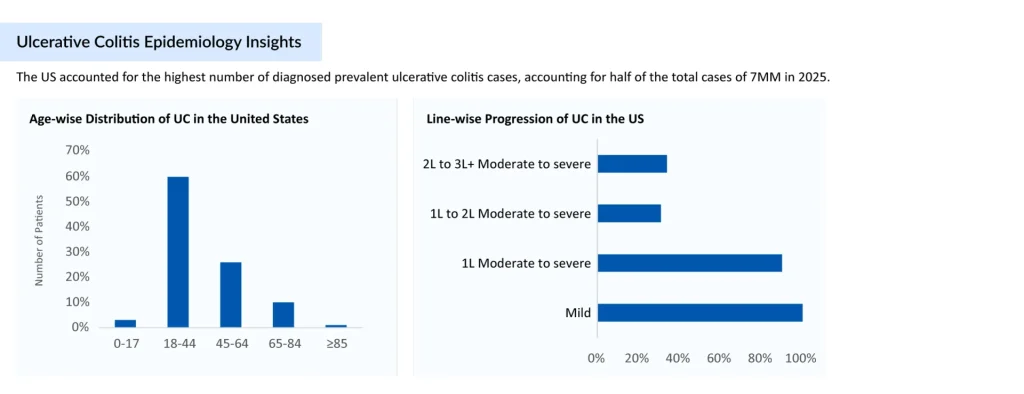
As per DelveInsight analysis, the total ulcerative colitis diagnosed prevalent cases in the 7MM comprised 3.3 million cases in 2025 and are projected to increase by 2036. As per the estimates, in 2025, approximately 60% of cases accounted for the moderate to severe cases of ulcerative colitis among the 7MM.
Treatment strategies for ulcerative colitis are guided by disease severity and typically fall into key categories such as conventional therapies, biologics, S1P receptor modulators, and JAK inhibitors. The landscape of ulcerative colitis medications is expanding with the development of new ulcerative colitis medications targeting novel pathways, including LANCL2 protein stimulators, miR-124 enhancers, TNF-like ligand 1A inhibitors, and toll-like receptor 9 agonists. While advancements have significantly improved treatments for ulcerative colitis medications over time, safety concerns remain a critical challenge. The lack of safer and potentially curative options continues to impact patients’ quality of life and daily functioning. Although existing therapies benefit some patients with ulcerative colitis and Crohn’s disease, many require multiple lines of treatment, underscoring the need for more effective alternatives and raising the ongoing question of what is the best medicine for ulcerative colitis.
Downloads
Click Here To Get the Article in PDF

Recent Articles
- AstraZeneca’s Tropion-Lung01 Phase III Trial Positive Outcomes; Biogen’s LEQEMBI South Korea Appr...
- 5 Promising Exosome-based Therapies Paving the Way for Personalized Medicine
- Lilly’s Morphic Acquisition; IDEAYA’s IDE397 Positive Phase II Trial Result; XPOVIO (seline...
- New Player in Ulcerative Colitis Treatment: Pfizer’s Etrasimod Entry Counters BMS’ Zeposia
- InnoCare’s Trial In China; Sanofi/GSK COVID-19 Vaccine; Apellis’s Empaveli for PNH; LianBio...
The current ulcerative colitis medications list includes several approved therapies, with commonly referenced ulcerative colitis medications names such as TREMFYA (Janssen Pharmaceuticals), SIMPONI (Janssen Pharmaceuticals), ENTYVIO (Takeda Pharmaceuticals), XELJANZ/XELJANZ XR (Pfizer), STELARA (Janssen Pharmaceuticals), CAROGRA (EA Pharma/Kissei Pharma), JYSELECA (Gilead Sciences and Galapagos NV), RINVOQ (AbbVie), ZEPOSIA (Bristol-Myers Squibb), REMICADE (Janssen Pharmaceuticals), HUMIRA (AbbVie), OMVOH (Eli Lilly), and SKYRIZI (AbbVie). Continued collaboration among leading pharmaceutical companies is driving innovation to address existing gaps and bring forward the next generation of therapies.
SIMPONI is a human monoclonal antibody designed to target and neutralize excess tumor necrosis factor (TNF)-alpha, a protein linked to inflammation and tissue damage in chronic inflammatory diseases. As a drug for ulcerative colitis, it holds the distinction of being the first subcutaneous anti-TNF-alpha ulcerative colitis medication administered every four weeks as maintenance therapy. Approved for treating moderately to severely active ulcerative colitis in adults, SIMPONI is also being evaluated in ongoing trials for pediatric patients with the same condition, expanding its potential role among medications for UC.
Vedolizumab is a humanized monoclonal antibody that targets and blocks the alpha 4 beta 7 integrin, preventing it from binding to the intestinal mucosal addressin cell adhesion molecule 1 (MAdCAM-1). This integrin is present in a specific group of circulating white blood cells involved in the inflammatory processes of ulcerative colitis and Crohn’s disease. By inhibiting this pathway, vedolizumab reduces the infiltration of these immune cells into gut tissues, thereby mitigating inflammation. It is currently approved as a colitis treatment for moderate to severe ulcerative colitis in adults who have not responded to, have lost response to, or cannot tolerate conventional therapy or a TNF-alpha blocker. As one of the new ulcerative colitis medications, it offers a targeted approach among today’s advanced UC medications.
Etrasimod (APD334) is a novel oral ulcerative colitis medication taken once daily, designed to selectively modulate the sphingosine 1-phosphate (S1P) receptor. Developed by Arena Pharmaceuticals, it is engineered to interact optimally with S1P receptors 1, 4, and 5, potentially offering improved effectiveness and safety. Etrasimod targets specific immune cells both systemically and locally, making it a promising medicine for ulcerative colitis and other immune-mediated inflammatory conditions like Crohn’s disease.
Now approved by both the FDA and EMA, Etrasimod is indicated for adults with moderately to severely active ulcerative colitis who have had inadequate response, loss of response, or intolerance to conventional or advanced UC medications.
On June 18, 2024, the FDA approved SKYRIZI for the treatment of adult patients with moderately to severely active ulcerative colitis. This milestone expands the drug’s accessibility to approximately 1 million patients in the United States. SKYRIZI becomes the first IL-23 inhibitor approved for both ulcerative colitis and Crohn’s disease—the two primary forms of inflammatory bowel disease (IBD). Following a 12-week induction period, patients can self-administer this ulcerative colitis medication at home using an on-body injector device, which AbbVie describes as user-friendly. The device adheres to the body and delivers the medication for ulcerative colitis in about five minutes.
Since its initial approval for Crohn’s disease in 2022, SKYRIZI has emerged as a strong competitor to Johnson & Johnson’s STELARA in the IBD market. AbbVie’s UC medication has already captured a significant portion of STELARA’s market share.
In September 2025, the FDA approved a SC induction regimen of TREMFYA (guselkumab) for adults with moderately to severely active ulcerative colitis. This approval makes TREMFYA the first and only IL-23 inhibitor to provide both subcutaneous and intravenous (IV) induction treatment options for patients with UC and Crohn’s disease, conditions that collectively impact nearly three million people in the United States.
TREMFYA is also the first and only approved fully human, dual-acting monoclonal antibody designed to inhibit IL-23 while simultaneously binding to CD64, a receptor found on IL-23-producing cells. IL-23, a cytokine released by activated monocytes/macrophages and dendritic cells, plays a central role in driving immune-mediated inflammatory diseases, including ulcerative colitis.
The market for ulcerative colitis drugs remains highly competitive, with companies like Roche, Eli Lilly, Abivax, Landos Biopharma, NImmune, Merck, Takeda, and Mesoblast Ltd. actively conducting clinical trials to develop new treatments for ulcerative colitis.
Several promising drugs for UC are currently in various stages of development and are expected to further enrich the ulcerative colitis treatment landscape. Now, let’s explore the 7 best ulcerative colitis medications currently under investigation.
Abivax’s ABX464 (Obefazimod)
Phase III
ABX464 (obefazimod) is a first-in-class, orally administered small molecule that selectively enhances the expression of microRNA-124 (miR-124) in immune cells. Through its unique mechanism of action, obefazimod promotes the production of miR-124, a key anti-inflammatory regulator, resulting in broad immunomodulatory effects. The therapy has demonstrated a favorable safety profile and significant anti-inflammatory activity across preclinical studies as well as Phase IIa and Phase IIb clinical trials in ulcerative colitis. Clinical findings have highlighted its potential to induce remission and promote mucosal healing in patients with ulcerative colitis.
At the 2026 European Crohn’s and Colitis Organisation (ECCO) Congress, Phase III data showed that obefazimod delivered rapid and early improvements in patient-reported symptoms while maintaining a safety profile comparable to placebo. Topline results from the pivotal Phase III maintenance study are anticipated in late Q2 2026.
In July 2025, Abivax announced positive results from the Phase III ABTECT induction studies evaluating obefazimod in patients with moderately to severely active ulcerative colitis. Treatment with obefazimod 50 mg once daily achieved a pooled placebo-adjusted clinical remission rate of 16.4% at Week 8, including remission rates of 19.3% in ABTECT-1 and 13.4% in ABTECT-2, further supporting its potential as a novel therapeutic option for ulcerative colitis.
Merck’s Tulisokibart
Phase III
Tulisokibart is an investigational humanized monoclonal antibody that targets tumor necrosis factor (TNF)-like ligand 1A (TL1A), a key mediator of intestinal inflammation and fibrosis. The therapy was added to Gilead Sciences’ pipeline through its acquisition of Prometheus Biosciences. Tulisokibart is currently being evaluated in Phase III clinical trials for the treatment of ulcerative colitis. In the Phase II ARTEMIS-UC study (NCT04996797), tulisokibart demonstrated superior efficacy compared with placebo in inducing clinical remission among patients with moderately to severely active ulcerative colitis, highlighting its potential as a promising treatment option for the disease.
Recently, in June 2026, Merck reported positive topline results from the Phase 3 ATLAS-UC induction-only trial (Study 2) assessing tulisokibart (MK-7240), an investigational humanized monoclonal antibody targeting tumor necrosis factor-like cytokine 1A (TL1A), in patients with moderately to severely active ulcerative colitis. The study met its primary endpoint, demonstrating clinical remission at Week 12 based on the Modified Mayo Score (MMS), while also achieving key secondary endpoints. The safety profile was consistent with findings from earlier Phase 2 studies, with no new safety signals or concerns observed.
Teva Pharmaceuticals/Sanofi’s Duvakitug
Phase III
Duvakitug is an investigational human monoclonal antibody that targets TL1A and is currently being evaluated in Phase III clinical trials for the treatment of ulcerative colitis and Crohn’s disease. TL1A signaling is thought to play a key role in inflammatory bowel disease (IBD) by promoting both inflammation and fibrosis through its interaction with the death receptor 3 (DR3). Duvakitug is designed to selectively inhibit TL1A–DR3 signaling while preserving TL1A binding to decoy receptor 3 (DcR3), potentially offering therapeutic benefits by reducing inflammation and limiting fibrotic progression.
Duvakitug has not yet been approved by any regulatory authority, and its safety and efficacy remain under investigation. Under a separate agreement announced in 2023, Teva is collaborating with Sanofi on the co-development of duvakitug and, pending regulatory approvals, will also share commercialization rights for the therapy.
In March 2026, Teva Pharmaceuticals, together with funds managed by Blackstone Life Sciences, announced a four-year strategic financing agreement of up to $400 million to support the continued clinical advancement of duvakitug.
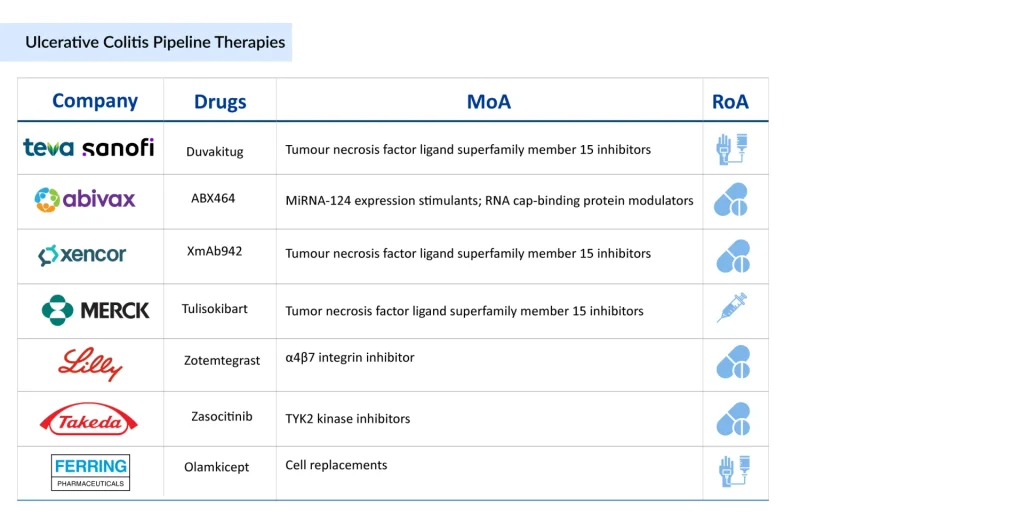
Eli Lilly’s Zotemtegrast
Phase II
Zotemtegrast (LY4268989) is an oral, small‑molecule inhibitor targeting the α4β7 integrin pathway designed to reduce gut‑homing of inflammatory lymphocytes in ulcerative colitis, a mechanism similar to vedolizumab but delivered as a gut‑selective oral agent. Early clinical development is evaluating zotemtegrast both as monotherapy and in combination with biologics (for example, a phase II program testing co‑administration with mirikizumab and placebo‑controlled studies in moderate‑to‑severe UC), with trials currently underway to assess safety, induction of clinical remission, and maintenance outcomes.
Takeda’s Zasocitinib
Phase II
Zasocitinib (TAK-279) is an oral, investigational TYK2 inhibitor being studied for moderate-to-severe ulcerative colitis. It is designed to reduce inflammation by targeting the IL-23/TYK2 pathway, and Takeda is evaluating it in phase 2 studies for both ulcerative colitis and Crohn’s disease, including a long-term extension trial for patients who responded in the parent studies.
Xencor’s XmAb942
Phase II
XmAb942 is a monoclonal anti-TL1A antibody designed using Xencor’s proprietary Xtend™ Fc Domain and Fc-silencing technologies. The investigational therapy has demonstrated the potential for best-in-class potency and is being developed for the treatment of inflammatory bowel disease (IBD), including its two major forms, Crohn’s disease and ulcerative colitis.
In May 2026, Xencor reported final Phase 1 data from a study evaluating XmAb942 in healthy volunteers and provided an update on its TL1A-focused development program. The company is currently advancing XmAb942 in the global XENITH-UC trial, a Phase 2b randomized, double-blind, placebo-controlled study enrolling patients with moderate-to-severe ulcerative colitis. The trial is evaluating the efficacy and safety of XmAb942 in individuals whose disease has inadequately responded to, or progressed despite, at least one conventional or advanced treatment.
Ferring Pharmaceuticals’ Olamkicept
Phase I
Olamkicept is currently undergoing evaluation in two randomized, double-blind, placebo-controlled Phase I clinical trials in Japan and Germany. These studies are designed to assess the drug’s safety, tolerability, and pharmacokinetic profile following single ascending-dose administration in healthy male volunteers. Based on its current stage of development, Olamkicept remains an early-stage (Phase I) asset within the company’s pipeline.
The anticipated launch of new drugs for ulcerative colitis represents a major advancement in the treatment landscape, offering the potential to significantly improve patient outcomes and quality of life. Historically, managing ulcerative colitis has posed considerable challenges, with many patients facing recurrent symptoms and the risk of long-term complications. However, the emergence of these novel medicines for ulcerative colitis brings renewed hope. Many of these ulcerative colitis meds are designed to target specific pathways involved in the inflammatory process, offering more precise symptom control and better disease management.
By reducing the frequency and severity of flare-ups, these ulcerative colitis medications aim to help patients achieve sustained remission, an essential goal in improving long-term health and daily functioning. This evolution in ulcerative colitis treatment not only enhances clinical outcomes but also boosts quality of life for individuals living with this chronic condition.
Moreover, the arrival of these ulcerative colitis medications signals a shift toward more personalized approaches in gastroenterology. Tailoring treatment plans based on factors such as disease severity, genetic profile, and past response to colitis meds allows healthcare providers to fine-tune therapy and reduce the risk of side effects. The broader availability of drugs for UC now enables clinicians to better match therapies with patient needs, potentially lowering healthcare costs linked to flare-ups, complications, and hospital stays.
The latest breakthroughs in ulcerative colitis medication focus on more targeted and effective therapies that improve long-term disease management. Advances include the development of novel biologics such as anti-IL-23 inhibitors, as well as small-molecule drugs like JAK inhibitors and S1P receptor modulators, which offer faster symptom relief and improved remission rates. These innovative treatments are designed to precisely target inflammatory pathways, reducing side effects associated with traditional therapies. Additionally, ongoing clinical research is exploring personalized medicine approaches, aiming to match patients with the most effective treatment based on their disease profile and response patterns.
Overall, the introduction of these new ulcerative colitis treatments marks a transformative era in IBD care, delivering improved disease control, greater patient adherence, and enhanced overall outcomes for those affected.

FAQs
The treatment options for ulcerative colitis vary based on the disease’s severity and can be categorized into six main types: conventional therapies, biologics, S1P-receptor modulators, and JAK inhibitors. New mechanisms of action, such as LANCL2 protein stimulators, miR-124 enhancers, TNF-like ligand 1A inhibitors, and toll-like receptor 9 agonists, among others, are expected to broaden the range of ulcerative colitis medications.
Several FDA-approved drugs for ulcerative colitis are SIMPONI (Janssen Pharmaceuticals), ENTYVIO (Takeda Pharmaceuticals), XELJANZ/XELJANZ XR (Pfizer), STELARA (Janssen Pharmaceuticals), CAROGRA (EA Pharma/Kissei Pharma), JYSELECA (Gilead Sciences and Galapagos NV), RINVOQ (AbbVie), ZEPOSIA (Bristol-Myers Squibb), REMICADE (Janssen Pharmaceuticals), HUMIRA (AbbVie), OMVOH (Eli Lilly), and SKYRIZI (AbbVie).
Companies such as Janssen Pharmaceuticals (TREMFYA), Abivax (ABX464), Landos Biopharma/NImmune (BT-11), Merck (Tulisokibart), Eli Lilly (MORF-057), Takeda (TAK-279), Mesoblast Ltd. (Remestemcel-L), and others are currently evaluating their lead ulcerative colitis drugs in various stages of clinical trials.
Traditional treatments, such as aminosalicylates and immunomodulators, primarily focus on general inflammation. In contrast, emerging therapies target specific immune pathways or cellular mechanisms, offering more precise and potentially effective treatments with fewer side effects.
The latest treatments for ulcerative colitis include advanced biologics and small-molecule therapies that target specific pathways involved in inflammation. Recently approved options include Janus kinase (JAK) inhibitors, S1P receptor modulators, and newer biologics such as anti-IL-23 agents. These therapies offer improved symptom control, better remission rates, and more personalized treatment approaches compared to traditional medications like corticosteroids and aminosalicylates. Ongoing research is also focused on developing more targeted and long-lasting therapies.
There is no single “miracle drug” that cures ulcerative colitis, as it is a chronic condition with varying responses to treatment. However, several advanced therapies such as biologics (e.g., anti-TNF and anti-IL-23 agents) and small-molecule drugs like JAK inhibitors have shown significant effectiveness in controlling symptoms and achieving remission in many patients. The best treatment depends on disease severity, patient response, and medical history, so therapy is typically personalized under a healthcare provider’s guidance.
Downloads
Article in PDF
Recent Articles
- Pfizer to acquire Arena Pharma; Takeda’s ‘Wave 2’ multiple myeloma med data; No...
- Evaluating the Upcoming Drugs in Pipeline for Major Autoimmune Diseases
- Cogent Biosciences’ Bezuclastinib Phase 3 PEAK Trial Positive Results for GIST; Domain Therapeuti...
- Astellas & AviadoBio’s Exclusive Deal for AVB-101; GSK’s Depemokimab Shows Positive Res...
- Algernon’s NP-120; FDA nod to 4DMedical tool; SaNOtize’s NORSTM trial; Pole’s c...