Emerging Therapies for Retinal Vein Occlusion Treatment: What Lies Ahead?
Mar 18, 2026
Table of Contents
Retinal vein occlusion is the second most common retinal vascular disease after diabetic retinopathy and primarily affects people over 65, making aging a key driver of disease burden and of the growing retinal vascular occlusion market. RVO is broadly classified into central retinal vein occlusion (CRVO) and branch retinal vein occlusion (BRVO), with CRVO further divided into ischemic and non‑ischemic forms based on perfusion, and BRVO including major and macular branch involvement.
In 2024, there were an estimated 2.7 million prevalent RVO cases across the 7MM, with around 170,000 CRVO and 765,000 BRVO cases in the US alone, highlighting the size and growth potential of the retinal vein occlusion market and retinal vascular occlusion therapeutics market. Because blocked veins cannot be mechanically reopened, the focus of treatment for retinal vein occlusion is on stabilizing vision, controlling macular edema, and preventing complications rather than providing a definitive “crvo cure” or complete reversal of central retinal vein occlusion.
Downloads
Click Here To Get the Article in PDF

Recent Articles
- Top Emerging Therapies To Watch Out for in the Retinal Vein Occlusion Market
- Analyzing the Most Promising Drugs That Will Lose Patent in the US & EU in 2022
- Leo Pharma’s Hand Eczema Clinical Trial Updates; GSK’s PD-1 inhibitor Jemperli Approval; Ro...
- Could Amgen’s Biosimilar Wezlana Pose a Challenge to Johnson & Johnson’s Stelara
- What are the options available for the treatment of Retinal vein occlusion?
Anti-VEGF Therapies: The Backbone of RVO Treatment
From a clinical standpoint, can retinal vein occlusion be cured, or can central retinal vein occlusion be cured? At present, there is no approved therapy that reverses the underlying venous obstruction, so most patients are left with some permanent visual changes despite appropriate retinal vascular occlusion treatment. As a result, answers to questions like can retinal vein occlusion be reversed or can crvo be reversed remain cautious: some eyes show visual improvement over time, some remain stable, and others worsen, with roughly one‑third in each category, and recovery potentially taking more than a year.
Given this reality, the best treatment for central retinal vein occlusion or branch disease is early, sustained management of macular edema and risk factors using retinal vein occlusion treatment injection strategies, laser, and systemic control, rather than expecting a true CRVO cure. This positioning is crucial both for patient counseling and for framing value propositions in the retinal vein occlusion therapeutics market and the retinal vein occlusion treatment market.
Today’s standard retinal vein occlusion treatment relies on intravitreal anti‑VEGF agents and corticosteroids, which form the backbone of both clinical practice and the US retinal vein occlusion market. Key approved drugs in the retinal vein occlusion treatment injection class include LUCENTIS (ranibizumab), EYLEA (aflibercept), OZURDEX (dexamethasone intravitreal implant), and the newer VABYSMO (faricimab), while AVASTIN (bevacizumab) and intravitreal triamcinolone remain widely used off‑label eye injections for RVO and other retinal vascular obstruction treatment needs.
AVASTIN for retinal vein occlusion, though off‑label, remains a cost‑effective retinal disease treatment option for RVO in many settings, particularly where access or pricing is a concern. This mix of branded biologics, implants, and off‑label agents defines what’s the current anti‑VEGF treatment landscape for RVO, especially in high‑volume centers such as retinal vascular occlusion treatment downtown clinics in global metros.
Sadaf Javed, Manager of Forecasting at DelveInsight, said that RVO management is evolving toward more personalized approaches, combining established anti-VEGF therapies with next-generation treatments that offer longer durability, reduced injection frequency, and better long-term visual outcomes for patients.
New Treatments for Retinal Vein Occlusion in Horizon
A robust pipeline of new treatments for retinal vein occlusion is expected to reshape both clinical practice and the broader retinal vascular occlusion market over the next decade. These new treatments for retinal vein occlusion aim to extend dosing intervals, improve anatomical and functional outcomes, and, ultimately, move closer to disease modification for both branch retinal vein occlusion and central retinal vein occlusion.
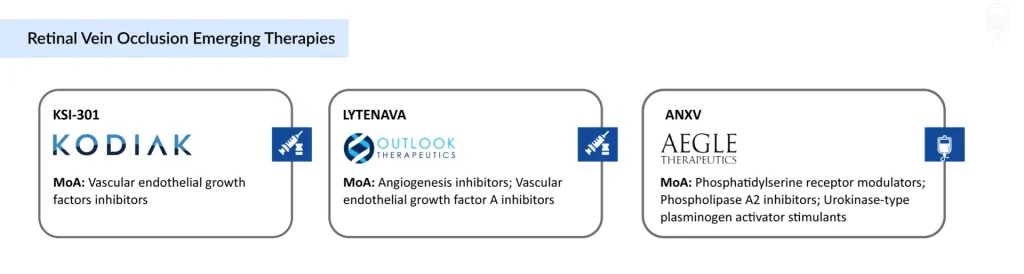
Some of the promising emerging RVO drugs in clinical trials include Tarcocimab tedromer (KSI-301) (Kodiak Sciences), LYTENAVA (ONS-5010) (Outlook Therapeutics), ANXV (Annexin Pharmaceuticals), and others. Tarcocimab tedromer (KSI-301), developed by Kodiak Sciences, is an intravitreal therapy and a next-generation anti-VEGF biologic designed for extended activity within the eye. It integrates a customized anti-VEGF antibody with a phosphorylcholine-based biopolymer to target VEGF, a central factor in retinal vascular disorders. Built on the Antibody Biopolymer Conjugate (ABC) platform, the therapy aims to enhance drug durability in ocular tissues, maintaining therapeutic levels for longer periods than currently available treatments.
In September 2023, Kodiak Sciences announced top-line findings from the BEACON study, a pivotal trial assessing tarcocimab tedromer (5 mg). The 48-week results focused on patients with macular edema secondary to RVO. The company intends to file a single Biologics License Application (BLA) in 2026, combining data across three major retinal diseases, including RVO. This strategy underscores its goal to streamline the regulatory pathway and broaden its presence in the retinal disease market, with a potential launch anticipated in 2027 for RVO.
ONS-5010/LYTENAVA is a U.S.-manufactured ophthalmic formulation of bevacizumab designed to treat wet age-related macular degeneration (AMD). It has received centralized marketing authorization from the European Commission for use in the EU, as well as approval from the UK’s Medicines and Healthcare products Regulatory Agency (MHRA) for the same indication. However, in some EU countries, additional pricing and reimbursement approvals are required before commercialization.
In March 2026, the company shared an update following a Type A meeting with the U.S. Food and Drug Administration (FDA) regarding the Complete Response Letter (CRL) issued on December 30, 2025, for its Biologics License Application (BLA). The meeting focused on addressing the FDA’s concerns about demonstrating substantial evidence of effectiveness and exploring possible pathways to secure regulatory approval.
Clinical data showed that ONS-5010/LYTENAVA achieved statistically significant and clinically meaningful improvements in visual acuity in the Phase 3 NORSE TWO trial, successfully meeting both primary and key secondary endpoints. Additional support from the NORSE EIGHT study and other BLA submissions reinforced its efficacy and safety, including evidence aligned with its anti-VEGF mechanism of action. The therapy also exhibited a favorable safety profile, with no major concerns raised by the FDA.
If approved, ONS-5010/LYTENAVA would become the first FDA-approved ophthalmic formulation of bevacizumab backed by standardized manufacturing, approved labeling, and comprehensive pharmacovigilance.
ANXV is an experimental biologic developed by Annexin Pharmaceuticals, derived from the human protein Annexin A5. It is produced using recombinant DNA technology by inserting the Annexin A5 gene into E. coli, allowing scalable protein manufacturing through microbial expression systems.
In August 2024, the company announced positive topline data from a Phase IIa study of ANXV in RVO, demonstrating a favorable safety profile and clinical improvement in most patients, along with reduced reliance on anti-VEGF therapy.
These programs, although nascent, underscore how the future retinal vein occlusion therapeutics market may look very different, with regenerative concepts added to the current anti‑VEGF and steroid paradigm.
Future RVO Treatment Space Looks Promising
The retinal vein occlusion market and the more focused retinal vein occlusion treatment market are expected to expand as prevalence rises with aging populations and as multiple new entrants launch across both biologics and small implants. Patent expiries for legacy agents, together with the introduction of biosimilars such as BYOOVIZ and ONGAVIA, will intensify price competition and widen access, but also increase barriers for premium‑priced newcomers in the retinal vascular occlusion therapeutics market.
For health systems and providers, this evolving mix creates opportunities to design cost‑effective retinal disease treatment options for RVO, balancing branded anti‑VEGF agents, biosimilars, implants, and off‑label AVASTIN for retinal vein occlusion to tailor regimens by indication, such as BRVO versus CRVO treatment. Markets such as the US retinal vein occlusion market and geographies like Turkey retinal vascular occlusion treatment centers, where interest in transparent Turkey retinal vascular occlusion treatment prices is rising, will be closely watched as testbeds for novel reimbursement and access models.
Across global hubs, including “retinal vein occlusion treatment downtown” clinics and specialized “central retinal vein occlusion treatment downtown” centers, clinicians will increasingly have a wider menu of retinal occlusion treatment injection options and RVO injection schedules to individualize care. In parallel, targeted segments such as “best treatment for central retinal vein occlusion downtown” or “treatment for CRVO” will remain highly competitive as payers seek value and patients seek therapies that come closer to answering whether retinal vein occlusion can be cured or whether CRVO treatment can truly change the long‑term visual trajectory.

FAQs
Some of the promising new treatments for RVO in clinical trials include Tarcocimab tedromer (KSI-301) (Kodiak Sciences), LYTENAVA (ONS-5010) (Outlook Therapeutics), ANXV (Annexin Pharmaceuticals), and others.
Emerging therapies for RVO are designed to go beyond frequent anti-VEGF injections by targeting additional disease pathways such as inflammation, fibrosis, and vascular stability. Many of these next-generation approaches aim to provide longer-lasting effects through sustained delivery systems, gene therapies, or novel biologics, potentially reducing treatment burden and improving patient outcomes.
Yes, early-stage cell-based and gene-adjacent approaches are being explored for RVO, but they remain largely investigational. Small studies have evaluated autologous CD34+ stem cell therapies for vascular repair, and while true gene therapies are not yet advanced specifically for RVO, adjacent retinal gene therapy platforms could eventually be adapted.
Emerging treatments for RVO aim to address key limitations of current therapies, such as the need for frequent intravitreal injections and variable patient response. They focus on improving durability, targeting underlying disease mechanisms beyond VEGF, and delivering more consistent visual outcomes with reduced treatment burden.
Most pipeline therapies are still in mid- to late-stage trials, suggesting broader clinical availability and FDA approvals will likely emerge over the next 2–5 years, depending on trial outcomes and regulatory timelines.
Downloads
Article in PDF
Recent Articles
- Top Emerging Therapies To Watch Out for in the Retinal Vein Occlusion Market
- What are the options available for the treatment of Retinal vein occlusion?
- Leo Pharma’s Hand Eczema Clinical Trial Updates; GSK’s PD-1 inhibitor Jemperli Approval; Ro...
- Phase III RUBY Trial of Jemperli Plus Chemotherapy Updates; FDA Approves Roche’s Vabysmo for RVO;...
- Analyzing the Most Promising Drugs That Will Lose Patent in the US & EU in 2022