Liquid Biopsy: The Blood Test That Is Redefining Cancer Diagnosis, Monitoring, And Precision Oncology
Jul 24, 2026
Table of Contents
For decades, the diagnosis and monitoring of cancer have depended heavily on tissue biopsy, a procedure that involves surgically or percutaneously removing a piece of tumor for pathological examination. While tissue biopsy remains the diagnostic gold standard, it is invasive, carries procedural risk, cannot always be repeated, and offers only a single snapshot of a tumor that is often genetically heterogeneous and constantly evolving. Liquid biopsy has emerged as a transformative, minimally invasive alternative that analyzes tumor-derived material shed into a patient’s blood, urine, saliva, or other body fluids.
By capturing circulating tumor DNA (ctDNA), circulating tumor cells (CTCs), exosomes, non-coding RNAs, and tumor-educated platelets, liquid biopsy provides a real-time, whole-body molecular picture of a patient’s cancer. It enables earlier detection, more precise treatment selection, continuous monitoring of therapy response, and early identification of relapse, often weeks to months before changes are visible on imaging. As of 2026, liquid biopsy has moved from an experimental research tool to a clinically validated component of mainstream oncology practice, with multiple FDA-approved companion diagnostics and expanding Medicare coverage.
Downloads
Click Here To Get the Article in PDF

Recent Articles
- The Rise of Targeted Therapeutics in Modern Healthcare
- Biopsy Devices: Advancing Diagnostic Precision in Modern Healthcare
- Cancer Diagnostic Market: Evaluating the Major Growth Factors and the Key Developments in the Domain
- FDA Approval to DePuy TELIGEN System; FDA Breakthrough Device Designation for the EndoStim System...
- Leo Cancer Care Receives CE Mark Approval for Marie® Upright Radiotherapy System; PorTal Access,...
What Is Liquid Biopsy?
Liquid biopsy refers to the sampling and analysis of biomarkers shed by tumors into bodily fluids, most commonly peripheral blood. As a tumor grows, its cells continuously release material into circulation through apoptosis, necrosis, and active secretion. This material carries the same genetic and molecular fingerprints as the tumor itself, making it possible to characterize cancer without a surgical procedure.
Key Analytes
Circulating tumor DNA (ctDNA): Small fragments of tumor-derived DNA that carry the same mutations, methylation patterns, and structural alterations found in the primary tumor.
Circulating tumor cells (CTCs): Whole intact tumor cells that detach from the primary tumor or metastatic sites and enter the bloodstream.
Extracellular vesicles (exosomes): Nanoscale vesicles carrying tumor-derived proteins, RNA, and DNA that mediate intercellular communication and pre-metastatic niche formation.
Non-coding RNAs: MicroRNAs and long non-coding RNAs that regulate gene expression and can serve as diagnostic and prognostic biomarkers.
Tumor-educated platelets and secreted proteins: Platelets and plasma proteins altered by their interaction with tumor cells, offering additional layers of biomarker information.
|
Liquid Biopsy vs. Conventional Tissue Biopsy |
||
|---|---|---|
|
Attribute |
Tissue Biopsy |
Liquid Biopsy |
|
Invasiveness |
Invasive (surgical/percutaneous) |
Minimally invasive (blood draw) |
|
Repeatability |
Limited; procedural risk with repeat sampling |
Easily repeated for serial monitoring |
|
Tumor heterogeneity |
Single-site snapshot |
Captures signal from multiple tumor sites |
|
Turnaround time |
Days to weeks (procedure + pathology) |
Days (tumor-agnostic) to weeks (tumor-informed) |
|
Sensitivity (early stage) |
High, if tumor is accessible |
Lower at Stage I, improves with disease burden |
|
Use in monitoring/MRD. |
Not practical for serial use |
Well suited to longitudinal tracking. |
How Liquid Biopsy Works
Modern liquid biopsy platforms combine ultrasensitive molecular techniques with advanced bioinformatics and, increasingly, artificial intelligence to detect trace amounts of tumor material within a vast background of normal cell-free DNA. Core technologies include:
Next-generation sequencing (NGS): Enables comprehensive genomic profiling across hundreds of genes in a single assay, detecting point mutations, insertions/deletions, copy-number alterations, and fusions.
Digital PCR (dPCR) and droplet digital PCR (ddPCR): Provide extremely high analytical sensitivity for detecting known, specific mutations at very low allele frequencies.
Methylation and epigenomic profiling: Detects tumor-specific DNA methylation patterns, which is particularly valuable for tumor-agnostic, multi-cancer early detection tests.
Fragmentomic: Analyzes the characteristic fragmentation patterns of cell-free DNA released by tumor cells versus normal cells.
Microfluidics: Isolates rare circulating tumor cells from whole blood based on physical or biological properties.
AI and machine learning: Integrate genomic, epigenomic, and fragmentomic signals to improve sensitivity, specificity, and cancer-signal-origin prediction.
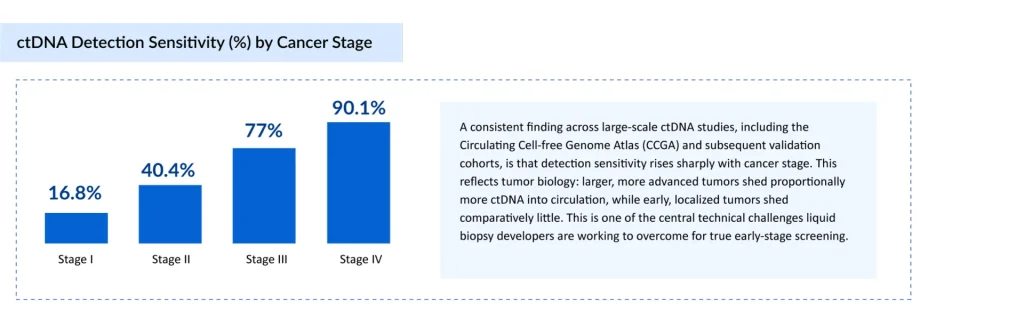
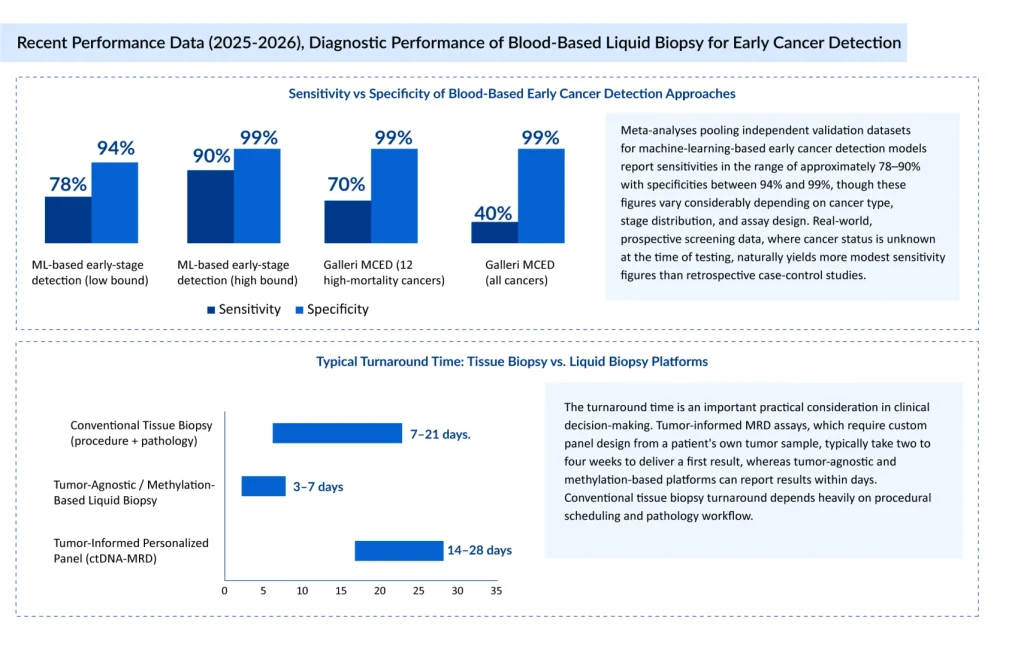
A key distinction in clinical practice is between tumor-informed and tumor-naïve (tumor-agnostic) assays. Tumor-informed assays are custom-built from a patient’s own tumor tissue sequencing results, offering very high specificity for detecting minimal residual disease (MRD), but requiring two to four weeks for personalized panel design. Tumor-agnostic and methylation-based platforms do not require prior tumor tissue and return results faster, though typically with some trade-off in sensitivity.
Clinical Applications
Early Cancer Detection and Screening
Multi-cancer early detection (MCED) tests, such as GRAIL’s Galleri, aim to detect a shared cancer signal across dozens of tumor types from a single blood draw before symptoms appear. In the landmark PATHFINDER 2 study, the largest interventional MCED trial in North America, enrolling 35,878 participants, adding Galleri to standard-of-care screening increased the number of screen-detected cancers by up to 6.5-fold, with 71% of newly detected cancers found at Stage I–III. The test demonstrated an episode sensitivity of 69.8% for twelve cancers responsible for two-thirds of U.S. cancer deaths, an all-cancer episode sensitivity of 39.3%, a specificity of 99.6% (false positive rate under 0.4%), and a positive predictive value of 60.3%.
Companion Diagnostics and Treatment Selection
Plasma-based companion diagnostics guide targeted therapy selection by identifying actionable mutations without requiring fresh tumor tissue. The cobas EGFR Mutation Test v2 became the first FDA-approved ctDNA companion diagnostic in 2016 for EGFR-mutant non-small-cell lung cancer. Since then, the field has expanded considerably: FoundationOne Liquid CDx and Guardant360 CDx now support companion diagnostic indications across lung, prostate, and other solid tumors, including 2026 approvals pairing Guardant360 CDx with HERNEXEOS® and pairing FoundationOne Liquid CDx with TALZENNA® in combination with XTANDI® for HRR gene-mutated metastatic castration-resistant prostate cancer. In May 2026, the FDA approved Guardant360 Liquid CDx, an updated assay that layers epigenomic data on top of genomic profiling from a single blood draw; the company describes it as the largest FDA-approved liquid biopsy panel, with roughly a 100-fold wider genomic footprint than its predecessor, and it carries forward seven previously approved companion diagnostic indications.
Minimal Residual Disease (MRD) Monitoring
Perhaps the fastest-growing clinical application of liquid biopsy is minimal residual disease detection, identifying trace amounts of ctDNA that persist after curative-intent surgery or treatment, often long before recurrence would be visible on imaging. In 2026, the FDA approved Signatera CDx for use with adjuvant atezolizumab in muscle-invasive bladder cancer, the first-ever companion diagnostic approval for a blood-based, tumor-informed MRD test, establishing MRD status as a formal treatment-selection criterion. NCCN guidelines have also been updated to recommend multiplex PCR–based MRD testing for risk stratification in bladder cancer, and Signatera has received regulatory approval in Japan for adjuvant colorectal cancer monitoring, the first PMDA-approved MRD test in that market.
Treatment Response and Resistance Monitoring
Serial liquid biopsy sampling allows oncologists to track tumor burden and detect emerging resistance mutations in real time as treatment progresses, enabling earlier therapy adjustments than would be possible with periodic imaging alone.
Regulatory Milestones
Regulatory acceptance of liquid biopsy has accelerated markedly over the past decade, moving from a single narrow companion diagnostic indication in 2016 to a broad and growing portfolio of approved comprehensive genomic profiling panels and, most recently, blood-based MRD companion diagnostics.
- January 2023: The U.S. FDA continued expanding companion diagnostic indications for Guardant360® CDx, broadening its clinical utility across multiple targeted oncology therapies and reinforcing the role of liquid biopsy in precision medicine.
- March, 2023: Guardant Health submitted a Premarket Approval (PMA) application to the U.S. FDA for its Shield™ blood test, seeking approval as a non-invasive blood-based screening test for colorectal cancer in average-risk adults.
- May 2023: The U.S. FDA approved FoundationOne® Liquid CDx (P190032/S005) for an expanded indication to identify EGFR exon 20 insertion mutations in patients with non-small cell lung cancer (NSCLC), further strengthening the use of liquid biopsy as a companion diagnostic.
- July 2023: The U.S. FDA granted Breakthrough Device Designation to DELFI Diagnostics’ FirstLook Lung blood test, accelerating the development and regulatory review of the company’s liquid biopsy assay for early lung cancer detection.
- May, 2024: The FDA’s Molecular and Clinical Genetics Panel voted overwhelmingly in favor of the benefit-risk profile of Guardant Health’s Shield™ blood test, recommending its approval for colorectal cancer screening in average-risk adults aged 45 years and older.
- July, 2024: The U.S. FDA approved Guardant Health’s Shield™ blood test, making it the first FDA-approved blood-based screening test for colorectal cancer for average-risk adults aged 45 years and older.
- August, 2024: Following FDA approval, Shield™ became commercially available in the United States, and the Centers for Medicare & Medicaid Services (CMS) confirmed Medicare coverage under the National Coverage Determination for blood-based colorectal cancer screening tests, significantly improving patient access.
- August 2024: The National Comprehensive Cancer Network (NCCN) updated its Colon Cancer Clinical Practice Guidelines to recognize circulating tumor DNA (ctDNA) as an important prognostic biomarker for assessing minimal residual disease (MRD) and recurrence risk following curative treatment, further supporting the clinical integration of liquid biopsy.
- January 2025: Palmetto GBA (MolDX) expanded Medicare coverage for Guardant Reveal™, allowing reimbursement for surveillance testing to monitor disease recurrence in colorectal cancer patients after curative-intent therapy, extending coverage beyond the early post-surgical setting.
- March, 2025: The Centers for Medicare & Medicaid Services (CMS) granted Advanced Diagnostic Laboratory Test (ADLT) status to Guardant Health’s Shield™ blood test, recognizing its clinical innovation and establishing a market-based Medicare reimbursement pathway.
- In June 2026, BioMark Diagnostics Inc. announced that the U.S. Patent and Trademark Office (USPTO) has issued a Notice of Allowance for Patent Application No. 18/304,741, entitled “Method of Detecting Lung Cancer.” The patent covers the company’s proprietary urine-based approach for lung cancer detection, monitoring treatment response, screening high-risk individuals, and assessing therapeutic efficacy. The technology leverages a highly specific biomarker panel comprising polyamine metabolites and other key analytes to enable accurate and non-invasive disease evaluation.
- In June 2026, Hummingbird Diagnostics GmbH announced that it will showcase new data at the upcoming EACR Congress, scheduled for June 8–11 in Budapest, Hungary, highlighting the biological and clinical significance of its liquid biopsy RNA biomarkers in lung cancer.
- In May 2026, Avant Genomics™ secured over $3 million in funding to further develop its automated liquid biopsy sample preparation platform. The financing round attracted participation from TitletownTech, Halyard Ventures, Virginia Venture Partners, CAV Angels, Global Impact Fund, as well as several angel investors and family offices. The newly raised capital will be used to advance research and development efforts, scale manufacturing capabilities, and strengthen the company’s team through strategic hiring initiatives.
- In April 2026, CareDx Inc. signed a definitive agreement to acquire Naveris, a precision oncology diagnostics company focused on blood-based surveillance of viral-driven cancers. Under the terms of the deal, CareDx will make an upfront cash payment of $160 million, with up to an additional $100 million contingent upon the achievement of specified future revenue milestones. The acquisition marks CareDx’s expansion into specialty oncology, targeting a market opportunity estimated at $4.5 billion. Naveris’ proprietary liquid biopsy platform leverages Tumor Tissue Modified Viral (TTMV) DNA technology to detect and monitor fragments of viral DNA shed by tumor cells into the bloodstream, enabling non-invasive cancer monitoring and disease management.
- In April 2026, TCM Biotech was granted Breakthrough Device Designation by the U.S. Food and Drug Administration (FDA) for CatCHimera, its innovative liquid biopsy platform developed to detect and monitor minimal residual disease (MRD) in patients with hepatocellular carcinoma.
- In April 2026, Johnson & Johnson launched a new initiative in the United Arab Emirates to improve access to liquid biopsy testing for patients with metastatic non-small cell lung cancer (NSCLC). Under the program, the company will fund liquid biopsy testing for eligible patients whose insurance plans do not cover the diagnostic procedure. The initiative utilizes Guardant Health’s genomic testing platform to perform liquid biopsy analyses, helping facilitate timely and comprehensive molecular profiling.
- In April 2026, PanGIA Biotech, Inc. announced the publication of a peer-reviewed clinical study in Diagnostics titled “Urine-Based Machine Learning Assay Detects Prostate Cancer,” demonstrating the clinical validation of its PanGIA Analysis System (PAS), a machine learning-powered, urine-based liquid biopsy platform.
- May 2026: The U.S. FDA approved Guardant360® Liquid CDx, combining genomic and epigenomic profiling from a single blood draw and carrying forward seven previously approved companion diagnostic indications for advanced-cancer treatment selection.
- May 2026: The American Cancer Society updated its Colorectal Cancer Screening Guideline to formally include blood-based testing, listing Guardant Shield™ and the Freenome SimpleScreen™ multiomics blood test as options for average-risk adults 45 and older who decline or have not completed stool-based or visual screening.
- June 2026: The NCCN updated its Bladder Cancer guidelines to recommend multiplex PCR-based ctDNA-MRD testing, as used by Natera’s Signatera, for risk stratification and adjuvant immunotherapy decisions.
- July 2026: UnitedHealth Group began covering Guardant Health’s Shield™ blood test for colorectal cancer screening in eligible members aged 45 and older, becoming the first major U.S. commercial insurer to do so and extending potential access to roughly 40 million plan members.
Market Insights
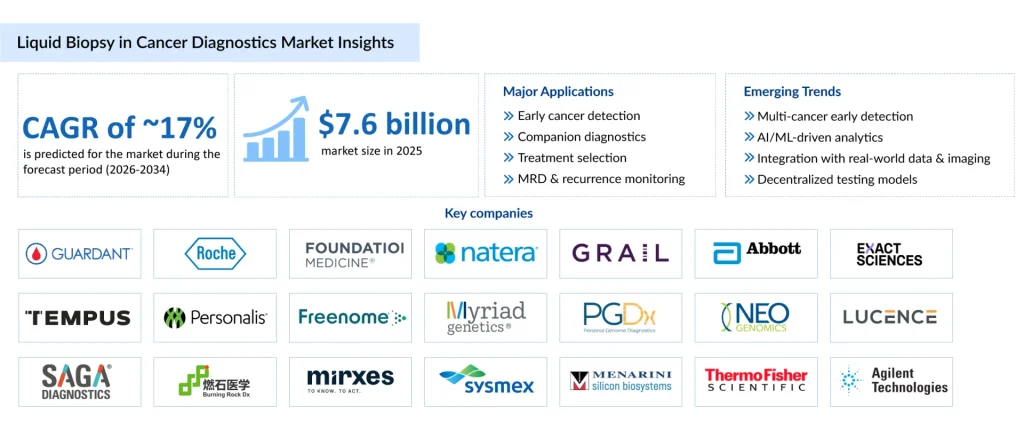
The global liquid biopsy in cancer diagnostics market was valued at USD 7.64 billion in 2025 and is expected to reach USD 19.24 billion by 2034. The global liquid biopsy in cancer diagnostics market is expected to grow at a CAGR of 16.64% during the forecast period from 2026 to 2034.
Liquid Biopsy Market in Cancer Diagnostics: Competitive Landscape
The leading companies operating in the liquid biopsy in cancer diagnostics market include Guardant Health, F. Hoffmann-La Roche Ltd. Foundation Medicine, Natera, GRAIL, Abbott including Exact Sciences, Tempus AI, Personalis, Freenome, Myriad Genetics, Labcorp, Personal Genome Diagnostics, NeoGenomics Laboratories, Lucence, SAGA Diagnostics, Burning Rock Biotech, MiRXES, Sysmex Corporation, Menarini Silicon Biosystems, QIAGEN, Illumina, Thermo Fisher Scientific, Agilent Technologies, Bio-Techne, Biocartis, and Agena Bioscience, among others.
The liquid biopsy market in cancer diagnostics is evolving from a fragmented group of assay developers into a competitive ecosystem of integrated precision-oncology companies, specialized MRD providers, cancer-screening innovators, and technology-platform suppliers. Competition is increasingly determined not only by analytical sensitivity, but also by FDA authorization, clinical utility, reimbursement coverage, turnaround time, pharmaceutical partnerships, longitudinal datasets, and integration into oncology workflows.
|
Competitive segment |
Representative companies |
Competitive positioning and market insight |
|---|---|---|
|
Comprehensive Genomic Profiling and Companion Diagnostics |
Guardant Health, Foundation Medicine, Tempus, Caris Life Sciences |
Guardant Health and Foundation Medicine remain strongly positioned in advanced-cancer therapy selection. Guardant strengthened its portfolio through the 2026 FDA approval of the expanded Guardant360 Liquid CDx platform, while FoundationOne Liquid CDx offers a 324-gene FDA-approved blood-based assay with an approximately seven-day turnaround time and multiple companion diagnostic indications. Their regulatory portfolios, pharmaceutical relationships, clinical datasets, and payer access create meaningful entry barriers for smaller competitors. |
|
Molecular Residual Disease and Recurrence Monitoring |
Natera, Guardant Health, Personalis, Exact Sciences |
Natera holds a strong position in tumor-informed MRD through Signatera. Its May 2026 FDA approval as a companion diagnostic for identifying ctDNA-MRD-positive muscle-invasive bladder cancer patients represented the first FDA-approved personalized MRD test linked directly to treatment selection. This milestone shifts MRD testing from a predominantly prognostic and surveillance tool toward a regulated, therapy-guiding diagnostic category. Guardant differentiates through tissue-free MRD approaches, while Personalis and other participants compete through increased assay sensitivity and personalized genomic tracking. |
|
Blood-Based Colorectal Cancer Screening |
Guardant Health and emerging blood-test developers |
Guardant Health currently benefits from a first-mover advantage through Shield, the first FDA-approved blood-based screening test for average-risk colorectal cancer screening in adults aged 45 years and older. Shield also benefits from a defined Medicare coverage pathway for qualifying blood-based screening tests. However, competition will depend on more than cancer sensitivity: detection of advanced precancerous lesions, patient adherence, colonoscopy completion after positive results, testing frequency, cost, and integration into primary-care workflows will determine long-term adoption. |
|
Multi-Cancer Early Detection |
GRAIL, Guardant Health, Freenome, Exact Sciences and other multi-omics developers |
GRAIL is one of the most advanced commercial participants in MCED through Galleri and its large clinical development program. The company reported more than 185,000 Galleri tests sold during 2025 and completed a PMA submission to the FDA. PATHFINDER 2 included 35,878 participants and showed that adding Galleri to recommended screening increased cancer detection, although broad adoption will ultimately depend on regulatory authorization, health-outcome evidence, reimbursement and management of false-positive results. |
|
Technology and Workflow Enablers |
Illumina, Thermo Fisher Scientific, QIAGEN, Bio-Rad and specialized sample-preparation companies |
These companies compete primarily through sequencing systems, PCR platforms, extraction technologies, reagents and bioinformatics rather than through direct clinical oncology services. Their technologies support many liquid biopsy developers, giving them exposure across multiple competing assays. However, increasing vertical integration by large diagnostic companies may place pressure on independent technology suppliers to provide greater automation, sensitivity and cost efficiency. |
Key Competitive Insights
Regulatory approval is becoming a major competitive moat
The market has historically included a large number of laboratory-developed tests offered through CLIA-certified laboratories. The growing number of FDA-approved companion diagnostics, screening assays, and MRD tests is creating a clearer separation between clinically validated commercial leaders and early-stage assay developers. Natera’s Signatera CDx approval is particularly important because it establishes a regulatory precedent for using MRD status to determine which patients should receive adjuvant treatment. This may encourage pharmaceutical companies to incorporate MRD assays into prospective trials and co-develop treatment-linked companion diagnostics.
Companies are expanding across the cancer-care continuum
Leading participants are moving beyond single-use assays toward portfolios covering:
Early detection → molecular profiling → treatment selection → response monitoring → MRD assessment → recurrence surveillance
Guardant Health currently has one of the broadest portfolios, encompassing advanced-cancer genomic profiling, MRD and recurrence monitoring, pharmaceutical data services, and FDA-approved colorectal cancer screening. During 2025, the company reported approximately 276,000 oncology tests and approximately 87,000 Shield screening tests, illustrating the commercial benefit of operating across multiple stages of cancer management.
MRD is emerging as the next major competitive battleground
MRD represents one of the most attractive areas because testing is repeated longitudinally rather than performed only once. A patient may undergo multiple tests after surgery, during adjuvant therapy, and throughout surveillance, creating recurring revenue opportunities. The key competitive distinction is between:
- Tumor-informed assays, which use sequencing from the patient’s tumor to create a personalized test and generally offer high specificity.
- Tissue-free or tumor-naïve assays, which avoid the need for tumor tissue and may provide faster test initiation.
- Ultra-sensitive genome-wide approaches, which aim to identify recurrence at increasingly low ctDNA concentrations.
The winning platforms are likely to be those that demonstrate that MRD-guided intervention improves survival or safely avoids unnecessary treatment, rather than those reporting analytical sensitivity alone.
Clinical evidence and reimbursement are more defensible than sequencing technology
NGS, digital PCR, and methylation-analysis capabilities are becoming increasingly accessible. Consequently, proprietary sequencing methods alone may not provide sustainable differentiation. The strongest competitive barriers are likely to include:
- Prospective clinical-trial evidence
- FDA-approved therapy-linked claims
- Medicare and commercial payer coverage
- Large longitudinal genomic datasets
- Pharmaceutical companion-diagnostic partnerships
- Integration into electronic ordering and oncology workflows
- Reliable turnaround times and low test-failure rates
Natera itself identifies clinical performance, reimbursement, distribution, operational execution, and provider support as major competitive factors in molecular diagnostics.
Screening will be a high-volume but evidence-sensitive market
Cancer screening potentially offers much larger testing volumes than advanced-cancer profiling or MRD. However, it also requires exceptionally high specificity because tests are administered to predominantly healthy populations. Shield’s FDA approval provides Guardant with an important commercial advantage, but the test does not replace diagnostic colonoscopy, and positive results require follow-up evaluation. The FDA reported an overall colorectal cancer detection rate of approximately 83%, while highlighting more limited detection of precancerous lesions. Therefore, future competition will focus on improving early-stage and precursor-lesion detection without increasing false positives.
Overall Competitive Outlook
The liquid biopsy market is likely to remain highly innovative but gradually consolidate around companies capable of combining regulatory approvals, clinically actionable evidence, payer coverage, pharmaceutical collaborations, and scalable laboratory operations.
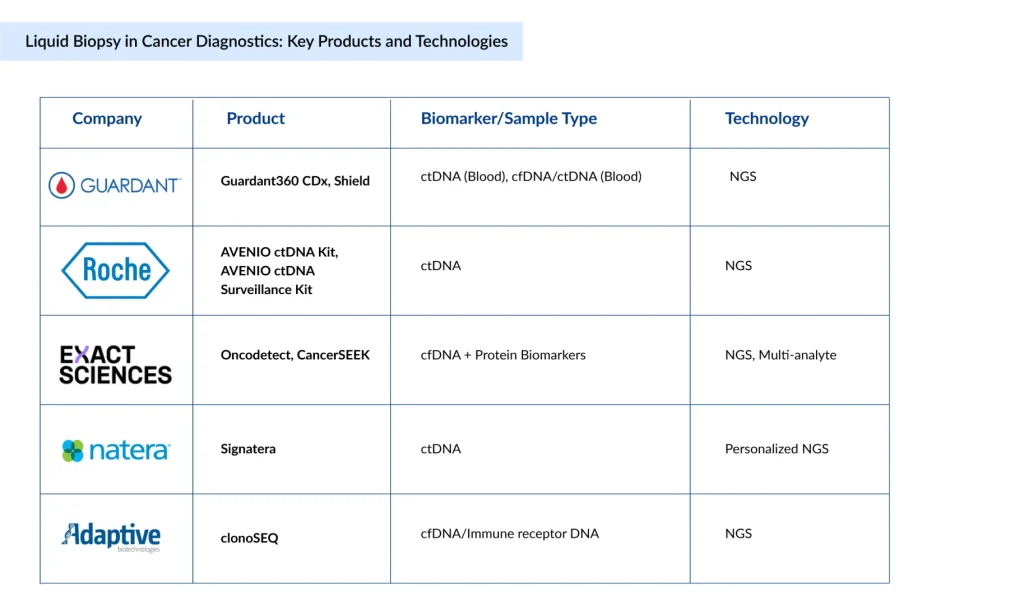
Guardant Health and Foundation Medicine are strongly positioned in therapy selection and comprehensive genomic profiling; Natera has established a leading position in personalized MRD; and GRAIL remains a prominent participant in multi-cancer early detection. Smaller specialists can still compete effectively in selected cancer types, alternative biofluids, fragmentomics, methylation, RNA biomarkers and ultra-sensitive MRD, but they will increasingly require strategic partnerships or differentiated clinical evidence to compete with integrated precision-oncology platforms.
Factors Driving the Growth of the Liquid Biopsy Market in Cancer Diagnostics
Rising Global Cancer Burden: The increasing global incidence of cancers, particularly lung, breast, colorectal, prostate, and liver cancers, is creating a strong demand for accurate and minimally invasive diagnostic solutions. As governments and healthcare organizations emphasize early cancer detection through screening initiatives, liquid biopsy is increasingly being adopted to facilitate timely diagnosis and improve patient survival rates.
Shift toward Minimally Invasive Diagnostics: Liquid biopsy has gained significant attention as it eliminates the need for invasive tissue sampling, reducing procedure-related risks, patient discomfort, and recovery time. Its ability to collect blood samples repeatedly enables clinicians to monitor disease progression and treatment response over time, making it particularly valuable for patients who cannot undergo repeated tissue biopsies.
Advancements in Genomic Technologies: Continuous innovations in next-generation sequencing (NGS), digital PCR (dPCR), and multi-omics platforms have substantially improved the analytical performance of liquid biopsy assays. These technologies enable highly sensitive detection of circulating tumor DNA (ctDNA), circulating tumor cells (CTCs), exosomes, and other circulating biomarkers, expanding the clinical applications of liquid biopsy across multiple cancer types.
Growing Use in Personalized and Precision Oncology
The growing adoption of precision medicine has significantly increased the demand for liquid biopsy-based molecular profiling. By identifying actionable genetic alterations such as EGFR, ALK, KRAS, BRAF, and PIK3CA mutations, liquid biopsy helps clinicians select targeted therapies and immunotherapies while supporting personalized treatment decisions throughout the patient journey.
Increasing Adoption in Treatment Monitoring: Liquid biopsy is increasingly used for monitoring therapeutic response, detecting minimal residual disease (MRD), identifying disease recurrence, and tracking resistance mutations. The technology provides real-time information on tumor dynamics, enabling physicians to modify treatment strategies earlier than conventional imaging methods and improve long-term clinical outcomes.
Expanding Regulatory Approvals and Reimbursement Coverage: The growing number of regulatory approvals for liquid biopsy assays as companion diagnostics and cancer monitoring tools is strengthening market confidence. At the same time, expanding reimbursement policies in several developed healthcare systems are improving patient access and encouraging broader adoption across hospitals, diagnostic laboratories, and oncology centers.
Integration into Clinical Trials and Drug Development: Pharmaceutical and biotechnology companies are increasingly incorporating liquid biopsy into oncology clinical trials to identify eligible patients, monitor treatment efficacy, and evaluate biomarker responses. The technology supports more efficient clinical trial design, accelerates drug development, and enhances the success of precision oncology programs.
Rising Investments and Strategic Collaborations: Strong investment activity from venture capital firms, biotechnology companies, and public research organizations is accelerating innovation in liquid biopsy technologies. Strategic collaborations between diagnostic developers, pharmaceutical companies, hospitals, and academic institutions are expanding clinical validation, improving assay performance, and increasing commercialization opportunities worldwide.
Rapid Growth of Multi-Cancer Early Detection (MCED) Tests: The development of multi-cancer early detection (MCED) tests represents one of the fastest-growing opportunities within the liquid biopsy market. These blood-based tests utilize DNA methylation signatures, cell-free DNA (cfDNA), proteomic biomarkers, and advanced genomic algorithms to detect multiple cancer types from a single sample, supporting population-wide cancer screening and earlier intervention.
Adoption of Artificial Intelligence and Bioinformatics: Artificial intelligence (AI) and advanced bioinformatics platforms are transforming liquid biopsy by improving biomarker discovery, variant interpretation, and genomic data analysis. Machine learning algorithms enhance the accuracy of mutation detection, identify complex cancer-specific molecular signatures, and reduce analysis time, enabling faster and more reliable clinical decision-making.
Challenges and Limitations
Low tumor fraction in early-stage disease: early tumors shed very little ctDNA, limiting sensitivity for true early detection screening.
Clonal hematopoiesis (CH), age-related mutations in blood cells that are not tumor-derived, can be mistaken for ctDNA, creating background noise that assays must computationally filter out.
Standardization: variability in pre-analytical handling, assay design, and bioinformatic pipelines across laboratories can affect result comparability.
Cost and reimbursement: while Medicare coverage is expanding for specific indications, broad, tumor-type-agnostic reimbursement remains a work in progress.
Regulatory pathway complexity: most MRD assays currently operate as CLIA/CAP laboratory-developed tests rather than under a unified FDA approval framework, though this is evolving.
False negatives in low-shedding tumors: certain cancer types and small, localized lesions shed comparatively little detectable material into circulation.
Screening tests are not a substitute for diagnostic follow-up, blood-based colorectal cancer screening tests such as Shield are validated as an option for patients who decline stool-based or visual screening, not as a replacement for colonoscopy; a positive result still requires diagnostic colonoscopy, and per the American Cancer Society’s 2026 guideline update, blood-based tests show lower sensitivity for advanced precancerous lesions and Stage I cancers than established stool-based tests.
Future Directions
Several converging trends are likely to shape the next phase of liquid biopsy development and adoption:
- Broader FDA recognition of ctDNA-based MRD as a surrogate clinical trial endpoint, which could accelerate drug development and test approval timelines.
- Continued expansion of multi-cancer early detection into population-level screening, contingent on regulatory approval and outcomes data such as the NHS-Galleri randomized controlled trial.
- Deeper integration of AI and machine learning to improve cancer-signal-origin prediction and reduce false positives.
- Growth of multi-analyte platforms that combine ctDNA, methylation, fragmentomics, and protein biomarkers for higher composite sensitivity.
- Expansion beyond oncology into infectious disease and transplant monitoring; in June 2026, for example, Zepto Life Technology received FDA Breakthrough Device Designation for a targeted liquid biopsy test for invasive mold infections, illustrating how the underlying detection platforms are migrating into non-cancer indications.
Conclusion
Liquid biopsy has emerged as a transformative approach in cancer diagnostics, offering a minimally invasive, rapid, and repeatable alternative to conventional tissue biopsy. By analyzing circulating tumor DNA (ctDNA), circulating tumor cells (CTCs), exosomes, cell-free RNA (cfRNA), and other tumor-derived biomarkers from blood and other body fluids, liquid biopsy enables early cancer detection, molecular profiling, treatment selection, monitoring of therapeutic response, and identification of minimal residual disease (MRD) and disease recurrence. Continuous advancements in next-generation sequencing (NGS), digital PCR, multi-omics technologies, and artificial intelligence-driven data analysis have significantly enhanced the sensitivity and specificity of liquid biopsy assays, expanding their clinical utility across multiple cancer types.
Growing adoption of precision oncology, increasing demand for non-invasive diagnostic solutions, and supportive regulatory approvals are expected to drive further market growth. Although challenges such as assay standardization, reimbursement limitations, and reduced sensitivity in early-stage cancers remain, ongoing technological innovations and large-scale clinical validation studies are addressing these barriers. As evidence supporting its clinical value continues to strengthen, liquid biopsy is poised to become an integral component of routine cancer management, enabling earlier diagnosis, personalized treatment strategies, and improved patient outcomes while reshaping the future of oncology care.

FAQs
Liquid biopsy offers a minimally invasive alternative to traditional tissue biopsy by analyzing circulating tumor DNA (ctDNA), circulating tumor cells (CTCs), or other biomarkers from blood samples. It enables real-time monitoring of disease progression, treatment response, and emerging resistance while reducing patient discomfort and allowing repeated testing when tissue samples are difficult to obtain.
Liquid biopsy can help detect and monitor several types of cancer by analyzing circulating tumor DNA (ctDNA), circulating tumor cells (CTCs), or other tumor-derived biomarkers in a blood sample. It is commonly used in cancers such as lung, breast, colorectal, prostate, ovarian, pancreatic, and melanoma, and is increasingly being explored for multi-cancer early detection. While liquid biopsy is a valuable complement to traditional tissue biopsy, its use depends on the cancer type, stage, and clinical purpose.
No. Liquid biopsy is not currently approved for routine cancer screening in the general population for most cancers. While certain blood-based tests have been authorized for specific indications, such as colorectal cancer screening in eligible adults or multi-cancer early detection in limited clinical settings, most liquid biopsy applications remain focused on treatment selection, monitoring disease progression, detecting minimal residual disease (MRD), or identifying recurrence rather than routine population-wide screening.
Downloads
Article in PDF
Recent Articles
- Medtronic Gains FDA Clearance for Altaviva™ Device to Simplify Treatment of Urge Urinary Incontin...
- Edwards Lifesciences Receives FDA Approval for SAPIEN M3 Mitral Valve System; StimLabs Secures FD...
- Medtronic’s Hugo Robotic-Assisted Surgery System Trial; Insightec’s Pivotal LIBERATE Clinical Tri...
- Polymerase Chain Reaction (PCR) Market: Evaluating the Major Market Dynamics and Key Trends Drivi...
- MIMEDX Launches HELIOGENTM Fibrillar Collagen Matrix; DocGo Launches Mobile X-ray Program; Labcro...