Diabetes Care Devices: Transforming Management Through Innovation and Precision
Feb 18, 2026
Table of Contents
Diabetes care devices are becoming increasingly vital as the global burden of diabetes continues to rise. Today, more than 530 million adults worldwide live with diabetes, a number projected to increase in the future. The condition requires continuous monitoring and timely intervention to prevent serious complications, making reliable tools like glucose meters, continuous glucose monitoring (CGM) systems, smart insulin pens, and insulin pumps essential parts of daily management. Advances in sensor technology, connectivity, and data analytics are transforming these devices from basic monitoring tools into intelligent, integrated systems that empower patients to track trends, personalize treatment, and maintain better long-term control of their health.
Market Dynamics: Why Diabetes Care Devices Are Accelerating?
Market dynamics are rapidly accelerating the demand for diabetes care devices as rising disease prevalence, shifting patient expectations, and advancing technology converge. A growing global diabetic population, driven by aging demographics and lifestyle-related risk factors, is pushing healthcare systems toward more efficient, continuous monitoring solutions. At the same time, patients increasingly prefer convenient, minimally invasive tools that support real-time, data-driven self-management. This trend is reinforced by innovations such as connected sensors, mobile health platforms, and predictive analytics, which make glucose tracking more accurate and actionable.
Downloads
Click Here To Get the Article in PDF

Recent Articles
- AnchorDx’s UriFind Bladder Cancer Assay in the US; UroMems Initiates Smart Implant to Treat Stres...
- Sana Biotechnology Reveals Long-Term Positive Data from Type 1 Diabetes Islet Cell Transplant Tri...
- Notizia
- Cancer, diabetes and eczema on list; AbbVie’s Humira; Teva weighs $2B; Fresenius in buyout ...
- FDA Expands SOLIRIS for Pediatric Myasthenia Gravis; vTv’s Cadisegliatin Program Resumes as FDA L...
The CGM Revolution: From Niche to Standard of Care
CGM has evolved from a niche tool for type 1 diabetes to a standard of care for both type 1 and insulin-using type 2 patients, per clinical guidelines. Devices like Abbott’s FreeStyle Libre and Dexcom G7 provide real-time data with MARD accuracy of 7.9-9.7%, reducing HbA1c by 0.25-3.0% and boosting time in range by 15-34%. This shift minimizes hypoglycemia risks and empowers lifestyle adjustments through trend alerts.
As adoption has grown, CGM has reshaped the broader ecosystem of diabetes management. Integrated digital platforms, predictive alerts, and automated insulin delivery systems now form a cohesive data-driven framework that empowers both patients and clinicians. What was once an optional technology has become a foundational tool, improving outcomes, enhancing quality of life, and redefining what “standard of care” means for people living with diabetes.
Automated Insulin Delivery Systems: Expanding Beyond Type 1 Diabetes
Automated insulin delivery (AID) systems, or hybrid closed-loops, integrate CGM with pumps like Tandem’s t:slim X2 for semi-automated dosing. Initially, for type 1, expansions now include type 2 adults aged 18+, as FDA-cleared for Insulet’s SmartAdjust. These systems predict glucose trends up to 60 minutes ahead, enhancing control without constant user input.
Expanding AID beyond type 1 diabetes reflects a growing recognition that many individuals with type 2 diabetes face similar challenges in achieving stable glucose control, particularly those with long-standing disease, diminished beta-cell function, or complex insulin regimens. Early studies suggest that AID can reduce glycemic variability and insulin workload for this population as well, offering a promising tool for simplifying care and improving outcomes. As algorithms adapt to broader physiological needs and devices become more accessible, AID systems may play a rising role in personalized diabetes management across the spectrum of insulin-dependent conditions.
Smart Insulin Pens: Digitizing Injectable Insulin Administration
Smart insulin pens are transforming diabetes management by adding digital intelligence to traditional injectable insulin delivery. These connected devices track dosing history, timing, and insulin temperature, helping users avoid missed or incorrect doses—two of the most common challenges in daily diabetes care. By pairing with smartphone apps, smart pens provide real-time reminders, dose calculators, and easy-to-read logs that reduce the cognitive burden of managing insulin therapy.
The smart insulin pens market is projected to grow significantly by 2034 at ~13% CAGR. Integration with CGM and AI enables real-time provider sharing and predictive dosing. The increase in demand for smart insulin pens is primarily attributed to the increase in prevalence of diabetes mellitus due to genetic factors, age, obesity, and unhealthy lifestyles.
Furthermore, the enhanced awareness of self-management of diabetes through smart insulin pens and the technological advancements in devices like avoiding extra dosages, maintenance of the systematic record of dosages, easy conversion of information of dose regimen & insulin level in computer-based records, and adjusting blood glucose levels based on changes in blood sugar levels will drive the market growth of the device.
Patient Satisfaction: The Hidden Determinant of Real-World Outcomes
Technology alone does not guarantee better health; adoption and consistent use are essential. In diabetes care, patient satisfaction is a primary determinant of real-world success. Devices that are perceived as intrusive, difficult to operate, or lacking actionable feedback often see high discontinuation rates. Conversely, those that integrate seamlessly into daily life not only improve metrics like time-in-range but also boost confidence and reduce diabetes-related distress.
What Drives Patient Satisfaction?
Several factors shape how people perceive and continue using diabetes devices. Intuitive design, easy setup, and comfortable wear make the technology more inviting. Engagement increases when users clearly experience the value, such as fewer low-glucose episodes, improved energy, and better sleep. Strong connectivity, clear data visualizations, and personalized insights further enhance users’ sense of control. Smaller, more discreet sensors also help reduce social and emotional barriers. Ultimately, creating satisfying devices requires balancing clinical performance with the emotional and lifestyle needs of the user.
Barriers to Adoption and Persistence
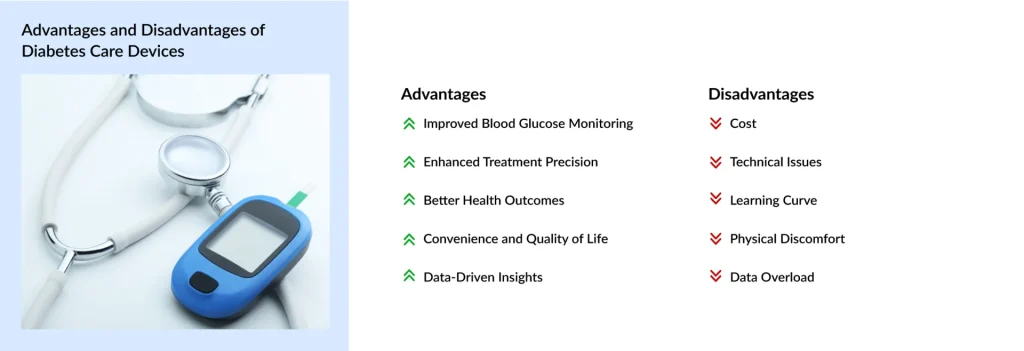
Despite significant progress, several challenges persist. Many regions continue to face cost and reimbursement inconsistencies, leaving patients with high out-of-pocket expenses that limit access. Some users also experience technology fatigue, feeling overwhelmed by constant data streams and alerts. In addition, gaps in training can reduce confidence in proper device use, while limited interoperability between devices and electronic health records often leads to fragmented workflows. Overcoming these barriers will require coordinated efforts from manufacturers, clinicians, payers, and patient advocacy groups.
Emerging Technologies: AI, Wearable Integration, and Digital Biomarkers
Emerging technologies are pushing diabetes management into a new era defined by anticipatory care, continuous monitoring, and holistic health insights. Artificial intelligence is becoming central to this evolution, powering algorithms that predict glucose fluctuations, optimize insulin dosing, and analyze long-term patterns that would be difficult for patients or clinicians to detect on their own. At the same time, the integration of diabetes devices with mainstream wearables, such as smartwatches and biometric patches, is enabling seamless data collection across activity, sleep, heart rate, and stress markers. These diverse inputs are feeding the development of digital biomarkers that offer a more nuanced picture of metabolic health, potentially enabling earlier interventions and truly personalized therapy adjustments.
Beyond real-time monitoring and prediction, a second major wave of innovation is emerging around closed-loop ecosystems and interconnected digital therapeutics. Future systems will likely combine CGM data, behavioral cues, and environmental information to guide patients through highly individualized care pathways. Advances in sensor miniaturization and noninvasive glucose detection may further expand access by reducing device burden and eliminating the need for frequent insertions. Together, these innovations signal a shift from reactive management to proactive, precision-guided diabetes care, one in which patients benefit from continual insights and a smoother, more intuitive treatment experience.
Conclusion
Diabetes care has evolved from basic tools to advanced systems that improve autonomy, accuracy, and health outcomes. Driven by market demand, patient needs, and technological innovation, solutions like continuous glucose monitors (CGMs), automated insulin delivery systems, and smart pens are transforming daily life for people with diabetes.
Key industry players are at the forefront in the diabetes care devices market: Dexcom and Abbott Laboratories are leading global CGM adoption; Medtronic is expanding hybrid closed-loop therapies; Insulet Corporation is pioneering tubeless insulin delivery; and Companion Medical is digitizing injectable insulin management. Together, they showcase the movement toward integrated, data-driven, patient-centered care.
Despite ongoing challenges, the overall trend is one of empowerment, enabling individuals with smarter tools, supporting clinicians with richer insights, and equipping healthcare systems to offer more personalized treatment. At this pivotal moment, diabetes technology is not just progressing; it is redefining the standard of care, with an expanding ecosystem of innovators ensuring precision, convenience, and patient satisfaction guide the next generation of diabetes management.

Downloads
Article in PDF
Recent Articles
- The Question That Remains Unanswered: What Might Be Causing Alzheimer’s?
- Bayer’s New Cardiology Drug Acoramidis; Two Datopotamab Deruxtecan Applications Validated in the ...
- Intellia’s Quest with CRISPR; Innovent, Synaffix ADC Tech Deal; Lilly’s Diabetes Bloc...
- Rise In Bispecific Antibodies Utilization As Antibody Therapeutics
- Diabetic Retinopathy: The Hornet’s Nest of Diabetes Mellitus