Novartis’ Pipeline Setback in 2026: Two Trial Failures, One Brutal Week
Sep 14, 2026
Table of Contents
Summary
- Novartis faced an unusually difficult period in late August–September 2026, with two Phase 3 programs (pelacarsen and del-desiran) failing their primary endpoints and eight rap-cel autoimmune trials paused following three patient deaths.
- The back-to-back setbacks triggered a sharp market response, with Novartis shares falling roughly 9–10% around the del-desiran announcement and analysts describing the developments as a “major pipeline setback.”
- Despite the setbacks, Novartis retains important growth opportunities. Radioligand therapy, oncology, immunology, and neuromuscular programs remain key strengths.
- KISQALI, SCEMBLIX, and COSENTYX continue to contribute meaningfully, while several Avidity-derived programs, including del-zota for Duchenne muscular dystrophy and del-brax for FSHD, remain on track.
For a company that has spent the past two years positioning itself as pharma’s comeback story, September 2026 delivered a gut check. In the space of roughly a week, Novartis watched two closely tracked Phase 3 programs fail to hit their primary endpoints and was forced to pause eight clinical trials of an experimental cell therapy after three patient deaths. Investors didn’t wait for the dust to settle; the stock shed close to a tenth of its value, and “major pipeline setback” became the phrase of the moment in analyst notes.
Downloads
Click Here To Get the Article in PDF

Recent Articles
- FDA Approves Jardiance for Type 2 Diabetes; FDA Approves Pfizer’s LITFULO for Alopecia Areata; Sa...
- Gene therapy: Following Pfizer’s Unexpected Failure, Sarepta is celebrating its much-awaite...
- Zealand Pharma’s Phase III Results of Glepaglutide; FDA Approves Amylyx’s ALS Drug Relyvrio; Novo...
- Novartis Announces the Positive Results of Phase III NATALEE Trial Evaluating Kisqali; FDA Approv...
- What Does the Future Hold for Gene Therapy in the Duchenne Muscular Dystrophy (DMD) Treatment Mar...
None of this happens in a vacuum. Novartis is racing against one of the industry’s steepest looming patent cliffs, leaning hard on its $12 billion acquisition of Avidity Biosciences to refill the tank, and trying to convince the market that cardiometabolic disease and cell therapy in autoimmunity are the next big growth chapters. This week’s news puts real pressure on that narrative, even if it doesn’t erase it.
What Actually Went Wrong: A Timeline of the Damage
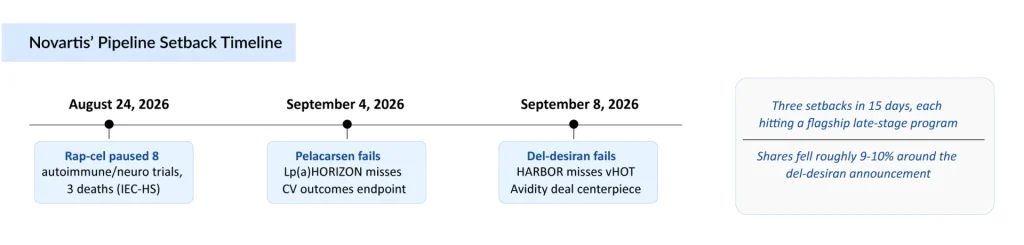
In the span of just fifteen days, from August 24 to September 8, 2026, Novartis absorbed three separate blows to its late-stage pipeline, each landing on a program the market had pegged as a genuine growth driver. None of the three failures are connected by biology or mechanism; a heart drug, a rare-disease RNA therapy, and a cell therapy platform have nothing scientifically in common. What connects them is timing and stakes: each was a flagship asset central to a different piece of Novartis’s post-patent-cliff growth story, and hitting all three in rapid succession is what turned a string of individually explainable setbacks into what analysts are now calling a systemic pipeline scare.
Pelacarsen misses in the Lp(a)HORIZON cardiovascular outcomes trial
On September 4, 2026, Novartis announced that pelacarsen, its once-monthly antisense injection designed to lower lipoprotein(a), or Lp(a), a stubborn inherited driver of heart attacks and strokes, failed to meet its primary endpoint in the pivotal Phase 3 Lp(a)HORIZON trial. The study enrolled more than 8,300 patients with elevated Lp(a) and established cardiovascular disease, and pelacarsen did lower Lp(a) levels as expected. But that biomarker win didn’t translate into fewer cardiovascular deaths, heart attacks, strokes, or urgent revascularizations compared with placebo.
This was supposed to be the trial that finally proved the “Lp(a) hypothesis”, the idea that lowering this specific lipid particle actually prevents heart events, not just that it can be lowered. Instead, analysts are now raising the bar of proof for rival programs from Amgen and Eli Lilly chasing the same target, and Novartis’s own cardiometabolic ambitions took a direct hit.
Del-desiran flunks the HARBOR study, a blow to the Avidity thesis
Four days later, on September 8, Novartis delivered a second gut-punch: del-desiran (delpacibart etedesiran), the centerpiece asset of its Avidity Biosciences acquisition, failed to beat placebo in the Phase 3 HARBOR study for myotonic dystrophy type 1 (DM1), a rare, progressive muscle-wasting disease with no approved treatments. The trial’s primary endpoint, video hand-opening time (vHOT), a novel measure of hand myotonia, did not reach statistical significance, even though the company reported “evidence of clinical activity” on secondary and exploratory measures.
Del-desiran mattered enormously to the Avidity thesis. Novartis paid roughly $12 billion for Avidity’s antibody-oligonucleotide conjugate (AOC) platform, and analysts had flagged this readout as one of three pivotal events shaping the company’s growth story beyond 2030. It was widely viewed as the deal’s proof point.
Rap-cel autoimmune trials paused after three patient deaths
Just before the two Phase 3 misses, Novartis quietly disclosed a more troubling development: eight clinical trials of its experimental CAR-T cell therapy rap-cel (rapcabtagene autoleucel, YTB323), being tested in lupus, myasthenia gravis, multiple sclerosis, systemic sclerosis, and other autoimmune and neurological conditions, were placed on hold after three patients died from immune effector cell-associated hemophagocytic syndrome (IEC-HS), a severe, recognized complication of CAR-T therapy. Rap-cel’s oncology trials were not affected and continue as planned.
Rap-cel had been billed as a flagship next-generation cell therapy, an attempt to essentially “reboot” a dysfunctional immune system rather than suppress it indefinitely, and Novartis wasn’t alone: Bristol Myers Squibb also paused enrollment in its own autoimmune CAR-T program around the same time, citing milder inflammatory events. The cluster of incidents has cast a wider shadow over the entire emerging category of autoimmune cell therapy.
Why this is More Than Three Bad Headlines
Individually, clinical trial failures are a routine cost of drug development. What made this stretch different is that all three hits landed on high-profile, high-expectation programs simultaneously, and did so just as Novartis is trying to convince Wall Street it has a credible plan for life after its current blockbusters go generic.
Investor confidence took a real hit, with Novartis shares falling roughly 9–10% around the del-desiran announcement alone, putting the stock on course for one of the company’s worst trading days in years and compounding an already negative reaction to the pelacarsen miss just days earlier. Analysts at multiple banks described the combined news flow as a “major pipeline setback,” with some noting that the back-to-back failures raise the burden of proof for the company’s broader late-stage pipeline, rather than affecting only the two programs directly involved.
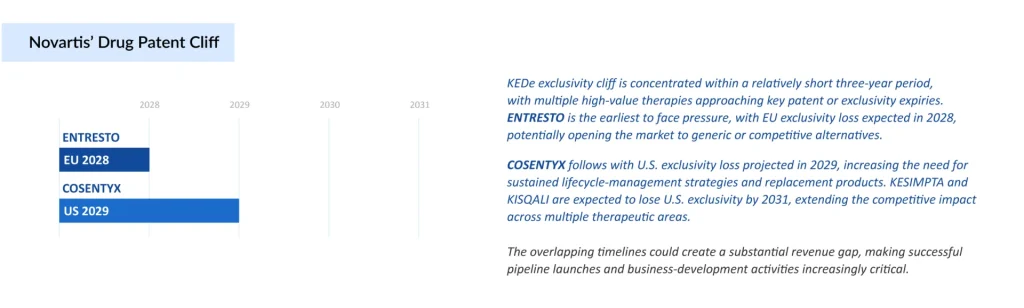
The timing further amplifies the pain, as Novartis is navigating one of the industry’s more daunting patent walls, with ENTRESTO’s exclusivity winding down in major markets while COSENTYX, KESIMPTA, and KISQALI all face patent expirations between roughly 2029 and 2031. The underlying logic of the company’s recent dealmaking, including the Avidity transaction and smaller bolt-on acquisitions, has been to build the next wave of growth drivers before that revenue begins to erode, meaning a pipeline intended to serve as the bridge to the 2030s has now effectively lost two planks.
Against this backdrop, the Avidity deal is facing real scrutiny. Del-desiran was not a side bet; it was the asset analysts had pointed to as validation for the entire $12 billion transaction, and its failure inevitably raises questions about the other AOC candidates within the same platform, even though those programs are based on different biology and different data.
The Other Side of the Ledger: What Still Works
It would be a mistake to read this stretch as a verdict on Novartis’s entire R&D engine. The company’s pipeline strategy has always been broader than any single readout, spanning cardiovascular and cardiometabolic disease, immunology, neuroscience, oncology, and, increasingly, radioligand therapy. Radioligand therapy remains a genuine bright spot for Novartis, with PLUVICTO, the company’s targeted radiotherapy for prostate cancer, continuing to deliver strong growth. Novartis has also been investing aggressively in manufacturing capacity and next-generation radioligand assets, reinforcing a franchise that many analysts consider one of the company’s most defensible long-term competitive advantages.
At the same time, Novartis’s oncology and immunology franchises continue to perform well, with KISQALI in breast cancer and SCEMBLIX in leukemia both posting strong growth, while Cosentyx remains a solid contributor despite its approaching patent cliff. Importantly, not all of the company’s recent clinical readouts have been disappointing. Novartis’s neuroscience and immunology pipeline recorded a positive development earlier in the same stretch of 2026 readouts, while other Avidity-derived programs, including del-zota for Duchenne muscular dystrophy, which has already been submitted to the FDA for accelerated approval with priority review, and del-brax for facioscapulohumeral muscular dystrophy, which is expected to enter FDA discussions following encouraging early-stage data, remain on track and have not been affected by the setback involving del-desiran.
Similarly, Rap-cel’s oncology programs remain unaffected, as the pause is specifically limited to autoimmune and neurological indications, allowing cancer-focused trials involving the same cell therapy platform to continue. Against this backdrop, management has continued to stand by its financial guidance. Despite the recent clinical news flow, Novartis has reaffirmed its mid-term sales outlook, including its targeted compound annual growth rate through 2030, indicating that leadership does not believe these setbacks will materially derail the company’s broader financial trajectory.
Although it remains to be seen whether investors will fully accept this reassurance, the decision to maintain guidance represents a deliberate and notable stance from a management team that has generally demonstrated a strong track record of delivering against its commitments in recent years.
What’s Next for Novartis?
The immediate effect of this cluster of setbacks is a reset of near-term expectations for Novartis. Upcoming readouts in cardiometabolic and neuromuscular diseases are likely to face greater scrutiny, with investors demanding a higher evidentiary bar before viewing any individual trial result as potentially transformative. This marks a notable shift in tone from the largely optimistic narrative Novartis had built around its post-Avidity pipeline earlier in the year. Strategically, the company is likely to respond on several fronts, beginning with sharper prioritization of R&D spending.
With two high-cost, high-visibility programs encountering setbacks, pressure is expected to grow to redirect resources toward areas demonstrating the strongest and most consistent signals, particularly radioligand therapy, oncology, and the advancing portions of its neuromuscular franchise. At the same time, Novartis is likely to pursue a cautious, data-driven approach toward the affected assets rather than abandoning them outright. The company has indicated that it will assess the complete HARBOR dataset and engage with regulators before determining the future of del-desiran, while the rap-cel safety data are also being reviewed in consultation with regulators. The presence of secondary signals of activity in both programs could leave the possibility of a narrower development path open.
Meanwhile, Novartis is expected to maintain its appetite for business development and acquisitions. Having remained an active acquirer in 2026, the company may have an even greater incentive to pursue in-licensing opportunities or acquisitions capable of addressing potential near-term pipeline gaps, particularly if sector-wide valuations decline amid broader concerns following these readouts. Del-desiran’s setback also raises lingering questions about Avidity’s broader AOC platform, although the failure does not necessarily undermine del-zota or del-brax, which operate through different mechanisms and have generated supportive data. Nevertheless, future AOC readouts are likely to be viewed as independent tests of the platform’s credibility rather than being treated as presumed successes.
Overall, Novartis has experienced one of its most challenging periods in years, with two Phase 3 failures and a safety-related program pause occurring within days of one another across assets that were considered important to the company’s long-term growth strategy. The market response was swift and pronounced. However, Novartis’ diversified portfolio across radioligand therapy, oncology, immunology, and a broad neuromuscular pipeline provides the company with greater capacity to absorb these setbacks than a single-asset biotechnology company. The key test for Novartis now will not be how effectively it manages the narrative surrounding these setbacks, but whether its upcoming clinical readouts and future dealmaking can rebuild the confidence that has been weakened by this difficult stretch.

Downloads
Article in PDF
Recent Articles
- Novel Mutation-Targeting Therapies in the Horizon to Relieve the Global Healthcare Burden NSCLC P...
- FDA’s Ok to Roche’s Oral SMA Therapy; Roche’s Etrolizumab Mixed Results in Ulce...
- J&J nabs; Clovis plots Rubraca; Novartis scores EU approval; Seattle Genetics stops trials
- Revolutionizing the Food Allergy Treatment: The Impact of Xolair’s Approval
- Genentech remunerates Xencor; XPrize upraises fund; GSK gambles