Molecular Modelling: The Silent Powerhouse Reshaping Drug Discovery, Development, and Competitive Strategy
Jun 03, 2026
Table of Contents
It costs, on average, $2.6 billion and over a decade to bring a single drug to market. Roughly 90% of drug candidates fail in clinical trials. And yet, the pressure to innovate faster, spend smarter, and outmanoeuvre competitors has never been more intense. Molecular modelling isn’t just a scientist’s tool anymore. It’s a strategic asset, one that is quietly rewriting the rules of drug discovery, pipeline prioritisation, manufacturing efficiency, and regulatory success. At its core, molecular modelling is the use of computational techniques to simulate, visualise, and analyse the behaviour of molecules, particularly how drugs interact with biological targets at an atomic level. Think of it as a digital laboratory where scientists can:
- Test thousands of drug-target interactions before a single experiment is run
- Predict how a molecule will fold, bind, react, or degrade
- Simulate physiological environments to anticipate real-world drug behaviour
- Optimise molecular structures for potency, selectivity, and safety in silico
The key techniques include:
Downloads
Click Here To Get the Article in PDF

Recent Articles
- Notizia
- Bristol-Myers Squibb to nix; Pfizer commits $100M; Merck and GSK production issues; Shire unloads...
- The Regenerative Medicine Revolution: Opportunities Shaping the Next Decade
- Break the Gene Therapy Barrier with DelveInsight’s Gene Therapy Reports
- Will The Burgeoning Gene Therapies Make a Difference in Dystrophic Epidermolysis Bullosa Patients...
- Molecular Dynamics (MD) Simulations: Studying how molecules move and interact over time
- Homology Modelling: Building 3D protein structures based on known templates
- Docking Studies: Predicting how drug candidates bind to target proteins
- Quantum Mechanical (QM) Modelling: Analysing electronic properties for precision chemistry
- ADMET Prediction: Forecasting Absorption, Distribution, Metabolism, Excretion, and Toxicity computationally
- AI-Augmented Generative Modelling: Designing entirely novel molecules using machine learning
Each of these tools translates directly into business outcomes: faster timelines, lower attrition, stronger IP, and smarter capital allocation.
The Strategic Case: Why This is a Board-Level Conversation?
Compressing the Most Expensive Phase of Drug Development
Pre-clinical research is where fortunes are made or lost. Traditional high-throughput screening of compound libraries is expensive, time-consuming, and often uninformative. Molecular modelling flips this dynamic entirely. Virtual screening can evaluate millions of compounds against a biological target in days, identifying a focused set of high-probability candidates for wet-lab validation. This compresses the hit-to-lead phase from months to weeks and slashes reagent, resource, and facility costs dramatically.
Companies integrating molecular modelling into early-stage discovery report up to 40–60% reduction in lead identification timelines and significant cost savings in compound synthesis.
De-Risking the Pipeline Before the Money Flows
Investors and Strategy teams know the brutal truth: attrition in Phase II and Phase III is where billions disappear. Most failures are rooted in poor target selection, off-target toxicity, or inadequate understanding of mechanism, problems that could have been identified much earlier with robust in silico analysis.
- Molecular modelling enables predictive risk stratification of the pipeline:
- Identify selectivity risks before preclinical spend accelerates
- Flag metabolic liabilities that will likely cause safety issues
- Predict drug-drug interaction profiles with precision
- Assess cross-reactivity with anti-targets (e.g., hERG channel, CYP enzymes)
Powering Precision Medicine and Targeted Therapies
The era of blockbuster, one-size-fits-all drugs is fading. Precision medicine, tailoring treatments to genetic, proteomic, and phenotypic profiles, is the new frontier. And molecular modelling is its backbone. By analysing patient-specific protein variants, mutations, or polymorphisms, modelling can predict:
- Which patient subpopulations will respond to a given drug
- How genetic mutations (e.g., in oncology targets like KRAS, EGFR, or BRAF) alter drug binding
- The optimal molecular scaffold for targeting a specific disease variant
Accelerating Biologics, Antibodies, and Next-Gen Modalities
Molecular modelling is no longer limited to small molecules. The biologics revolution, monoclonal antibodies, bispecifics, ADCs, RNA therapeutics, and gene therapies have brought with them new computational challenges and opportunities. Protein-protein interaction (PPI) modelling, antibody-antigen docking, and RNA secondary structure prediction are now standard tools for:
- Antibody engineering: Optimising CDR regions for affinity and stability
- ADC design: Selecting optimal linker-payload combinations
- mRNA therapeutics: Predicting secondary structures and codon optimisation for expression efficiency
- Gene therapy vectors: Modelling capsid-target interactions for tissue specificity
Transforming Manufacturing and Formulation Development
The value of molecular modelling doesn’t end at the discovery bench. It extends deep into manufacturing and formulation strategy, an often-overlooked application with enormous commercial implications. Crystal form prediction (polymorph screening), a key area of pharmaceutical solid-state modelling, helps manufacturers:
- Identify stable crystalline forms of APIs early in development
- Avoid costly late-stage polymorph surprises that can derail regulatory submissions
- Optimise solubility, bioavailability, and processability of solid dosage forms
Integrating computational formulation tools can reduce formulation development timelines by 20–35% while cutting the cost of physical stability studies significantly.
Strengthening the Regulatory Pathway
Regulatory agencies, including the FDA, EMA, and CDSCO, are increasingly receptive to computational evidence in submissions. The FDA’s Model-Informed Drug Development (MIDD) guidance and the EMA’s push for Physiologically-Based Pharmacokinetic (PBPK) modelling signal a clear directional shift. Molecular modelling supports regulatory strategy in multiple dimensions:
- Mechanistic understanding of drug action to support label claims
- Safety predictions that supplement or reduce animal study requirements (aligned with 3Rs principles)
- Impurity profiling and toxicological qualification using in silico methods per ICH M7 guidelines
- PBPK models for special populations (paediatric, renal impairment, drug-drug interaction scenarios)
The AI-Molecular Modelling Convergence: A Paradigm Shift in Progress
The convergence of artificial intelligence and molecular modelling is redefining the foundations of pharmaceutical R&D, marking one of the most transformative shifts the industry has witnessed in decades. What was once a time-intensive, trial-and-error process is rapidly evolving into a data-driven, predictive discipline powered by advanced computational intelligence. A major catalyst in this transition has been the breakthrough achieved by DeepMind’s AlphaFold, which solved the decades-old challenge of predicting protein 3D structures with near-experimental accuracy. This advancement has dramatically expanded the universe of druggable targets, enabling researchers to initiate structure-based drug design immediately after target identification and accelerating programs that were previously stalled due to structural uncertainties.
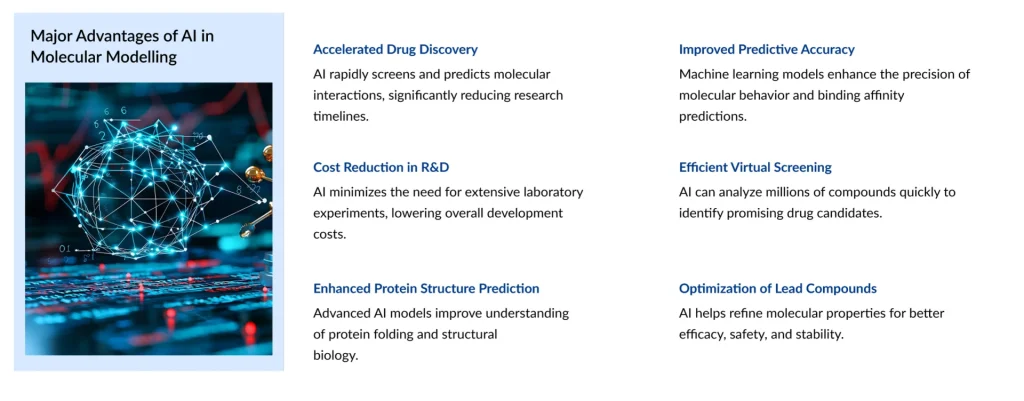
Beyond protein structure prediction, generative AI is fundamentally changing how new therapeutics are conceived and designed. Unlike traditional molecular modelling approaches that optimize existing chemical scaffolds, modern AI architectures, including graph neural networks, diffusion models, and transformer-based systems, can generate entirely novel molecules tailored for multiple parameters simultaneously. These systems can optimize potency, selectivity, metabolic stability, synthetic feasibility, and even patent novelty in a single iterative workflow. As a result, drug discovery is shifting from a largely sequential process to a highly integrated and predictive model where candidate molecules can be designed, tested, and refined virtually before entering the laboratory.
This AI-molecular modelling convergence is already demonstrating tangible industry impact. Companies such as Insilico Medicine, Recursion Pharmaceuticals, Schrödinger, and Relay Therapeutics have shown that AI-guided discovery platforms can compress the timeline from target identification to clinical candidate selection to nearly 18–24 months, compared with the traditional industry average of four to six years. As computational power, biological datasets, and machine learning models continue to evolve, the integration of AI with molecular modelling is expected to drive a new era of precision drug discovery, one characterized by faster development timelines, lower attrition rates, and the ability to tackle complex diseases once considered out of reach.
Competitive Landscape: Who is Winning and Why
The molecular modelling competitive landscape is bifurcating. On one side: organisations that have embedded computational science as a core capability. On the other: those still treat it as a peripheral support function. Big pharma leaders such as Pfizer, Novartis, AstraZeneca, Roche, and others have built dedicated computational chemistry and AI divisions with thousands of scientists and proprietary modelling platforms. Specialist biotech firms such as Schrödinger (which licenses its platform commercially), Relay Therapeutics, Nimbus Therapeutics, and others have made molecular modelling their primary scientific engine, building entire pipelines around structure-based and computationally-guided design.
CDMOs with in silico capabilities are commanding premium contracts and differentiating on speed and scientific credibility with innovative sponsors. The emerging winners share three characteristics:
- Computational capability embedded early in project teams, not bolted on later
- Proprietary data assets that train and improve their models over time
- Cross-functional literacy, where business leaders understand what modelling can and cannot do
The Market Opportunity: Numbers That Matter
The molecular modelling market reflects the growing importance of AI-driven drug discovery. Valued at nearly $8.4 billion in 2025, the market is projected to surpass ~$28 billion by 2034, expanding at a CAGR of ~14%. Among technologies, molecular docking accounts for nearly 37% of market revenue in 2025, driven by its ability to predict drug–target interactions and improve drug discovery efficiency. Software solutions dominate the component segment with around 60% share, supported by rising adoption of structure-based drug design, quantum chemistry simulations, and AI-powered virtual screening.
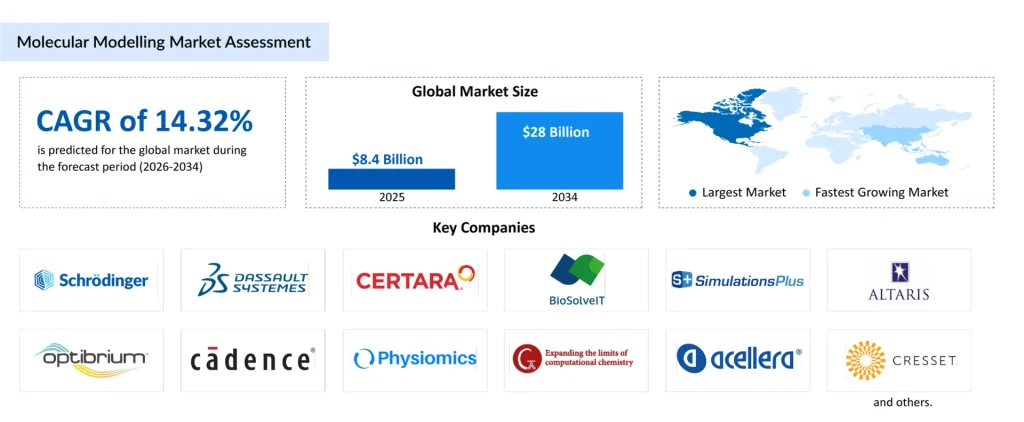
Drug discovery and drug design remain the leading applications, contributing nearly 45% of the market, while cloud-based platforms are expected to capture around 43% share due to their scalability and ability to support high-performance computing workloads.
Pharmaceutical and biotechnology companies continue to be the largest end users, relying heavily on computational tools for target identification, lead optimization, and pipeline acceleration. Regionally, North America is expected to hold nearly 41% of the global market in 2025, supported by strong R&D investments, advanced research infrastructure, and rapid adoption of AI and high-performance computing technologies.
The U.S., home to major pharmaceutical players such as Pfizer, Merck, and Johnson & Johnson, continues to drive demand for molecular modelling platforms through substantial investments in drug discovery. Companies leveraging AI-integrated molecular modelling are reporting 2–3x improvements in clinical success rates, highlighting the technology’s growing impact on pipeline value, development speed, and investor returns.
The Road Ahead for Molecular Modelling
The future of molecular modelling is poised to reshape the landscape of drug discovery, materials science, and precision medicine. Advances in artificial intelligence, quantum computing, and high-performance simulation platforms are enabling researchers to model increasingly complex biological and chemical systems with unprecedented speed and accuracy. As datasets grow larger and algorithms become more sophisticated, molecular modelling is transitioning from a supportive research tool to a core driver of innovation, helping companies identify promising therapeutic candidates, optimize molecular interactions, and reduce costly experimental failures.
In the pharmaceutical industry, molecular modelling is expected to play a critical role in accelerating the development of next-generation therapies, including targeted oncology treatments, RNA-based therapeutics, and protein degraders. Integration with AI-driven predictive analytics and real-world biological data will allow researchers to better understand disease mechanisms and design molecules with improved efficacy and safety profiles. This convergence of computational and experimental science is likely to shorten development timelines, lower R&D costs, and improve the probability of clinical success across therapeutic areas.
Beyond healthcare, molecular modelling is also gaining traction in fields such as sustainable chemistry, energy storage, and advanced material development. Researchers are leveraging computational simulations to design environmentally friendly compounds, optimize battery materials, and develop novel biomaterials with tailored properties. As cloud computing infrastructure expands and computational tools become more accessible, molecular modelling is expected to democratize innovation, enabling both large enterprises and emerging biotech companies to compete in the race toward scientific breakthroughs.

Downloads
Article in PDF
Recent Articles
- Biogen buys Nightstar; Pacira acquires Myoscience; Horizon Pharma announces pricing; STAT with Sl...
- Bristol-Myers Squibb to nix; Pfizer commits $100M; Merck and GSK production issues; Shire unloads...
- Gene Therapy: The Next Milestone in Treating Complex Diseases
- Revolutionizing Drug Discovery and Beyond: The Power of Molecular Modeling
- What are your views on Gene Therapy?