The Semaglutide Patent Cliff: A New Challenge for Novo Nordisk and Eli Lilly
Sep 21, 2026
Table of Contents
Summary
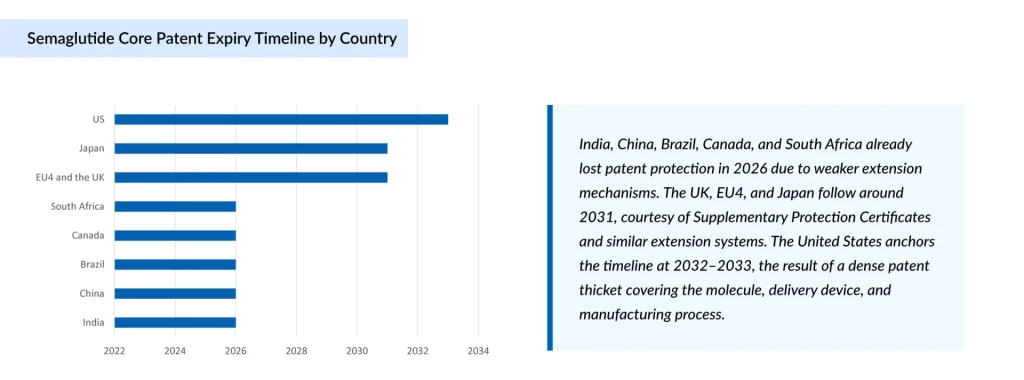
- Semaglutide patent expiry is staggered, not simultaneous: early wave in 2026 (India, China, Brazil, Canada, South Africa), mid wave ~2031 (UK, EU4, Japan), late wave 2032–33 (US).
- India and China are the biggest near-term battlegrounds, covering ~40% of the world population and a third of global obesity cases.
- The US remains Novo’s most valuable and most protected market, shielded by a patent thicket through 2033.
- Eli Lilly has overtaken Novo Nordisk as GLP-1 market leader, with tirzepatide protected until 2036.
- Generics are mobilizing fast, especially in India and China, setting up a major access expansion.
For nearly a decade, semaglutide has been pharma’s biggest growth story, the molecule behind OZEMPIC, WEGOVY, and RYBELSUS that turned Novo Nordisk into a healthcare giant and redefined how the world treats diabetes and obesity. But every blockbuster drug eventually hits the same wall: patent expiry. In 2026, that wall arrived, and not all at once, but market by market, in a staggered global rollout that’s already rewriting the competitive map of the anti obesity drug market.
Downloads
Click Here To Get the Article in PDF

Recent Articles
- BeiGene’s BRUKINSA Gets FDA Accelerated Approval; GSK’s Positive Results in DREAMM-8 ...
- Sanofi Strengthens Amlitelimab’s Position in Atopic Dermatitis; Corcept Announces Statistically S...
- What are the Top Five Leading Causes of Deaths in the World?
- Novo’s CagriSema Shows Greater Weight Loss Than Tirzepatide in REIMAGINE 5 Trial; Telix and ITM P...
- Novo Nordisk’s STEP Young Phase 3 Results Highlight Semaglutide’s Potential in Pediatric Obesity;...
This isn’t a simple “patent cliff” story, either. Because semaglutide’s protection expires at wildly different times in different countries, 2026 in some, 2032 in others, the drug is entering a strange, drawn-out twilight period where it’s simultaneously a generic commodity in New Delhi and a protected, premium-priced blockbuster in New York. Here’s exactly how the timeline breaks down, what it means for semaglutide market size and revenue projections for obesity treatment, and how the rivalry of Eli Lilly vs Novo Nordisk is playing out as a result.
Why Semaglutide’s Patent Expiry Isn’t a Single Date
Most people assume a drug patent has one clean expiration date. In reality, semaglutide is protected by a stack of patents: a core composition-of-matter (molecule) patent, plus secondary patents covering formulations, delivery devices (like the FlexTouch pen), dosing regimens, and manufacturing processes. Each of these can expire on a different date, and each country applies its own rules for extending protection beyond the standard 20-year term. That’s why the same drug can be legally “off-patent” in India in March 2026 while remaining protected in the United States until December 2032, a gap of more than six years for the exact same molecule.
Country-by-Country: When Does Semaglutide Actually Go Off-Patent?
Rather than a single global “loss of exclusivity” date, semaglutide’s patent expiry is playing out in three distinct waves, largely dictated by how aggressively each jurisdiction allows patent-term extensions beyond the standard 20-year baseline. Emerging markets with weaker or no extension mechanisms, India, China, Brazil, Canada, and South Africa, have already crossed the finish line in 2026. Regulated markets with formal extension systems, like the UK, EU4, and Japan, buy Novo Nordisk roughly five more years of protection, pushing their cliff to around 2031. And the United States, thanks to its own patent-term-extension provisions plus a dense layer of secondary patents on devices, dosing, and manufacturing, holds out the longest, into 2032 and potentially 2033. The map below breaks down exactly where each major market stands, and why the gap between the earliest and latest expiry dates stretches to more than six years for the same molecule.
India, China, Brazil, Canada, South Africa: The Early Wave (2026)
The core global patent family for semaglutide stems from a PCT application filed in early 2006. In countries that apply the standard 20-year term without extension mechanisms, that clock ran out in March 2026. India never granted Novo Nordisk’s semaglutide patent in the first place; it rejected it in 2019 on obviousness grounds. This meant Indian generic drugmakers could move almost immediately once the underlying IP landscape cleared, and within 24 hours of the broader patent expiry, generic launches were already underway. In China, the foundational patent (CN101133082B/CN200680006674.6) expired on 20 March 2026. Novo fought hard to maintain its patent protection, including securing a Supreme People’s Court reversal that briefly upheld the patent’s validity, but its request for a patent-term extension was rejected by China’s CNIPA in September 2025. More than a dozen Chinese drugmakers have since filed for approval, although regulatory review, rather than patent law, has now become the key bottleneck delaying generic launches. In Canada, Novo’s patent was allowed to lapse entirely, with no legal pathway available to reinstate it, while patents in Brazil and South Africa expired alongside India’s in March 2026.
Together, these early-wave markets represent roughly 40% of the world’s population and an estimated 33% of the global population of adults living with obesity, meaning the commercial stakes of this first wave are enormous, even if per-patient revenue is far lower than in the US or Western Europe.
EU4 (Germany, France, Italy, Spain) and the United Kingdom: The Middle Wave (~2031)
Europe doesn’t use the same blunt 20-year cutoff. Instead, innovators can apply for Supplementary Protection Certificates (SPCs), an EU-wide (and UK-mirrored) mechanism that extends protection by up to five years to compensate for the time a drug spends in clinical trials and regulatory review before reaching the market.
For semaglutide, this pushes core compound protection out to roughly March 2031 across most EU4 markets and the UK, with countries like Germany and Denmark potentially stretching slightly later, into early 2033, depending on national SPC filings and any pediatric-extension bonuses. Sandoz has already filed a biosimilar application with the European Medicines Agency, using a reformulated buffer and preservative system designed to sidestep secondary formulation patents, a sign that generic competitors are positioning years ahead of the actual cliff.
Japan: Aligned With the Later Wave (~2031)
Japan operates its own patent-term-extension system, similar in spirit to the US and EU mechanisms. Analysts expect Japanese protection to hold until approximately 2031, keeping it in step with Europe rather than the earlier-expiring emerging markets, though Japan’s biosimilar approval pathway is also expected to move more cautiously once patents do lapse.
United States: The Final and Most Valuable Frontier (2032–2033)
The US is where Novo Nordisk’s real financial exposure sits, and it’s protected the longest. The core compound patent (US 10,525,129) is set to expire on 5 December 2032, with a possible pediatric-exclusivity extension pushing it to mid-2033. Secondary patents cover everything from the FlexTouch injector pen (2029) to specific obesity dosing regimens (2031) to manufacturing processes (through 2033), a classic “patent thicket” strategy designed to make generic entry as difficult and drawn-out as possible even after the core molecule patent falls.
Crucially, several Hatch-Waxman challenges from generic makers, including Mylan, Dr. Reddy’s, Apotex, and Sun Pharma, have already been settled confidentially, and at least 13 companies have formally notified the FDA of interest in eventually marketing generic semaglutide. Industry analysts widely peg 2032 as the realistic date when the US market opens up, though full generic saturation (especially for complex injectable formulations) will likely stretch into 2034–2035 given the FDA’s lengthy review timeline for peptide-based “complex generics.”
Semaglutide Market Size and Revenue Projections for Obesity Treatment
Before diving into the competitive fallout, it’s worth sizing the prize. Combined semaglutide sales across OZEMPIC, WEGOVY, and RYBELSUS topped $35 billion in 2025 across the globe, with WEGOVY alone contributing roughly $12 billion and OZEMPIC around $19 billion, and the franchise had been compounding at close to 40% annual growth in the years prior. That scale is exactly why the staggered patent expiry matters so much: even a partial erosion of pricing power in high-volume markets like India and China, layered on top of intensifying branded competition, is enough to swing Novo Nordisk’s full-year guidance from double-digit growth to a projected 5–13% sales decline in 2026.
Looking ahead, most industry forecasts still expect the global GLP-1 obesity-treatment market to keep expanding through the end of the decade, but the mix is shifting. Analysts increasingly project that growth will be driven less by semaglutide itself and more by (a) lower-cost generic and biosimilar semaglutide volume in early-wave markets, and (b) next-generation branded molecules, tirzepatide, oral GLP-1s, and emerging candidates like orforglipron and retatrutide, capturing a growing share of obesity drug revenue in the still-protected US, EU, UK, and Japanese markets.
The Real-World Impact: Eli Lilly vs Novo Nordisk
Patent expiry is only half the story. What makes 2026 such a pivotal year for semaglutide isn’t just generics arriving in emerging markets; it’s that patent pressure is colliding head-on with the fiercest branded competition Novo Nordisk has ever faced, from Eli Lilly’s rival GLP-1 drug tirzepatide. The Eli Lilly vs Novo Nordisk rivalry has become the defining storyline of the semaglutide obesity treatment competitive landscape in 2026.
Novo Nordisk’s Obesity Drug Franchise: Under Siege on Three Fronts
Novo entered 2026 guiding for a 5–13% decline in adjusted sales and operating profit, marking a stunning reversal after years of more than 40% growth in its GLP-1 franchise. Management highlighted three compounding headwinds weighing on its obesity business. First, a clinical setback emerged as CagriSema, Novo’s next-generation obesity drug once positioned as a successor to semaglutide, underwhelmed in a head-to-head trial against Lilly’s tirzepatide, delivering 23% weight loss compared with 25.5% for tirzepatide. Novo’s shares fell more than 16% in a single session following the results, wiping out the stock’s entire post-semaglutide-launch rally.
Second, increasing pricing pressure in the US is weighing on profitability, with a government agreement to lower drug prices and the inclusion of certain products under the Medicare price-negotiation provisions of the Inflation Reduction Act compressing margins in Novo’s most profitable market. For some patients, list prices are expected to fall from roughly $959 to $274 per month by 2027. Finally, the expiry of international patents across China, India, Brazil, and Canada in 2026 is opening the door to lower-cost generic and biosimilar competition in markets that collectively account for roughly one-third of the global obesity burden, potentially undermining the international volume growth Novo had been counting on to fuel its next phase of expansion.
The cumulative effect has been brutal for shareholders: Novo’s stock has fallen roughly 75% from its 2024 peak, slipping the company out of Europe’s top-10 most valuable firms. Despite the turbulence, Novo Nordisk’s obesity products, led by Novo Nordisk’s WEGOVY, including its new oral formulation and higher-dose options, remain central to the company’s turnaround strategy, and management is banking on international rollout and pipeline diversification to stabilize the business.
Eli Lilly: The Chief Beneficiary
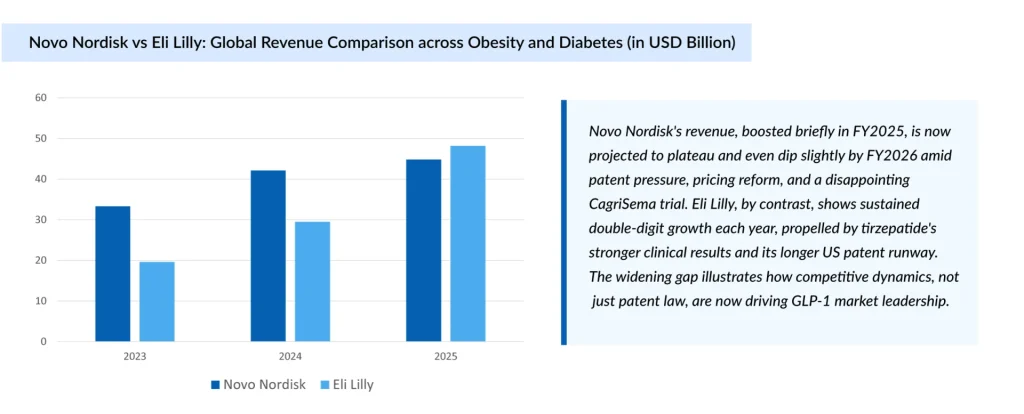
While Novo has stumbled, Eli Lilly has surged. Tirzepatide (sold as MOUNJARO for diabetes and ZEPBOUND for obesity) has posted superior clinical trial results and is now outselling OZEMPIC and WEGOVY in key markets.
Sadaf Javed, Functional Head of Forecasting and Analytics at DelveInsight, said that we project Lilly’s revenue climbing toward $77–78 billion by FY2026, compared with Novo’s roughly $47–48 billion, a gap that didn’t exist just two years ago. Lilly became the first trillion-dollar-market-cap healthcare company in 2025–2026, a symbolic passing of the crown in the obesity-drug race.
Crucially, Lilly’s own US patents on tirzepatide don’t begin expiring until 2036, giving it several extra years of exclusivity runway compared to Novo’s semaglutide, a meaningful strategic cushion as the two companies fight over the same shrinking window of patent-protected pricing power.
The Generics Are Already Mobilizing
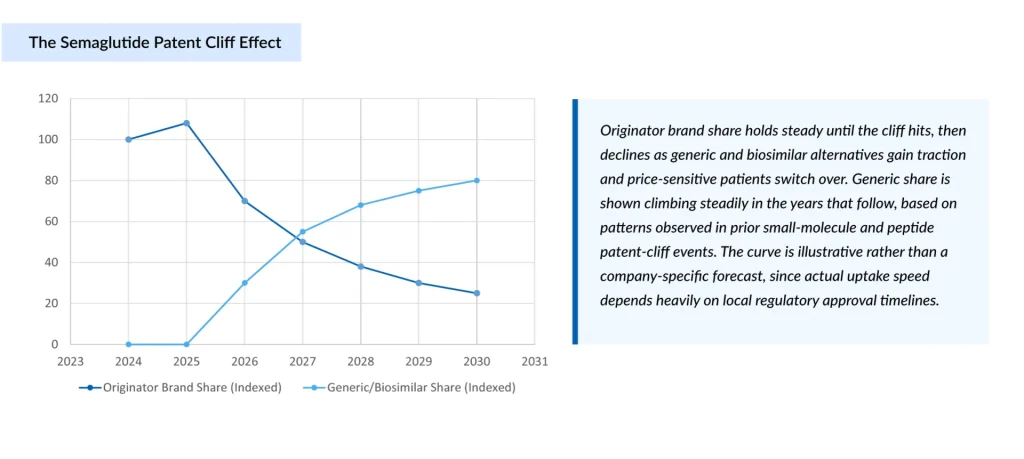
The early wave of patent expiries has sparked a genuine gold rush among generic and biosimilar manufacturers, particularly in India and China, as companies race to capitalize on the growing semaglutide opportunity. In India, major pharmaceutical companies such as Dr. Reddy’s, Biocon, Cipla, Sun Pharma, Lupin, and Aurobindo Pharma are advancing plans to launch injectable and oral semaglutide products for both domestic and export markets. Meanwhile, OneSource Specialty Pharma is investing $100 million to expand its peptide manufacturing capacity and expects its revenue to potentially quadruple over the next three years, driven largely by anticipated demand for semaglutide. In China, at least 16–17 companies have advanced generic semaglutide candidates to Phase 3 trials or the premarket filing stage. However, as of mid-2026, regulatory review delays rather than patent restrictions have allowed Novo Nordisk to retain practical market exclusivity in the country, despite the technical expiry of its patent.
What This Means Going Forward
The semaglutide patent story is really two stories happening on different timelines. In emerging markets, the patent cliff has already hit, and a wave of cheap generics is expected to dramatically improve access to GLP-1 therapy for diabetes and obesity patients who previously couldn’t afford it. In the US, UK, EU4, and Japan, branded exclusivity holds for several more years, meaning the real pricing battle in the world’s most lucrative markets will be fought not with generics, but between Novo Nordisk’s obesity drug lineup and Eli Lilly’s competing branded portfolio, plus a growing list of next-generation candidates (oral GLP-1s, orforglipron, retatrutide) racing to succeed both of them.
For Novo Nordisk, the message from 2026 has been unmistakable: patent protection alone can’t shield a company from a faster, more effective competitor. For the generics industry, especially in India and China, this is shaping up to be one of the largest single opportunities in pharmaceutical history, and a preview of how future high-value biologics may lose exclusivity: unevenly, market by market, and increasingly on the industry’s own terms rather than the originator’s.

Downloads
Article in PDF
Recent Articles
- Cytokinetics Announces Results From SEQUOIA-HCM Clinical Trial of Aficamten; FDA Approves Chiesi’...
- WEGOVY: A Leader in the Obesity and Weight Loss Treatment
- Assessing the Growing Role & the Demand of Chronic Disease Management Apps
- Neurotech’s ENCELTO Becomes First FDA-Approved Treatment for MacTel Type 2; Plus Therapeutics’ Rh...
- The Race to Redefine Obesity Treatment