Osteosarcoma Treatment on the Brink of Change: 4 Emerging Therapies Target the Biggest Gaps in Relapsed Disease
Oct 30, 2026
Table of Contents
Summary
- Osteosarcoma treatment remains chemotherapy-dominated, with standard care combining surgery, chemotherapy, and, in selected cases, radiation therapy.
- The market continues to face significant unmet medical needs, with few treatments specifically approved for osteosarcoma. KHAPZORY is FDA-approved in the United States, while MEPACT is approved in the European Union, underscoring the need for more effective disease-specific therapies.
- The osteosarcoma drug pipeline is expanding, with candidates such as OST-HER2 (OS Therapies), DANYELZA (naxitamab-gqgk) (SERB Pharmaceutical), Vactosertib (MedPacto), Risvutatug rezetecan (GSK), Olaparib With Ceralasertib (AstraZeneca), OMO-103 (Peptomyc), Lifileucel (Iovance Biotherapeutics), Eflornithine (DFMO) and AMXT 1501 (Aminex Therapeutics), and others.
Osteosarcoma bone cancer demands a hard-hitting, multi-pronged response, and the current standard of care reflects that. Today, treatment options for osteosarcoma revolve around a multimodal strategy that combines surgery, chemotherapy, and, in selected cases, radiation therapy. The chemotherapy backbone recommended in the NCCN Guidelines is built on four agents: methotrexate, doxorubicin, cisplatin, and ifosfamide. When the disease relapses, stops responding, or spreads, the guidelines point to a second line of osteosarcoma medications that includes high-dose ifosfamide, etoposide, regorafenib, sorafenib, radium-223 dichloride, and everolimus.
Downloads
Click Here To Get the Article in PDF

Recent Articles
- Diagnosis Delays, Ineffective Treatment Options Plaque the Bone Cancer Market Growth
- Rare but Real: Unraveling the Different Types of Bone Sarcoma
- Key Companies To Keep an Eye on for Pipeline Therapies in Osteosarcoma Market in the Next Decade
- Osteosarcoma vs Ewing sarcoma
- Osteosarcoma Treatment Landscape: Can New Therapies Break a 40-Year Stalemate in Bone Cancer Care?
Even so, the osteosarcoma treatment landscape remains strikingly underserved. Only a handful of osteosarcoma treatments carry an approval written specifically for the disease. In the United States, levoleucovorin (KHAPZORY) has secured FDA approval, while in Europe, mifamurtide (MEPACT) has been approved by the European Commission for use across the European Union. That scarcity of dedicated treatments for osteosarcoma is precisely why patients, clinicians, and investors are watching the pipeline so closely.
The Next Generation of Osteosarcoma Treatments: Promising Candidates to Watch
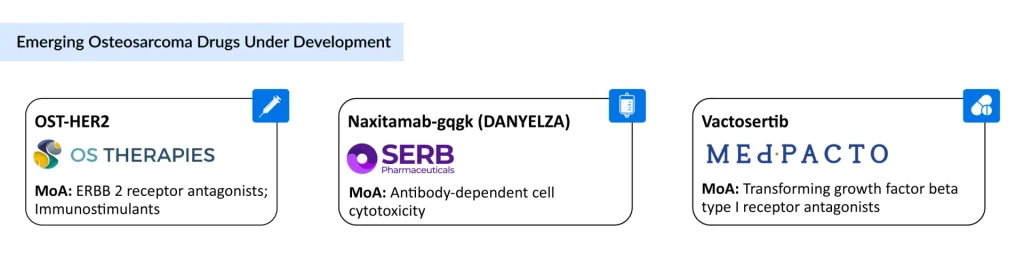
The osteosarcoma drug pipeline is finally gathering momentum. The osteosarcoma treatment market is welcoming a fresh wave of candidates, including OST-HER2 (OS Therapies), DANYELZA (naxitamab-gqgk) (SERB Pharmaceutical), Vactosertib (MedPacto), Risvutatug rezetecan (GSK), Olaparib With Ceralasertib (AstraZeneca), OMO-103 (Peptomyc), Lifileucel (Iovance Biotherapeutics), Eflornithine (DFMO) and AMXT 1501 (Aminex Therapeutics), afami-cel (US WorldMeds), PEEL-224 (Peel Therapeutics), Dendritic cell-based vaccine (CellxLife), LNTH-2403 (Lantheus), ADCE-D01 (ADCendo), Tegavivint plus Gemcitabine (Iterion Therapeutics), IONC101 (iOncologi), and other investigational agents.
Spanning immunotherapies, antibody-drug conjugates, TGF-β inhibitors, and cell-based vaccines, these assets bring new mechanisms of action to a field that has relied on the same chemotherapy for decades, and they could reshape the US osteosarcoma market and its global counterparts, especially in relapsed and metastatic settings.
Here is a closer look at the pipeline candidates best positioned to enter the osteosarcoma market in the coming years.
OS Therapies’ OST-HER2
HER2-targeted cancer vaccine
OST-HER2 is an investigational HER2-targeted immunotherapy designed to train the body’s own defenses to hunt down cancer. Developed for HER2-expressing cancers, including osteosarcoma, it works by activating HER2-specific T cells so they can recognize and destroy malignant cells. After intravenous administration, the OST-HER2 vector is rapidly taken up by antigen-presenting cells (APCs), which in turn mount a focused immune attack against HER2-positive tumors. Translational research, including studies in canine osteosarcoma, suggests the therapy may help reduce disease recurrence and limit metastatic progression. OST-HER2 is currently in Phase IIb development as a second-line treatment, and OS Therapies began a rolling Biologics License Application (BLA) submission in early 2026 and plans to complete it through the US FDA’s Accelerated Approval pathway in the fourth quarter of 2026, positioning OST-HER2 as the earliest of the new osteosarcoma medications to reach the US osteosarcoma market.
Regulators are taking notice. In March 2026, OS Therapies announced that the European Medicines Agency’s (EMA) Committee for Advanced Therapies (CAT) had granted Advanced Therapy Medicinal Product (ATMP) designation to OST-HER2 for pulmonary recurrence in patients with resected osteosarcoma in the European Union (EU). This builds on the Fast Track Designation (FTD) the EMA had previously granted for the same indication. In the United States, OST-HER2 has already earned both Orphan Drug Designation (ODD) and Fast Track Designation (FTD) from the US Food and Drug Administration (FDA) for the treatment of osteosarcoma.
On October 6, 2026, OS Therapies reported final 3-year overall survival of 72.7% in its Phase IIb trial, compared with 45.8% for a combined published historical control (P = .0006), up from the 71.2% interim result announced in September. These are company-reported results from a single-arm trial measured against historical controls. The regulatory runway is moving in step: in September 2026, the company announced full alignment with the UK MHRA on its pending Conditional Marketing Authorisation Application (CMAA) and confirmatory Phase 3 design, and incremental alignment with the US FDA on an adaptive Phase 3 design. OS Therapies is targeting the fourth quarter of 2026 for its US BLA and for CMAAs in Europe, the UK, and Australia. It has also resubmitted its request for Regenerative Medicine Advanced Therapy (RMAT) designation, and the FDA has accepted its letter of intent for a Commissioner’s National Priority Voucher. Starting the confirmatory Phase 3 trial remains a prerequisite for accelerated approval.
SERB Pharmaceutical’s DANYELZA
Antibody-dependent cell cytotoxicity
DANYELZA (naxitamab-gqgk) is a fully humanized anti-GD2 monoclonal antibody engineered for improved pharmacokinetic properties and enhanced cytotoxic activity. Early-stage pediatric studies of naxitamab have shown a manageable safety profile alongside promising clinical activity. The open question is how well it performs in comparatively older patients with osteosarcoma, where its toxicity and tolerability have not yet been well characterized. Corporate momentum is building behind the program: in September 2025, SERB Pharmaceuticals completed its acquisition of Y-mAbs Therapeutics, adding DANYELZA to its rare oncology portfolio and strengthening its ability to develop targeted treatments for rare cancers. No osteosarcoma-specific clinical data readout has been publicly announced under SERB so far, which means the 2029 US launch estimate hinges on early-stage studies in this population yet to report.
MedPacto’s Vactosertib
TGF-β1 kinase inhibitor
Vactosertib (TEW-7197) is a TGF-β1 signaling inhibitor built to change the battlefield itself: the tumor microenvironment. Under normal physiological conditions, TGF-β signaling helps regulate cell proliferation and apoptosis. Inside a tumor, however, it can suppress immune responses, promote metastasis, and fuel resistance to anticancer therapies. TGF-β also stimulates fibroblast proliferation in and around tumor tissue, leading to excess extracellular matrix deposition that forms a physical wall around the tumor and keeps immune cells out. By inhibiting stromal formation, vactosertib may tear down that wall, improving access to tumor cells and boosting the effectiveness of other anticancer therapies.
The regulatory record is already substantial. In January 2023, MedPacto announced that the U.S. FDA had granted Fast Track Designation (FTD) to vactosertib as a monotherapy for patients with relapsed/refractory metastatic osteosarcoma. This followed a Rare Pediatric Disease Designation (RPDD) from the U.S. FDA in September 2022 for the same indication. In July 2023, the European Commission granted Orphan Drug Designation (ODD) to vactosertib for the treatment of osteosarcoma, adding to the ODD the program had received from the U.S. FDA in August 2021.
Dosing is now the focus. In August 2026, MedPacto applied to South Korea’s Ministry of Food and Drug Safety to amend its Phase 2 osteosarcoma trial, adding a medium-dose group of 200 mg twice daily alongside the existing 300 mg twice daily group, with adolescents to receive 150 mg twice daily. The move follows Phase 1 data showing an objective response rate of 36.4% in 11 osteosarcoma patients, with the medium dose delivering the best efficacy of the three tested. In September 2026, MedPacto also sought FDA approval to modify the dosing schedule of its US Phase 1/2 monotherapy trial in adolescents and adults with relapsed, refractory, or progressive osteosarcoma, comparing 200 mg and 300 mg twice daily to identify the optimal regimen. The company expects the added-dose group to help recruitment, which has been slow.
GSK’s Risvutatug rezetecan
ADC targeting B7-H3
Risvutatug rezetecan (Ris-Rez; GSK5764227; HS-20093) is an investigational antibody-drug conjugate (ADC) that selectively targets B7-H3, a cell-surface protein overexpressed across a wide range of solid tumors. The ADC binds to B7-H3-expressing cancer cells and delivers its cytotoxic payload directly to the tumor, concentrating antitumor activity where it is needed. It is being studied within GSK’s global EMBOLD clinical development program, which is evaluating its potential across multiple tumor types. In 2025, the US FDA granted risvutatug rezetecan Breakthrough Therapy Designation (BTD) for patients with late-line relapsed or refractory osteosarcoma, a strong signal of its promise in one of the most difficult-to-treat populations.
On July 28, 2026, GSK and its partner Hansoh announced that the Phase III ARTEMIS-011 trial met its primary endpoint. Risvutatug rezetecan significantly improved independent-review-assessed progression-free survival versus chemotherapy in patients with relapsed osteosarcoma who had progressed after at least two prior lines of systemic therapy, and the improvement was described as statistically significant and clinically meaningful. Secondary endpoints, including overall survival, showed a consistent benefit, with no new safety signals. Hansoh plans to engage China’s regulators to prepare a BLA, and detailed results will be presented at an upcoming international oncology congress. Separately, GSK is running EMBOLD Sarcoma-202, a global Phase Ib/II trial in previously treated advanced or metastatic sarcomas, including osteosarcoma.
The Road Ahead for Osteosarcoma Treatment
With limited approved options today, relapsed and metastatic disease remains the clearest area of unmet need. From OST-HER2’s maturing survival data to a positive Phase III result for an antibody-drug conjugate in relapsed disease, a pipeline that blends immunotherapy, targeted antibodies, antibody-drug conjugates, and tumor microenvironment modulators signals a genuine shift in how treatments for osteosarcoma are being designed. As these candidates advance toward regulatory milestones between 2026 and 2031, the osteosarcoma treatment market is set to move from chemotherapy-dominated care toward a more targeted, patient-centered future.

Downloads
Article in PDF
Recent Articles
- Diagnosis Delays, Ineffective Treatment Options Plaque the Bone Cancer Market Growth
- Osteosarcoma Treatment Landscape: Can New Therapies Break a 40-Year Stalemate in Bone Cancer Care?
- Osteosarcoma vs Ewing sarcoma
- Key Companies To Keep an Eye on for Pipeline Therapies in Osteosarcoma Market in the Next Decade
- Pitfalls of Current Osteosarcoma Treatment Approaches