Rehab Without Walls: How Telerehabilitation Is Rewriting the Rules of Recovery
Nov 25, 2026
Table of Contents
For decades, recovery meant a commute. After a stroke, a knee replacement, or a spinal injury, patients were expected to travel to a clinic two or three times a week, sit in a waiting room, complete a 45-minute session, and then go home to practice alone for the other 160-odd hours of the week. Millions of people simply could not do it. Distance, cost, work schedules, caregiving duties, and limited mobility quietly pushed many of them out of care altogether.
Telerehabilitation is dismantling that model. By moving therapy onto smartphones, tablets, sensors, and cloud platforms, it brings the therapist, the exercise plan, and the progress data into the patient’s living room. And the market is responding: the global telerehabilitation market is estimated at roughly USD 5.6 billion in 2025, with forecasts pointing to USD 18.2 billion by 2034.
Downloads
Click Here To Get the Article in PDF

Recent Articles
- 7 Key Technologies Pioneering Cybersecurity in the Healthcare Sector
- Snippet
- Advances in Varicose Vein Treatment Devices: Technologies Shaping Modern Venous Care
- FDA Breakthrough Device Designation to Pi-Cardia’s ShortCut; AbSolutions Med’s REBUILD Bioabsorba...
- Edwards’ Sapien 3 with Alterra Prestent; Koios Medical’s breast, thyroid cancer-spotting AI; Line...
Telerehabilitation is the delivery of rehabilitation services remotely through digital platforms such as video conferencing, mobile apps, wearable sensors, and cloud-based clinical portals. Instead of requiring the patient to be physically present, it allows licensed clinicians to assess, instruct, monitor, and adjust therapy from a distance, either live or through prescribed programs reviewed over time. It is not a single product. It is a care model that spans several disciplines:
- Physical therapy: Guided exercise programs for post-surgical recovery, back and neck pain, joint replacement, balance training, and fall prevention, often with camera- or sensor-based form correction.
- Occupational therapy: Remote coaching on daily-living skills, home modifications, fine-motor training, and energy conservation for patients recovering from injury, stroke, or living with chronic conditions.
- Speech-language therapy: Video-based treatment for aphasia, dysarthria, voice disorders, swallowing difficulties, and pediatric language delay, supported by interactive exercise apps.
- Neurological rehabilitation: Intensive, repetitive task practice for stroke, Parkinson’s disease, multiple sclerosis, traumatic brain injury, and spinal cord injury, where dosage and consistency strongly influence recovery.
- Musculoskeletal (MSK) rehabilitation: Programs for chronic pain, osteoarthritis, sports injuries, and post-operative orthopedic recovery, currently the most commercially mature segment.
Cardiopulmonary and pediatric rehabilitation are also growing, but the five areas above account for most of the activity today.
Why Telerehabilitation Matters: Access, Continuity, and Outcomes
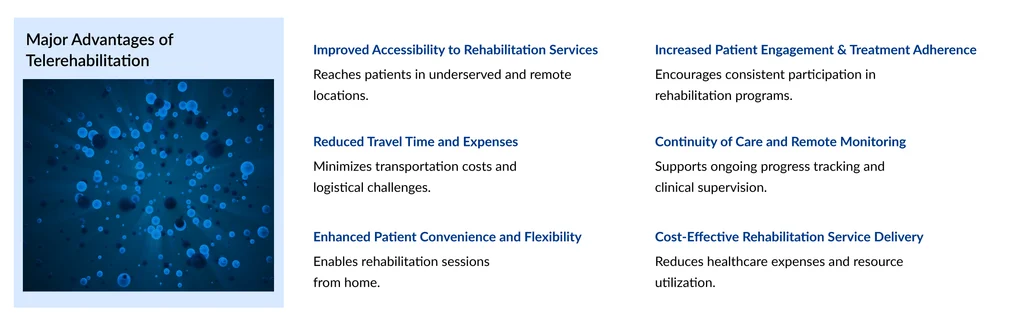
Telerehabilitation plays a crucial role in closing access gaps by addressing barriers faced by rural communities, older adults, people with disabilities, and patients in regions with limited therapist availability. By extending clinicians’ reach beyond geographical boundaries, it enables patients in remote locations to access specialized rehabilitation services without traveling long distances. Additionally, it reduces logistical challenges associated with transportation, time away from work, and childcare responsibilities, which frequently contribute to missed appointments. Beyond improving accessibility, telerehabilitation helps maintain continuity of care, particularly during the transition from hospital discharge to outpatient rehabilitation.
Remote programs can commence shortly after discharge, remain accessible during travel or illness, and provide clinicians with greater visibility into patients’ rehabilitation activities between scheduled sessions. This continuity is particularly important because recovery outcomes depend on consistent participation, adequate treatment intensity, and timely progression of therapeutic interventions. Furthermore, telerehabilitation supports improved patient adherence and engagement by incorporating digital reminders, guided exercises, interactive coaching, and motivational features that address the limitations of conventional paper-based home exercise programs.
Evidence from digital musculoskeletal rehabilitation programs demonstrates encouraging outcomes, with a randomized trial in chronic low back pain reporting lower dropout rates with digital rehabilitation than conventional physical therapy (15.7% versus 34.3%). Similarly, a large-scale analysis conducted in 2025 involving 4,190 participants associated digital physical therapy with a 58% lower relative risk of surgery compared with in-person therapy. Earlier studies of camera-guided home rehabilitation following joint replacement also reported outcomes comparable to traditional rehabilitation, alongside lower per-patient costs and fewer readmissions. Although outcomes vary depending on the clinical condition, patient population, and program design, these findings highlight the potential of well-designed telerehabilitation solutions to deliver outcomes comparable to in-person care across several rehabilitation settings while improving accessibility, continuity, patient engagement, and treatment adherence.
The Technology Stack Powering Modern Telerehabilitation
Telerehabilitation has moved far beyond a grainy video call. Today’s platforms combine multiple technologies into a connected care loop.
Artificial Intelligence: The Digital Co-Therapist
AI is the engine of personalization. Computer-vision models analyze a patient’s movement through a phone or webcam, count repetitions, flag compensations, and give instant feedback. Machine-learning algorithms adjust exercise difficulty based on performance and pain reports, and predictive models can identify patients at risk of dropping out or stalling in recovery. Sword Health’s AI care specialist, Phoenix, and Hinge Health’s heavily automated care delivery are leading examples of AI being embedded directly inside the therapy session, with licensed clinicians retaining responsibility for the plan of care.
Virtual Reality and Augmented Reality: Therapy That Feels Like Play
VR immerses patients in gamified environments where repetitive, often tedious movements become engaging tasks, which is particularly valuable in neurological and pediatric rehabilitation. AR overlays visual cues on the real world, helping patients with balance, gait, or hand function practice in realistic settings. Both increase motivation, allow safe simulation of challenging scenarios (crossing a street, reaching for a shelf), and generate rich performance data for clinicians.
Wearable Sensors and Motion-Tracking Systems
Inertial sensors, flex sensors, and smart gloves capture range of motion, speed, smoothness, and quality of movement with a precision that a video call alone cannot match. Sword Health places wearable motion sensors at the center of its Digital Therapist program, while Neofect’s sensor-enabled devices quantify wrist, hand, and finger movement for gamified upper-limb training. Camera-based approaches such as Hinge Health’s TrueMotion offer a sensor-free alternative that lowers cost and shipping complexity.
Remote Patient Monitoring (RPM)
RPM tools stream adherence, pain scores, vital signs, and functional metrics to clinicians in near real time. Instead of discovering a setback at the next appointment, therapists can intervene the week it happens. RPM also supports billing pathways in some markets, helping providers build sustainable remote-care models.
Cloud-Based Platforms
Cloud infrastructure ties the ecosystem together: clinician dashboards, electronic health record (EHR) integration, video visits, secure messaging, outcomes analytics, and population-level reporting. For health systems and payers, the cloud is what makes it possible to scale from a pilot of fifty patients to a program of fifty thousand.
Mobile Health Applications
The smartphone is the delivery channel that makes everything else practical. Apps provide exercise videos, reminders, educational content, symptom tracking, and chat with care teams, wrapping therapy into the patient’s daily routine.
The Roadblocks: What Is Slowing Telerehabilitation Down?
Despite its considerable potential, telerehabilitation continues to face several challenges that stakeholders must carefully consider when making investment decisions, developing product strategies, or designing clinical programs. Data privacy and cybersecurity remain critical concerns, as rehabilitation platforms collect sensitive information, including video recordings, biometric measurements, and patient health data, making them attractive targets for cyberattacks. Compliance with regulations such as HIPAA in the United States, GDPR in Europe, and equivalent local frameworks requires robust encryption, stringent access controls, and effective vendor governance. A single data breach can significantly undermine patient confidence, highlighting the importance of integrating security into platform architecture from the outset rather than treating it as an afterthought. Inconsistent reimbursement policies represent another major commercial barrier.
In the United States, the Consolidated Appropriations Act, 2026, signed on February 3, 2026, extended Medicare telehealth flexibilities through December 31, 2027, maintaining eligibility for physical therapists, occupational therapists, speech-language pathologists, and audiologists as telehealth practitioners while allowing patients to receive services from their homes. This extension provides welcome stability following a lapse in late 2025 that left reimbursement claims uncertain. Nevertheless, the measure remains temporary and applies exclusively to Medicare, while commercial insurers and state Medicaid programs continue to establish their own coverage and payment policies. Internationally, reimbursement frameworks for remote rehabilitation vary considerably, with many markets lacking established payment mechanisms.
Limited connectivity and digital literacy further constrain adoption, particularly among populations that stand to benefit significantly from remote care but often have limited broadband access, outdated devices, or insufficient familiarity with digital technologies. Without intuitive interfaces, multilingual functionality, and adequate onboarding assistance, telerehabilitation may inadvertently exacerbate existing healthcare inequalities rather than address them. Technology and implementation costs also present significant challenges, as investments in sensors, virtual reality headsets, robotic systems, platform subscriptions, integration infrastructure, and clinician training can create substantial financial burdens.
Although large healthcare systems may have the resources to absorb these expenses, smaller private practices and community-based providers frequently face affordability constraints, particularly in the absence of predictable reimbursement. Regulatory complexity introduces additional barriers to expansion, with clinician licensure requirements tied to patient locations, differing medical device classification frameworks, and evolving regulations governing artificial intelligence-enabled software complicating multi-state and cross-border deployment. Platforms making clinical claims may also require regulatory clearance, as demonstrated by Reflexion’s VERA platform, which obtained FDA clearance through the 510(k) pathway.
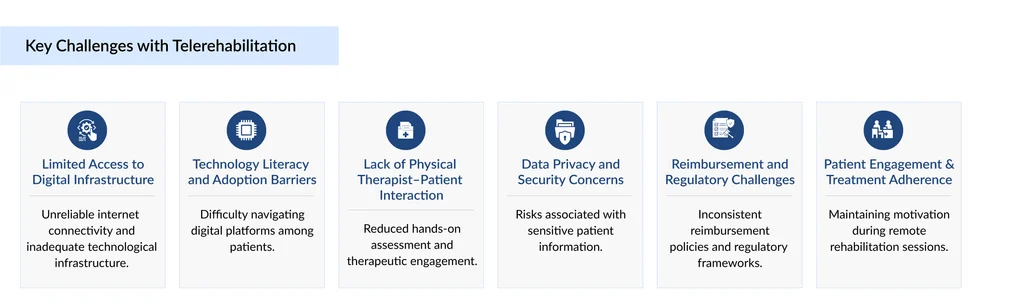
Finally, the limitations of remote clinical assessment remain an important consideration, as certain rehabilitation procedures, including palpation, manual therapy, detailed neurological examinations, strength grading, and specific safety assessments, are difficult to perform effectively through digital interfaces alone. Consequently, hybrid care models that combine virtual rehabilitation sessions with periodic in-person consultations are increasingly emerging as a practical and clinically appropriate approach, offering a balanced alternative to fully remote or exclusively facility-based rehabilitation.
Who’s Who in Telerehabilitation: Leading Companies to Watch
The competitive landscape spans employer-focused digital MSK giants, clinician-facing software providers, and specialized neurorehabilitation device makers. Here are prominent players and what sets them apart.
Hinge Health (United States)
A leader in employer- and health-plan-sponsored digital musculoskeletal care in the U.S. Hinge combines app-guided exercise therapy, physical therapists, and health coaches, and uses its TrueMotion camera-based tracking for on-screen form feedback. It also offers the Enso wearable for pain relief. Its model sells primarily to self-insured employers and health plans, positioning virtual PT as an alternative to surgery, opioids, and in-person therapy, and it has been scaling automation to raise care-team productivity. Strategic priorities center on enterprise contracts, AI-driven efficiency, and expanding clinical pathways (back, knee, hip, shoulder).
Sword Health (Portugal/United States)
Founded in Portugal and now a major U.S. player, Sword pairs wearable motion sensors with its AI care specialist, Phoenix, and licensed physical therapists. Its Thrive program is built around doctor of physical therapy supervision supported by real-time AI feedback, and the company has expanded beyond MSK into mental health with its Mind offering. Sword’s differentiation is its sensor-plus-AI approach and a push to turn AI into a core clinical engine while retaining clinician oversight.
Kaia Health (Germany/United States)
Kaia delivers app-based multidisciplinary programs for back pain, knee and hip osteoarthritis, and other chronic conditions, using motion-tracking feedback technology and behavioral components. The company has invested in clinical evidence, including randomized controlled studies of its hip and knee pain program, and sells to payers and employers across Europe and North America. Its strategic edge is a research-backed, digital-first care model.
Physitrack (Sweden/Global)
Physitrack serves the clinician side of the market: physical therapists and clinic owners who need tools for prescribing home exercise programs, running telehealth sessions, engaging patients, and supporting remote therapeutic monitoring. Rather than selling an employer benefit, it provides software that independent practices and health systems can plug into their own workflows. Its focus is international reach and platform breadth.
Reflexion Health/VERA (United States)
Reflexion’s VERA is a prescription digital physical therapy platform that uses an avatar coach and 3D motion capture to measure movement and functional performance, with dashboards for patients and providers. It holds FDA 510(k) clearances covering lower extremities and later trunk and upper extremities, and reported studies showing outcomes comparable to traditional therapy with savings of about USD 2,745 per patient in a bundled-payment setting. Partnerships with academic and health-system organizations, including Duke and Yale New Haven, underline its provider-focused strategy.
Neofect (South Korea/Global)
Neofect develops sensor-enabled rehabilitation hardware and software for neurological and musculoskeletal recovery. Its portfolio includes a wearable hand and finger motion-sensing device, arm support and planar training platforms, an interactive pegboard, and a balance training and assessment platform, tied together with clinician portals and a HIPAA-compliant teletherapy platform known as TeleRehab. Neofect has patented methods for delivering remote rehabilitation training and targets both clinical and home use, making it a notable name in tele-neurorehabilitation.
Future Outlook and Emerging Opportunities: Where Telerehabilitation Goes Next
The future of telerehabilitation will be shaped by its integration into mainstream healthcare, supported by sustained market growth and increasing adoption of hybrid care models. DelveInsight market forecasts indicate growth at 14% CAGR, with North America maintaining a significant share and Asia Pacific emerging as a high-growth region. Digital-first, human-supported care pathways are expected to become increasingly common, combining remote therapy, exercise monitoring, and patient engagement with in-person consultations for complex assessments and clinical decisions. Advances in artificial intelligence, computer vision, and multimodal sensing will further enhance movement assessment, personalized coaching, automated documentation, and early complication detection, while immersive technologies such as VR, AR, robotics, and haptics are expected to expand applications in neurological, pediatric, and balance rehabilitation.
Telerehabilitation is also expected to extend into underserved therapeutic areas, including post-cancer rehabilitation, cardiopulmonary care, pelvic health, long COVID recovery, vestibular disorders, and geriatric fall prevention. Value-based reimbursement models, employer-sponsored benefits, and greater policy certainty surrounding telehealth coverage could strengthen adoption by rewarding clinical outcomes and improving cost efficiency. Emerging markets offer additional opportunities through affordable smartphone-based rehabilitation solutions, particularly in regions facing significant therapist shortages. Meanwhile, continuous movement and outcomes data will support predictive analytics, clinical research, and payer negotiations, creating competitive advantages for organizations prioritizing interoperability, privacy, and data security.
Overall, telerehabilitation is evolving from a pandemic-era alternative into a permanent component of healthcare delivery, making rehabilitation more accessible, continuous, and measurable. Its long-term success will depend on combining clinical evidence, technological innovation, sustainable reimbursement, and positive patient experiences, with digital tools serving to enhance the capabilities of rehabilitation professionals rather than replace them.

Downloads
Article in PDF
Recent Articles
- How is Artificial Intelligence Used in Drug Discovery & Development?
- Advances in Varicose Vein Treatment Devices: Technologies Shaping Modern Venous Care
- Applications of AI in Healthcare: COVID-19 and Beyond
- Non-Surgical Body Contouring: What’s Fueling Its Growth in Aesthetic Medicine?
- AI Hospitals of the Future–Where Robotics, Predictive Analytics, and Compassion Converge