Aβ-Protein Inhibitors in Alzheimer’s Disease: The Amyloid-Busting Arsenal Redefining Care
Jul 24, 2026
Table of Contents
Summary
- Alzheimer’s disease treatment has shifted from symptomatic management to disease modification with the emergence of anti-amyloid beta (Aβ) inhibitors that target the root cause by clearing amyloid plaques.
- Biogen/Eisai’s LEQEMBI and Eli Lilly’s KISUNLA are currently the only Aβ-targeting therapies to receive full regulatory approval for the treatment of early Alzheimer’s disease in the United States.
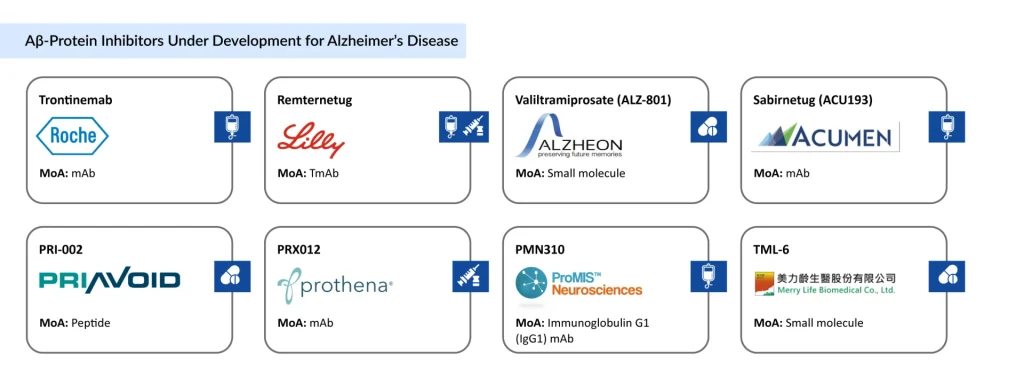
- Next-generation Aβ inhibitors focus on improved safety, speed, and convenience include Roche’s Trontinemab, Eli Lilly’s Remternetug, Alzheon’s ALZ-801, Acumen’s Sabirnetug, Priavoid’s PRI-002, Prothena’s PRX012, ProMIS Neurosciences’ PMN310, and Merry Life Biomedical’s TML-6.
For decades, Alzheimer’s disease was a condition doctors could only manage, never modify. That changed with the arrival of anti-amyloid beta (Aβ) protein inhibitors, a class of disease-modifying therapies designed to clear the sticky amyloid plaques that clump between neurons and drive cognitive decline. These drugs don’t just mask symptoms; they go after the biological root of the disease, and their arrival has reshaped how the world thinks about the Alzheimer’s disease treatment pipeline.
Downloads
Click Here To Get the Article in PDF

Recent Articles
- Sobi’s GAMIFANT Approved by FDA as First Treatment for Macrophage Activation Syndrome in Still’s ...
- Exploring the Current Alzheimer’s Disease Drug Development Pipeline
- Rising of Orphan Drug Development
- Can Alzheimer’s be cured with Marijuana?
- Wireless Brain Sensors: Revolutionizing Neuroscience and Healthcare
The amyloid hypothesis, the idea that the accumulation of Aβ plaques triggers the cascade of tau tangles, inflammation, and neuronal death seen in Alzheimer’s, has driven drug discovery for more than 20 years. After a long string of costly late-stage Alzheimer’s disease drug failures, the field finally has proof of concept: monoclonal antibodies that clear amyloid and, in doing so, modestly but measurably slow cognitive and functional decline. That success has triggered a wave of investment, and the Aβ-targeting space now sits at the center of the Alzheimer’s disease market size story, with a fast-growing Alzheimer’s disease drug development pipeline of next-generation antibodies, oral agents, and biomarker-guided programs aiming to go further, faster, and safer than the first approved wave.
Approved Aβ-Protein Inhibitors: The First Wave of Disease-Modifying Therapy
Only two Aβ-protein inhibitors currently hold full regulatory approval for early Alzheimer’s disease in the United States: LEQEMBI and KISUNLA. Both are intravenous monoclonal antibodies that target different forms of amyloid, and both have become the benchmark against which every emerging therapy in the Alzheimer’s disease drug development pipeline: 2026 landscape is measured.
LEQEMBI: Biogen and Eisai’s Amyloid Pioneer
Developed jointly by Biogen and Eisai, LEQEMBI (lecanemab) was among the first anti-amyloid antibodies to demonstrate a statistically significant slowing of clinical decline in a large Phase 3 trial, earning traditional FDA approval for people with mild cognitive impairment (MCI) or mild dementia due to Alzheimer’s disease. The recent approval of a subcutaneous maintenance formulation, LEQEMBI IQLIK, is expected to improve treatment convenience by enabling at-home or simplified administration compared with infusion-based dosing. Lecanemab binds selectively to soluble amyloid protofibrils, considered one of the most neurotoxic forms of Aβ, clearing plaque and reducing the rate of decline on standard clinical scales compared with placebo.
LEQEMBI (lecanemab) has received multiple regulatory designations aimed at accelerating its development, review, and patient access across key markets. In June 2021, the US FDA granted Breakthrough Therapy Designation (BTD) for the treatment of early Alzheimer’s disease based on Phase II data demonstrating potential clinical benefit, followed by Fast Track Designation (FTD) in December 2021 to expedite its development and regulatory review. In January 2023, Japan’s Ministry of Health, Labour and Welfare (MHLW) granted priority review to Eisai’s manufacturing and marketing application for LEQEMBI for the treatment of mild cognitive impairment (MCI) due to Alzheimer’s disease and mild Alzheimer’s disease dementia. Subsequently, the US FDA accepted Eisai’s supplemental Biologics License Application (sBLA) under Priority Review in March 2023, while the UK’s Medicines and Healthcare products Regulatory Agency (MHRA) granted lecanemab designation under the Innovative Licensing and Access Pathway (ILAP) in May 2023 to facilitate earlier patient access.
Since its approval, LEQEMBI has expanded its footprint with a subcutaneous maintenance dosing option, making long-term administration easier for patients and caregivers alike, and it continues to anchor real-world discussions around amyloid-related imaging abnormalities (ARIA) monitoring, APOE4 genotyping, and appropriate patient selection, themes that now inform nearly every next-generation program in the Alzheimer’s disease drug development space.
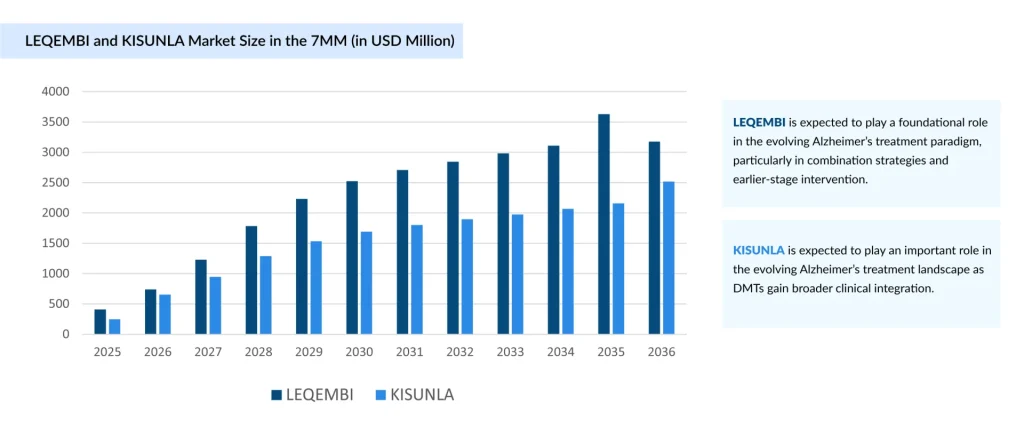
KISUNLA: Eli Lilly’s Fixed-Duration Contender
Eli Lilly’s KISUNLA (donanemab) took a different approach: targeting a pyroglutamate form of Aβ found specifically in established plaques, and pairing that mechanism with a novel fixed-duration treatment protocol; patients can stop dosing once amyloid clearance is confirmed on PET imaging. This plaque-completion-based approach was a first for the category and has fueled significant interest in donanemab MCI early Alzheimer’s disease usage statistics 2026 forecast models, as real-world adoption data increasingly shapes payer decisions, prescribing habits, and comparative positioning against lecanemab.
Donanemab’s pivotal trial also underscored how much earlier intervention matters; patients with lower tau burden at baseline saw the greatest benefit, reinforcing why biomarker-driven staging is now central to the Alzheimer’s disease treatment pipeline. That single insight has pushed the entire industry to ask a pointed question: what are the leading companies in Alzheimer’s disease biomarker development, and how quickly can blood-based diagnostics get patients onto therapy before irreversible neuronal loss sets in?
Emerging Aβ-Protein Inhibitors: The Next Generation Taking Aim at Amyloid
While LEQEMBI and KISUNLA proved the amyloid hypothesis can translate into clinical benefit, both come with real limitations: IV infusions, ARIA risk, and modest effect sizes. A new cohort of Aβ-protein inhibitors is now advancing through the Alzheimer’s disease drug development pipeline to clear plaque faster, more safely, and in some cases without a needle at all.
Trontinemab: Roche’s Brain-Shuttle Breakthrough
Roche’s trontinemab is arguably the most closely watched next-generation Aβ inhibitor in development. Built on the company’s proprietary “Brain Shuttle” technology, trontinemab is engineered to cross the blood-brain barrier far more efficiently than conventional antibodies, using a transferrin-receptor-binding fragment to ferry the drug directly into brain tissue. Early data showed the vast majority of participants reaching amyloid negativity within six months, with a notably low rate of ARIA, a profile that, if confirmed in Phase 3, could reset expectations for how fast and how safely amyloid can be cleared. Roche has now advanced trontinemab into large global Phase 3 trials, positioning it as one of the biggest catalysts in the Alzheimer’s disease drug development pipeline: 2026 and beyond.
Remternetug: Eli Lilly’s Subcutaneous Successor to Donanemab
Eli Lilly isn’t resting on KISUNLA’s approval. Remternetug, an antibody that, like donanemab, targets pyroglutamated Aβ, is being developed as a more convenient, self-administered subcutaneous option, with Phase 3 data expected to determine whether it can match or exceed donanemab’s plaque-clearing speed. If successful, remternetug could shift amyloid-targeted therapy away from infusion centers and toward at-home administration, a convenience factor that could meaningfully expand the addressable population within the Alzheimer’s disease therapeutics market.
Sadaf Javed, Functional Head of Forecasting & Analytics at DelveInsight stated that Remternetug highlights Eli Lilly’s strategy to advance next-generation amyloid-targeting antibodies with improved treatment convenience, particularly through the potential for subcutaneous administration and rapid plaque clearance.
Valiltramiprosate (ALZ-801): Alzheon’s Oral Amyloid Oligomer Inhibitor
Alzheimer’s disease drug development has been dominated by injectable antibodies, but Alzheon’s valiltramiprosate (ALZ-801) is charting a different course as an oral, small-molecule inhibitor of amyloid oligomer formation. Rather than clearing existing plaque, ALZ-801 works upstream, blocking the aggregation of toxic soluble Aβ oligomers before they form. In October 2017, the US FDA granted FTD to its lead clinical investigational drug, ALZ-801, to treat Alzheimer’s disease. Its ongoing Phase 3 program has focused on APOE4 homozygotes, a genetically high-risk population that also carries elevated risk of ARIA with antibody therapies, positioning ALZ-801 as a potentially safer oral alternative for one of the hardest-to-treat patient subgroups in the timeline of Alzheimer’s disease research.
The future clinical validation of meaningful cognitive benefits in genetically defined early Alzheimer’s populations will be critical for regulatory success and competitive positioning, as per Javed.
Sabirnetug (ACU193): Acumen Pharmaceuticals’ Oligomer-Selective Antibody
Acumen Pharmaceuticals is pursuing a mechanistically distinct target with sabirnetug (ACU193), the first clinical-stage antibody engineered to selectively bind toxic soluble amyloid beta oligomers rather than plaque or monomers. Because oligomers are considered by many researchers to be the most directly neurotoxic species of Aβ, sabirnetug’s Phase 2 ALTITUDE-AD trial, enrolling more than 500 people with early Alzheimer’s disease, is being closely watched as a test of whether hitting this specific target translates into meaningful clinical benefit. The therapy has received FTD from the US FDA for the treatment of early Alzheimer’s disease and is currently under evaluation in a Phase II clinical study in patients with early-stage disease. Topline results are anticipated in late 2026, and the outcome could validate an entirely new sub-category within the Alzheimer’s disease drug development pipeline.
The Road Ahead: Market Growth, More Molecules, and What Comes Next
The approval of LEQEMBI and KISUNLA didn’t close the chapter on amyloid-targeted therapy, it opened one. According to DelveInsight’s estimates, the Alzheimer’s disease market across the seven major markets (the US, EU4, the UK, and Japan) was valued at nearly USD 4 billion in 2025. The market is projected to grow significantly through 2036 at a CAGR of 22.7%, fueled by the rising adoption of disease-modifying therapies, improvements in diagnostic technologies, broader patient identification, sustained investments in research and development for neurodegenerative disorders, and a maturing Alzheimer’s disease drug development pipeline of next-generation antibodies and oral agents.
As real-world donanemab MCI early Alzheimer’s disease usage statistics 2026 forecast data accumulate alongside growing lecanemab experience, payers and physicians are gaining the confidence needed to diagnose and treat earlier, which is precisely when Aβ-protein inhibitors work best. Beyond the advanced candidates already discussed, a robust pipeline of early-stage Aβ inhibitors continues to expand the Alzheimer’s disease treatment landscape, with each therapy employing a distinct strategy to target the amyloid cascade.
Priavoid’s PRI-002 is an oral small molecule designed to directly disrupt toxic Aβ oligomers, offering the convenience of oral administration while utilizing a mechanism that differs from antibody-mediated amyloid clearance. Prothena’s PRX012 is a next-generation, high-potency anti-amyloid antibody developed for low-volume subcutaneous administration, aiming to achieve substantial plaque removal with greater dosing convenience than first-generation intravenous therapies.
ProMIS Neurosciences’ PMN310 leverages a computationally engineered antibody platform to selectively bind misfolded, toxic Aβ oligomers while avoiding healthy amyloid plaques and monomeric proteins, to enhance therapeutic efficacy while reducing the risk of amyloid-related imaging abnormalities (ARIA). Meanwhile, Merry Life Biomedical’s TML-6 is progressing through early clinical development as another promising Aβ-targeted candidate, reflecting the industry’s ongoing focus on developing safer, more selective approaches to amyloid modulation for Alzheimer’s disease.
Taken together, these programs illustrate just how crowded, and how competitive, the race to perfect amyloid-targeted therapy has become. The central questions shaping the next stretch of the timeline of Alzheimer’s disease drug development are no longer just “does clearing amyloid help?”, that’s been answered, but “who can clear it fastest, safest, and earliest in the disease course, and in the most convenient formulation?” As biomarker science, blood-based diagnostics, and next-generation antibodies converge, the Aβ-protein inhibitor class is poised to remain the engine driving growth across the Alzheimer’s disease therapeutics market for years to come.

Downloads
Article in PDF
Recent Articles
- Alzheimer’s drug fails! Is it time to move on?
- The Automated Eye: How AI-Driven Diagnostics are Reshaping the Future of Medical Imaging
- A New Dawn in Alzheimer’s Disease Treatment: Eli Lilly’s Donanemab Wins FDA Approval
- LEQEMBI Intravenous Infusion Approval; Novartis’ Presented Updates on Lutathera; FDA Accept...
- Biogen-Eisai’s Aduhelm; Quidel acquires Ortho Clinical Diagnostics; Accutar Biotechnology’s...