The Automated Eye: How AI-Driven Diagnostics are Reshaping the Future of Medical Imaging
Dec 17, 2025
Table of Contents
Artificial intelligence (AI) has rapidly emerged as a transformative force in medical imaging, revolutionizing disease detection, diagnosis, and monitoring. From radiology to pathology, AI algorithms are enhancing image interpretation, improving diagnostic accuracy, and streamlining clinical workflows across healthcare systems worldwide. This paradigm shift, driven by the massive availability of digital imaging data and the maturation of deep learning, promises not only to alleviate the heavy burden on healthcare professionals but also to make precision diagnosis more accessible and equitable for patients globally.
The Evolution of AI in Diagnostics: Market Trajectory
The journey of AI in diagnostics began with Computer-Aided Detection (CAD) systems in the 1980s, but the advent of Deep Learning (DL), particularly Convolutional Neural Networks (CNNs),truly unlocked its potential in image analysis. CNNs, capable of learning complex features directly from raw image data, far surpassed the capabilities of older, rule-based systems. Today, this technological advancement is reflected in the colossal growth of the market.
Downloads
Click Here To Get the Article in PDF

Recent Articles
- Unlocking New Avenues in KRAS-Driven Cancer Research Beyond G12C
- Tetra, Shionogi sign deal; Amgen remunerates; Gilead’s fibrotic disease deal
- Ipsen to Acquire Albireo; Chiesi Farmaceutici to Buy Amryt Pharma; Takeda Presents Phase III Resu...
- Mapping the Mind: How Neurodiagnostics Is Redefining the Future of Brain Healthcare
- Now, Artificial Intelligence to Accurately Identify Cancer Cells
The global AI in diagnostics market was valued at approximately USD 1.6 billion in 2024 and is projected to skyrocket to over USD 8 billion by 2032, exhibiting a remarkable CAGR of 22%. Similarly, the AI in medical imaging market is expected to grow from an estimated USD 1.6 billion in 2024 to USD 13.1 billion by 2032, with a CAGR of around 29%.
North America currently dominates the market, holding a share of over 51% in 2024, driven by the early adoption of advanced healthcare IT infrastructure and substantial investment from major players. Key companies driving this innovation include tech giants such as Google, IBM Corporation, and Microsoft Corporation, as well as specialized health technology companies such as Siemens Healthineers, GE HealthCare, Aidoc, Nanox Imaging (Zebra Medical Vision), and Arterys. These organizations are investing heavily in developing sophisticated software platforms that currently hold the largest share of the market, providing crucial tools for radiologists to manage surging imaging volumes and reduce burnout.
Key Applications of AI-driven Imaging Solutions in Healthcare
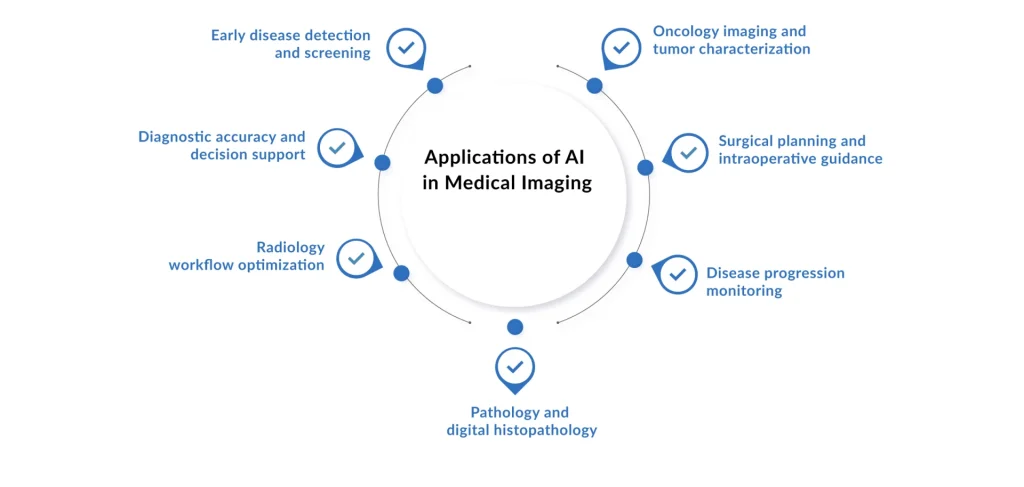
AI’s impact spans across medical specialties, providing tools that automate measurements, prioritize urgent cases, and extract hidden data (radiomics) that is often invisible to the human eye.
Radiology
The discipline of radiology is currently undergoing a profound transformation, becoming a primary beneficiary of AI integration given the sheer volume of data it processes. AI algorithms are now routinely employed to enhance all phases of the diagnostic workflow. For Prioritization and Triage, AI systems analyze incoming scans, such as CT images, in real time to immediately flag critical findings, such as intracranial hemorrhage or pulmonary embolism. This automated prioritization ensures that the most time-sensitive cases are pushed to the top of a radiologist’s worklist, dramatically reducing turnaround times and directly improving patient outcomes, especially in time-critical situations like stroke care (reducing “door-to-needle” times).
Simultaneously, AI acts as a reliable Lesion Detection and Quantification tool, serving as a “second reader” to improve the sensitivity of cancer screening, such as mammography for breast cancer. By detecting subtle nodules or lesions that a human might overlook due to fatigue or high caseloads, AI lowers false-negative rates and ensures consistent, quantitative measurements. Finally, AI contributes significantly to Workflow Optimization by assisting with non-diagnostic tasks. This includes generating standardized draft reports using Natural Language Processing (NLP), pulling relevant prior reports and clinical data from the Electronic Health Record (EHR) into the radiologist’s view, and optimizing hanging protocols on PACS systems, thereby streamlining the entire interpretation process and saving radiologists valuable time.
Cardiology
AI is fundamentally transforming the diagnosis of structural and functional heart disease by introducing quantitative, reproducible, and highly accurate analysis across multiple imaging modalities. In Echocardiogram Analysis, AI algorithms automate the measurement of key indicators of cardiac function, such as the Left Ventricular Ejection Fraction (LVEF), which is crucial for diagnosing conditions like heart failure. By automatically segmenting the cardiac chambers and calculating these metrics, AI reduces inter-observer variability and ensures consistent, reliable results, often in real-time. For Coronary Artery Disease (CAD) Staging, AI analyzes CT angiography (CCTA) scans to move beyond simple luminal stenosis. These advanced algorithms assess complex plaque composition (e.g., lipid-rich necrotic core) and volume, enabling non-invasive risk stratification for future cardiac events and supporting personalized, preventive treatment planning. Furthermore, in ECG Interpretation, AI tools leverage deep learning to analyze continuous and single-lead ECG data with high accuracy, detecting subtle or sub-clinical patterns of conditions like atrial fibrillation (AFib), left ventricular dysfunction, and certain structural heart diseases, often predicting risk long before it is clinically visible to the human eye.
Neurology
AI is recognized as a critical tool for rapid, precise analysis in the complex field of neurology, particularly concerning the brain and spine. For Stroke Triage in hyper-acute care, AI rapidly analyzes CT perfusion scans to accurately map the core infarct (irreversible damage) versus the penumbra (salvageable tissue), which is essential for guiding time-critical interventions like thrombectomy. In Neurodegenerative Disease Monitoring, AI-powered volumetric software automatically and objectively quantifies structural changes, such as hippocampus atrophy in Alzheimer’s disease or lesion load in Multiple Sclerosis, providing reliable metrics for tracking disease progression and treatment efficacy. Furthermore, for Tumor Classification, AI algorithms analyze imaging features (radiomics) that correlate with tumor genotype and prognosis, thereby providing crucial insights that significantly aid surgical planning and radiation oncology strategies.
Oncology
AI is fundamentally changing cancer care, from initial screening to long-term monitoring of treatment response. A crucial application is Tumor Segmentation and Delineation, where AI rapidly and accurately outlines tumors and nearby Organs-at-Risk (OARs) on planning scans (CT/MRI). This automation is essential for precise radiation therapy planning, significantly reducing a highly time-consuming manual task and minimizing inter-observer variability. Furthermore, Predictive Radiomics algorithms extract vast numbers of quantitative features from standard medical images. These features are correlated with underlying genetic traits and patient outcomes, allowing clinicians to predict an individual’s response to therapies (such as immunotherapy or radiotherapy), enabling highly personalized cancer management. Finally, in Breast Cancer Screening, large-scale trials, such as the major EDITH trial in the UK’s National Health Service, are evaluating AI’s role in matching or even surpassing human performance in detecting subtle malignancies from mammograms, with the potential to reduce the need for dual human readings, ease the workload on overstretched radiologists, and cut waiting lists.
Benefits of AI Integration in Medical Imaging
The integration of AI into diagnostic workflows offers profound benefits for patients, clinicians, and health systems:
Enhanced Diagnostic Accuracy: AI acts as an objective, tireless second reader, particularly in screenings, reducing inter-observer variability and lowering both false-positive and false-negative rates, ultimately leading to earlier disease detection.
Increased Efficiency and Throughput: By automating tedious tasks such as measurement, segmentation, and reporting, AI significantly reduces the time required for image interpretation. This increased efficiency boosts throughput in imaging centers, addressing the global shortage of radiologists.
Reduced Clinician Burnout: By handling routine and low-risk scans and prioritizing critical cases, AI systems allow radiologists to focus their cognitive effort on the most complex, challenging, and valuable interpretations, mitigating professional fatigue.
Democratization of Expertise: AI provides sophisticated diagnostic support to clinicians in areas with limited access to sub-specialty radiologists, such as rural or developing regions, thereby improving global health equity.
Personalized Medicine: AI extracts and analyzes deep, sub-visual features (radiomics) from medical images, linking them to genetic and clinical outcomes. This enables precision medicine by predicting an individual patient’s response to a specific drug or radiation dose.
Challenges and Ethical Considerations of AI Adoption in Imaging
Despite the immense promise, the widespread adoption of AI in imaging faces significant technological, logistical, and ethical hurdles:
Challenges
AI adoption in medical imaging faces several significant hurdles that challenge widespread implementation: A major concern is Data Quality and Generalizability, as the efficacy of AI models is entirely dependent on the quality and diversity of their training data. Algorithms trained on data sourced from a single hospital or specific demographic group may suffer from algorithmic bias and perform poorly when applied to diverse patient populations or different scanner models, thus undermining their reliability in varied clinical settings.
Another critical barrier is Model Interpretability, often referred to as the “Black Box” issue. Deep learning models can reach a diagnostic conclusion without providing a clear, human-understandable explanation for their decision. Clinicians require assurance and transparency (explicability) to fully trust a high-stakes AI diagnosis, particularly when it contradicts their professional judgment, making trust a prerequisite for clinical adoption. Furthermore, Regulatory and Reimbursement Complexity present financial and market obstacles. While obtaining regulatory approval (such as FDA clearance) is necessary, it is only the first step. Establishing clear, consistent reimbursement pathways from payers for AI-assisted diagnoses is essential to achieving commercial viability and incentivizing widespread market adoption of these innovative technologies.
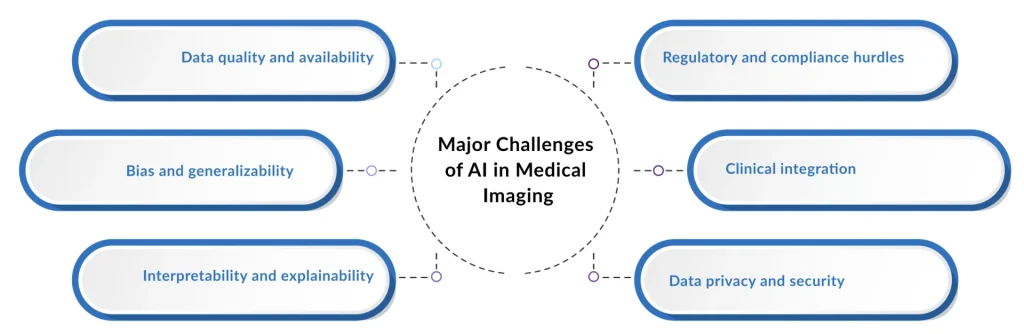
Finally, Integration into Workflow poses a significant technical and logistical challenge for hospitals. Achieving seamless integration of third-party AI software with existing Picture Archival and Communication Systems (PACS) and Electronic Health Records (EHRs) can be difficult, often requiring substantial IT resources and modifications to established clinical protocols.
Ethical Considerations
The widespread adoption of AI in medical imaging introduces complex ethical and legal considerations that remain largely unresolved:
One major challenge is Accountability and Liability. If an AI algorithm makes an error resulting in patient harm, current legal frameworks struggle to determine responsibility. The question of who is legally liable, the developer of the algorithm, the hospital that deployed it, or the physician who ultimately signed the diagnostic report, is a critical, unresolved issue in medical jurisprudence.
Another concern is Algorithmic Bias and Health Disparities. If the data used to train the AI model disproportionately represents specific demographics, the resulting model may exhibit bias. This can cause the AI to underperform or provide less accurate results for minority or underrepresented patient groups, thereby perpetuating or even exacerbating existing health disparities within the healthcare system.
Finally, ensuring Patient Autonomy and Consent is paramount. As AI tools increasingly contribute to diagnosis and automated decision-making, it is essential to ensure that patients have a clear understanding of when AI is being used in their care. Obtaining informed consent regarding the use of these tools in diagnosis, particularly regarding how their sensitive medical data is used, remains a critical requirement for maintaining patient trust and ethical standards.
What’s Ahead in AI in Medical Imaging?
Current Market Dynamics and Key Players
The current market is characterized by intense M&A activity and strategic collaborations aimed at consolidating technology and securing market positioning. Companies such as Siemens Healthineers are integrating AI capabilities directly into their core imaging hardware and software platforms. Meanwhile, pure-play AI vendors like Aidoc, Nanox, and Vuno are focusing on high-impact, FDA-cleared algorithms that provide specific workflow solutions across multiple modalities.
Key trends include:
The market for AI in medical imaging is undergoing dynamic shifts, with three key trends shaping the near future. First, there is a rapid shift toward Cloud Deployment, moving away from cumbersome on-premise systems. Cloud-based solutions offer superior scalability, enable easier software updates, and facilitate faster integration across large, often geographically dispersed, hospital networks. Second, while oncology and neurology currently dominate, the fastest-growing application segments are forecast to be Pulmonology and Ultrasound. This growth is driven by the increasing need for rapid screening capabilities and the expansion of point-of-care applications where immediate diagnostic insights are crucial. Finally, the next technological frontier involves the integration of Generative AI (GenAI) and Large Language Models (LLMs). These advanced AI tools are being deployed to automate complex reporting, synthesize patient information from multimodal data sources, and significantly improve the efficiency of clinical trial imaging workflows.
Future Outlook
The future of AI in medical imaging will usher in an era of True Personalization, primarily through the concept of “Virtual Biopsy,” in which non-invasive image analysis, using advanced radiomics, can reliably predict tumor genetics or therapeutic response, guiding treatment without the need for an invasive procedure. This technological shift will enable Proactive Health Management as AI transitions from reactive diagnosis to predictive analytics. Algorithms will analyze routine scans to identify individuals at high risk for future conditions, such as osteoporosis, cardiovascular disease, or future cancer risk, even before symptoms manifest, allowing for preemptive intervention. Consequently, the role of the human expert will evolve toward the Symbiotic Radiologist. AI will manage high-volume, repetitive tasks, freeing the radiologist’s focus from primary image detection to that of a clinical validator and a complex case manager, allowing more time for multidisciplinary collaboration and intricate patient consultations.
North America (U.S. and Canada): This region dominates the market, accounting for over 51% global share. The dominance is fueled by robust healthcare IT adoption, substantial government and private R&D funding, high patient awareness, and the presence of major AI and medical device companies (e.g., Google, IBM, Siemens Healthineers). Early and clear regulatory pathways (FDA) facilitate rapid market entry for innovative AI solutions.
Europe: Europe is a strong growth market, projected to achieve a healthy CAGR. Growth is driven by the increasing integration of AI into established national healthcare systems (like the NHS) and collaborative research efforts across the EU. However, adoption is sometimes hampered by disparate regulatory frameworks (country-specific hurdles in addition to EMA approval) and concerns about data privacy (GDPR).
Asia Pacific (APAC): This region is anticipated to be the fastest-growing market, with a high CAGR driven by massive, untapped patient populations, improving healthcare infrastructure (especially in China, Japan, and India), and governmental initiatives to leverage AI for rapid diagnosis and addressing specialist shortages in remote areas. While the initial deployment is focused on basic detection (e.g., lung nodules), local companies are rapidly developing proprietary, competitive technology.
Ultimately, the goal is not to replace the clinician, but to augment human expertise, creating an automated safety net that ensures faster, more accurate, and equitable access to high-quality diagnosis for every patient.

Downloads
Article in PDF
Recent Articles
- FDA Breakthrough Device Designation to Pi-Cardia’s ShortCut; AbSolutions Med’s REBUILD Bioabsorba...
- Coherus Biosciences’ Toripalimab; Keymed’s CMG901; Biogen Alzheimer’s Drug Aduhelm; Vicore’s Digi...
- Chimerix Submits Dordaviprone NDA for Accelerated Approval in Recurrent H3 K27M-Mutant Diffuse Gl...
- Biogen-Eisai’s Aduhelm; Quidel acquires Ortho Clinical Diagnostics; Accutar Biotechnology’s...
- Digital Twin Technology – Assessing the Growing Role and Its Evolving Applications in Healt...