Digital Diabetes Management: How Data, Devices, and AI Are Rewriting the Rules of Glucose Care
Sep 09, 2026
Table of Contents
Diabetes care used to run on snapshots: a fasting glucose check here, a quarterly HbA1c test there. Between those snapshots, patients were essentially flying blind, making daily decisions about food, insulin, and activity without knowing how their body was actually responding. That gap is closing fast. Digital diabetes management has moved glucose care from a once-in-a-while lab visit to an always-on, data-rich experience, powered by continuous glucose monitors (CGMs), connected apps, and increasingly sophisticated AI.
This shift isn’t a minor upgrade. It’s a fundamental redesign of how diabetes, and, increasingly, metabolic health in general, is monitored, understood, and managed. From real-time sensors that replace finger-prick tests to AI engines that predict a glucose spike before it happens, innovative diabetes management tools are turning reactive care into proactive, personalized health strategy.
Downloads
Click Here To Get the Article in PDF

Recent Articles
- FiberSense CGM System Secures CE Mark; AMDI™ Fast PCR System Achieves FDA 510(k) Clearance and CL...
- World Diabetes Day | 2018
- CEPI Grants $41.3 Million to Valneva; Innovent Achieves Phase III Success for Mazdutide; GSK’s BL...
- Deep Dive Into World Congress of Nephrology 2026 (WCN’26): Transforming Kidney Care and Innovation
- CE Mark to Ibex’s Gastric Cancer Detection System; Senseonics’s Eversense E3 Continuous Glucose M...
The Shift from Episodic to Continuous Care
For decades, diabetes management was built around two pillars: the periodic HbA1c blood test, which offers a rearview-mirror average of blood glucose over the past two to three months, and the finger-prick glucose meter, which delivers a single data point at a single moment. Both are useful, but both share the same fundamental flaw: they tell you almost nothing about what happens between checks. A patient could swing from dangerous highs to dangerous lows overnight and never know it, because the only test that mattered was the one taken hours later, after the body had already returned to a more “normal” reading.
That model is being replaced by continuous, data-driven care. CGMs and other connected devices now generate a steady stream of glucose readings, often every one to five minutes, around the clock, turning diabetes management from a series of isolated checkpoints into a continuous feedback loop. This is the essence of advances in diabetes management: not just new gadgets, but a new philosophy of care built on real-time visibility rather than periodic sampling.
The clinical benefits of this shift are well documented:
- Continuous data lets patients and clinicians make micro-adjustments to insulin, meals, and activity in real time, rather than waiting for the next lab result to catch a problem.
- Trend alerts and predictive warnings give people a chance to intervene before glucose drops to dangerous levels, rather than discovering a low after symptoms have already set in.
- TIR, the percentage of the day spent within a healthy glucose range, has become a core clinical metric alongside HbA1c, and continuous monitoring is what makes it measurable and actionable in the first place.
- Seeing glucose data on a phone screen, paired with clear trend arrows, turns an abstract number into an understandable, motivating signal, helping patients connect specific foods, activities, and habits to how they actually feel.
Put simply, continuous care doesn’t just generate more data; it changes the entire rhythm of managing diabetes, from a handful of decisions a month to dozens of informed micro-decisions a day.
CGM as the Core of Digital Diabetes Management
If there’s a single technology driving this transformation, it’s the continuous glucose monitor. CGMs sit at the center of digital diabetes management, and understanding how they work makes it clear why they’ve become indispensable. A typical CGM system has three components:
- Sensor, a small filament inserted just under the skin (usually on the arm or abdomen) that measures glucose levels in interstitial fluid, typically for 10 to 15 days per sensor.
- Transmitter, a device that sits on top of the sensor and sends readings wirelessly to a receiver or smartphone, usually every one to five minutes.
- App or receiver, the interface where users actually see their data: real-time glucose numbers, trend arrows showing whether levels are rising, falling, or stable, and customizable high/low alerts.
That combination, real-time readings plus directional trend arrows plus proactive alerts, is what makes CGM fundamentally different from finger-prick testing. It doesn’t just tell you where you are; it tells you where you’re headed, which is often the more clinically useful piece of information.
Key Players and Recent Innovations
The competitive landscape has evolved rapidly, with the expansion of OTC access emerging as one of the biggest recent developments. Dexcom continues to expand its G-series sensors and was the first to bring an OTC CGM, Stelo, to the U.S. market for people who do not use insulin. Abbott has built the most widely used CGM franchise globally through its FreeStyle Libre line and has extended the technology into two newer, purpose-built OTC products: Lingo, a wellness-focused biowearable for general consumers seeking to understand how food, exercise, sleep, and stress affect their glucose levels, and Libre Rio, designed specifically for adults with type 2 diabetes who do not use insulin and manage the condition through lifestyle changes.
Both products are OTC and FDA-cleared, joining Dexcom’s Stelo as part of the first wave of prescription-free CGMs in the U.S. Meanwhile, i-SENS, through products such as CareSens Air, represents the growing wave of CGM manufacturers focused on expanding access and affordability, particularly across Asian markets. More broadly, a growing number of emerging OTC CGMs for non-insulin users are entering the market, reflecting a decisive industry shift toward viewing glucose monitoring as a tool that extends beyond insulin-dependent patients.
That last point is arguably the biggest structural shift underway: CGM eligibility is expanding well beyond its original core audience. What began as a tool almost exclusively for people with type 1 diabetes on intensive insulin therapy has grown to include a much broader population, people with type 2 diabetes managing their condition through diet and exercise, and even metabolically healthy individuals who simply want to optimize energy, weight, and long-term metabolic health. This expansion is one of the clearest examples of innovations in diabetes management spilling over into general wellness and preventive health.
AI, Apps, and Personalized Insights
Raw glucose data is useful, but on its own it’s just numbers on a screen. The real leap forward in diabetes management technology has come from layering artificial intelligence and machine learning on top of that data stream, turning a flood of readings into pattern recognition, prediction, and personalized coaching. AI-driven platforms are now capable of detecting patterns across weeks or months of glucose data that would be nearly impossible for a person to identify manually, such as a consistent overnight rise associated with a specific dinner habit. They can also predict glucose excursions before they occur by analyzing trend data, historical patterns, and, in some cases, contextual inputs such as meal logging or physical activity, allowing them to flag likely spikes or drops in advance rather than after the fact. In addition, these platforms can deliver personalized recommendations on diet, physical activity, sleep, and, where relevant, medication timing, moving beyond generic advice toward guidance tailored to an individual’s actual physiological response.
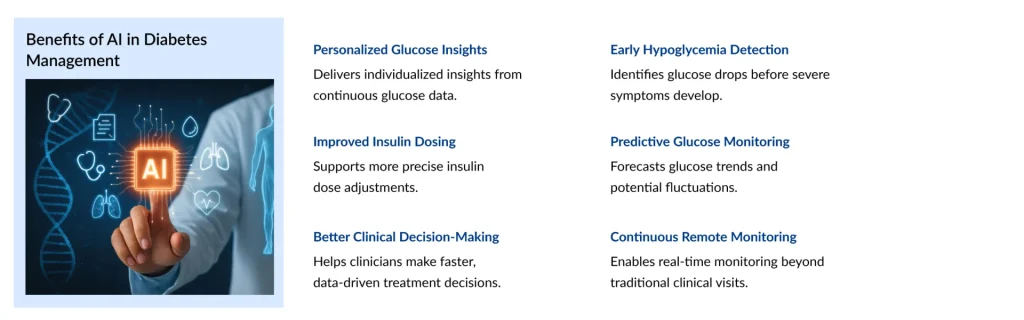
Several platforms illustrate how this is playing out in practice. Signos pairs CGM data with AI-driven coaching aimed at weight and metabolic health, translating glucose patterns into specific food and activity suggestions. Health2Sync integrates CGM data (including from Abbott’s FreeStyle Libre ecosystem) into a broader diabetes management app used to support logging, coaching, and provider communication, particularly across Asian markets. And in a notable sign of where the industry is heading, Abbott and Google Health announced a multi-year partnership integrating Abbott’s Lingo CGM data into the Google Health app, where Google’s AI-powered Health Coach will use glucose trends alongside activity, sleep, and other wellness metrics to deliver contextual, real-time recommendations — plus a large-scale real-world metabolic health study to further refine that guidance.
Beyond consumer coaching apps, AI and CGM data are also powering the most advanced end of the technology spectrum: automated insulin delivery (AID) systems, sometimes called hybrid closed-loop systems. These integrate CGM readings directly with insulin pumps, using algorithms to automatically adjust insulin delivery in response to real-time glucose trends, reducing the manual burden on patients while improving time-in-range and reducing both highs and lows. This is where new innovations in diabetes management are most tangibly closing the loop between monitoring and treatment, rather than leaving that translation entirely up to the patient.
Market Growth and Strategic Trends
The clinical momentum behind digital diabetes management is matched by serious commercial momentum. The global digital diabetes management market was valued at approximately USD 15.2 billion in 2025 and is projected to reach USD 46.8 billion by 2034, growing at a CAGR of roughly 13.4% over that period. Several forces are driving that growth, including rising diabetes prevalence, with global diabetes cases projected to climb sharply over the coming decades, creating sustained demand for better monitoring and management tools. At the same time, expanding reimbursement for CGM is helping broaden access, as payers increasingly recognize its clinical value not only for type 1 diabetes but also for a growing share of type 2 patients, lowering a major barrier to adoption.
OTC CGM launches are further expanding the market, with prescription-free products such as Stelo, Lingo, and Libre Rio opening the category to millions of people who previously had no simple way to try continuous monitoring. Smartphone penetration is also supporting adoption, as CGM’s value proposition increasingly depends on seamless app connectivity, while near-universal smartphone adoption has removed a significant source of friction. In parallel, growing investment in AI and cloud platforms is strengthening the software layer through predictive algorithms, coaching engines, and cloud infrastructure that can transform raw sensor data into actionable insights.
Strategic partnerships are a defining feature of this growth phase, and they signal where the industry believes the real value will be created, not in hardware alone, but in the software and data ecosystem around it. The Abbott–Google Health partnership integrates Lingo’s CGM data with Google’s AI-powered Health Coach, aiming to make metabolic insights part of a broader, everyday health picture rather than a standalone diabetes tool. Similarly, integrations like Dexcom and Health2Sync, and Abbott’s FreeStyle Libre data flowing into Health2Sync’s platform, show device makers increasingly partnering with dedicated software and coaching platforms rather than trying to build every layer themselves. The strategic implication is clear: the future competitive battleground isn’t just sensor accuracy; it’s who owns the most useful, AI-powered interpretation of the data.
Challenges and Considerations
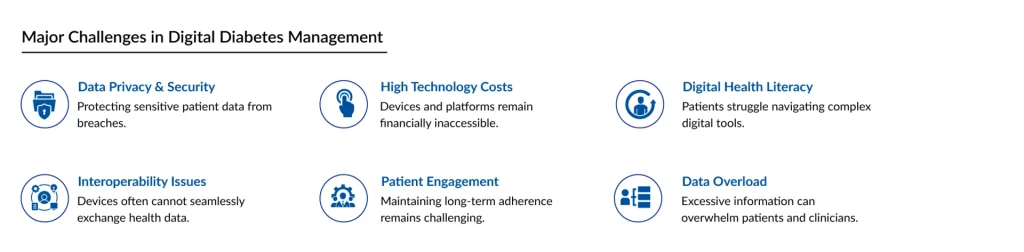
For all its promise, digital diabetes management isn’t a solved problem. Several real barriers stand between the technology’s potential and its equitable, effective use. Cost and reimbursement variability remains a significant challenge, as coverage for CGM and connected devices still varies considerably by country, insurer, and even diabetes type, leaving many patients, particularly those with type 2 diabetes who are not on insulin, paying out of pocket or going without these technologies. At the same time, data privacy and security concerns are growing as continuous streams of sensitive health data flow between sensors, apps, and cloud platforms, raising questions about how this information is stored, shared, and protected, particularly as more third-party platforms and AI systems become involved.
Digital literacy also remains an important barrier, as not every patient, especially older adults or those less comfortable with smartphone applications, finds it intuitive to interpret trend arrows, set alerts, or act on AI-generated recommendations without additional support. Interoperability between diabetes care devices and platforms presents another persistent challenge, with multiple CGM manufacturers, insulin pump makers, and third-party apps making seamless data exchange a continuing technical and business hurdle. Finally, the need for standardized clinical guidelines is becoming increasingly important as AI-driven predictions and recommendations become more common, with clinicians and regulators still working to establish consistent standards for validating, communicating, and integrating such guidance into clinical care.
On the regulatory side, the FDA’s clearance of OTC CGMs, from Dexcom’s Stelo to Abbott’s Lingo and Libre Rio, marks a significant shift toward broader consumer access, but it also raises new questions about appropriate use, labeling, and the line between a “wellness” device and a “medical” one. Ensuring equitable access, so that these tools reach lower-income patients and underserved regions, not just early adopters in high-income markets, remains one of the field’s most important open challenges.
Future Outlook
The trajectory of digital diabetes management points toward care that is increasingly proactive, preventive, and personalized, rather than reactive and generalized. Several developments are likely to define the next phase of the market, including continued advances in non-invasive glucose sensing, deeper AI integration, broader metabolic health applications, and more seamless device interoperability. Research into non-invasive glucose sensors that measure glucose without piercing the skin, using optical, radiofrequency, or other technologies, continues to advance and could eventually eliminate one of the last remaining friction points associated with continuous monitoring.
At the same time, AI is expected to become more deeply integrated into glucose management, with predictive algorithms moving beyond identifying patterns after they occur toward anticipating and helping prevent glucose excursions, medication-related issues, and potentially longer-term complications. As CGM adoption expands beyond insulin users to include non-insulin users and metabolically healthy individuals, the technology is also increasingly being positioned as a broader metabolic health tool, with applications spanning weight management and cardiovascular risk rather than diabetes alone. Finally, continued partnerships and platform integrations should enable more seamless interoperability, gradually reducing the fragmentation between CGMs, insulin delivery systems, and third-party coaching applications.
Taken together, these trends point toward a future where diabetes and metabolic health more broadly are managed continuously and intelligently, with data doing the heavy lifting that used to fall entirely on quarterly appointments and patient memory. The companies, clinicians, and platforms that get this integration right won’t just be treating diabetes more effectively; they’ll be redefining what preventive, personalized healthcare looks like at scale.

Downloads
Article in PDF
Recent Articles
- FDA Approves Simplera Sync™ Sensor for MiniMed™ 780G System; BVI Medical Secures FDA 510(k) Clear...
- The Rising Role of Biosensors in Modern Technology
- Intuitive’s da Vinci 5 Gets CE Mark; Boston Scientific’s FARAPULSE™ Secures Expanded FDA Approval...
- Notizia
- The Question That Remains Unanswered: What Might Be Causing Alzheimer’s?