Foot and Ankle Devices: Transforming Orthopedic Care Through Innovation
Mar 04, 2026
Table of Contents
The human foot and ankle constitute a complex mechanical structure containing 26 bones, 33 joints, and over 100 muscles, tendons, and ligaments. Given its role as the primary interface between the body and the ground, it is subject to immense biomechanical stress and a high incidence of pathology. Historically, foot and ankle surgery was often secondary to hip and knee orthopedics, but the last decade has seen a paradigm shift. Today, the foot and ankle device market is one of the most dynamic segments in healthcare, driven by a convergence of materials science, digital health, and surgical precision.
Technological Innovation as Market Engine
The rapid expansion of the foot and ankle market is not merely a result of an aging population but a direct consequence of technological breakthroughs that have redefined clinical outcomes. Innovation in this space is moving away from “one-size-fits-all” hardware toward intelligent, biological, and patient-specific systems.
Downloads
Click Here To Get the Article in PDF

Recent Articles
- Byondis’s HER2-targeting ADC trastuzumab duocarmazine; AbbVie Migraine Drug Atogepant; Grünenthal...
- Chemists may help solve the air-pollution health crisis
- Diabetes Care Devices: Transforming Management Through Innovation and Precision
- Commercial
- Human cells reprogrammed to create insulin in diabetic mice
The market engine is fueled by a desire to reduce surgical “revision rates”—historically high in foot and ankle procedures due to the complexity of the weight-bearing mechanics. Modern devices are now designed with advanced alloys, such as highly porous titanium, which mimics human bone structure (trabecular metal) to encourage faster osseointegration. Furthermore, the integration of digital ecosystems into the surgical workflow has transformed the operating room from a place of manual craftsmanship to one of high-tech engineering.
Patient-Specific Instrumentation and Precision Surgical Planning
One of the most significant leaps in foot and ankle care is the move toward Patient-Specific Instrumentation (PSI). In traditional surgery, surgeons rely on two-dimensional X-rays and standard cutting blocks to align implants. However, the unique anatomy of each patient’s hindfoot and midfoot often makes standard alignment difficult.
Precision surgical planning now begins weeks before the patient enters the operating room. Using high-resolution CT scans, engineers create three-dimensional models of the patient’s foot. Surgeons use specialized software to perform a “virtual surgery,” determining the exact size and orientation of implants. From these models, 3D-printed disposable cutting guides are manufactured specifically for that patient’s anatomy. This “GPS for surgery” ensures that bone cuts are accurate to the millimeter, significantly reducing operative time and improving the longevity of the joint replacement or deformity correction.
Minimally Invasive Surgical (MIS) Paradigm
The “Minimally Invasive” revolution has finally taken a firm hold in foot and ankle orthopedics. Traditionally, correcting a deformity like Hallux Valgus (bunions) required long incisions, significant soft-tissue disruption, and lengthy recovery periods.
The MIS paradigm utilizes specialized high-torque, low-speed burrs and micro-incisions (often only a few millimeters long). Through these tiny portals, surgeons can perform osteotomies and realignments under fluoroscopic guidance. The benefits for the patient are profound: reduced post-operative pain, minimal scarring, lower infection rates, and a much faster return to weight-bearing. This shift has necessitated a new generation of “low-profile” fixation devices, screws, and plates specifically designed to be inserted through small incisions without compromising structural stability.
Additive Manufacturing: From Customization to Clinical Standard
Additive manufacturing, or 3D printing, has transitioned from a niche experimental tool to a clinical standard in complex foot and ankle reconstruction. This technology is particularly transformative for limb salvage and large bone defects.
In cases of severe trauma or failed previous surgeries where significant bone loss has occurred, standard off-the-shelf implants are often insufficient. Additive manufacturing allows for the creation of custom titanium cages and spacers that fit perfectly into a patient’s unique defect. These 3D-printed structures are often designed with a lattice-like porosity that encourages the patient’s own bone cells to grow into the implant. This bio-integration is the “holy grail” of orthopedic fixation, turning a foreign object into a permanent part of the skeletal system.
Artificial Intelligence and Robotic-Assisted Systems
While robotics initially gained fame in hip and knee replacements, the complexity of the ankle joint has made it the next frontier. Artificial Intelligence (AI) is now being used to analyze gait patterns and predict surgical outcomes. AI algorithms can process thousands of patient data points to suggest the optimal implant position for a specific patient’s activity level.
Robotic-assisted systems provide a level of haptic feedback and precision that the human hand cannot achieve alone. In Total Ankle Replacement (TAR), robotic arms can ensure that the tibial and talar components are perfectly balanced throughout the entire range of motion. This reduces “edge loading”, a common cause of implant failure, and ensures that the artificial joint mimics the natural fluid movement of the human ankle.
Wearable Sensors and Digital Rehabilitation
The recovery phase is as critical as the surgery itself. The rise of “Smart Orthopedics” involves the integration of wearable sensors into the post-operative protocol. These devices, often attached to a walking boot or integrated into a shoe insert, track weight-bearing status, range of motion, and step counts in real-time.
This data is transmitted directly to the surgeon’s office via cloud-based platforms. If a patient is putting too much weight on a healing fracture too early, or if their activity level drops significantly (indicating potential pain or infection), the clinical team can intervene immediately. This “Digital Rehabilitation” creates a continuous loop of care, moving away from the traditional model of waiting for a six-week follow-up appointment to check progress.
Clinical Applications of Foot and Ankle Devices
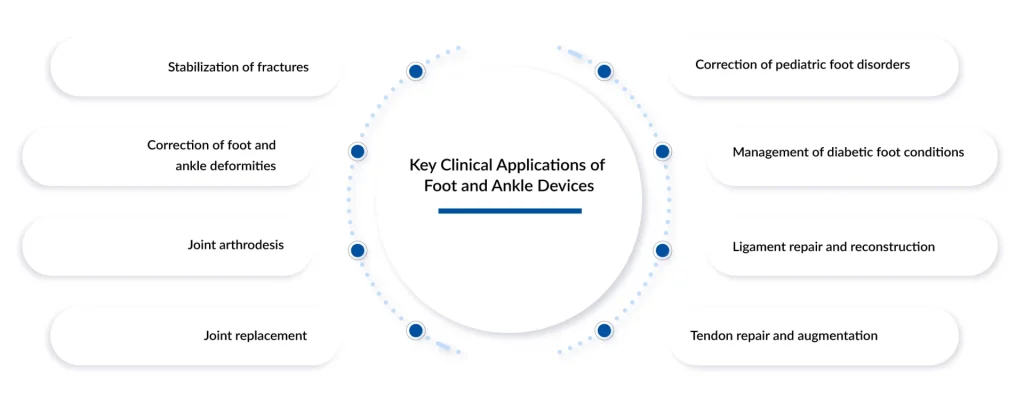
Clinical applications of foot and ankle devices span a wide range of orthopedic, rehabilitative, and biomechanical needs. Some of the key applications of foot and ankle devices are:
Trauma and Fracture Management
The foot and ankle are frequently subject to high-energy trauma, from car accidents to sports injuries. Modern trauma devices focus on “anatomical contouring.” Plates are now pre-shaped to fit the specific curves of the calcaneus or the distal tibia. This reduces the need for surgeons to bend plates manually during surgery, which can weaken the metal. Furthermore, the development of “Variable Angle Locking” technology allows screws to be angled into the best quality bone while still locking into the plate for rigid stability.
Degenerative Joint Disease and Arthroplasty
Ankle arthritis can be more debilitating than hip or knee arthritis because the ankle joint bears more weight per square centimeter than any other joint in the body. Total Ankle Replacement (TAR) has seen a massive resurgence. Third and fourth-generation implants are now designed with “mobile-bearing” or “fixed-bearing” options that better replicate the sliding and rolling motion of the talus, offering patients a viable alternative to ankle fusion.
Diabetic Foot Disease
The global rise in diabetes has led to an increase in Charcot neuroarthropathy and diabetic foot ulcers. Devices in this space focus on “off-loading” and stabilization. Circular external fixators (large metal frames outside the leg) are used to gradually correct deformities and allow for bone healing in patients with poor vascularity. Additionally, bioactive glass and advanced bone graft substitutes are used to fight infection and promote healing in immunocompromised patients.
Hallux Valgus and Forefoot Pathology
Forefoot surgery has evolved from simple bone shaving to complex “triplanar” corrections. Devices like the Lapiplasty system have revolutionized bunion surgery by treating the deformity at its source, the unstable joint in the midfoot. By rotating the bone back into its natural position and securing it with multi-planar plating, the recurrence rate of bunions has dropped significantly.
Foot and Ankle Devices: Market Outlook and Competitive Landscape
According to a comprehensive analysis by DelveInsight, the global foot and ankle devices market is witnessing significant growth, driven by an increasing prevalence of orthopedic disorders and technological advancements. The market was valued at USD 5.94 billion in 2024 and is projected to reach approximately USD 9.26 billion by 2032, expanding at a CAGR of 7.69% during the forecast period from 2025 to 2032. The market is categorized into various segments, including orthopedic implants (such as joint replacement implants and internal fixation devices), prosthetics, and orthotics.
The competitive landscape is characterized by intense innovation as key players, including DePuy Synthes (Johnson and Johnson), Stryker, Zimmer Biomet, Smith and Nephew, Medartis AG, Acumed, Orthofix Medical Inc., CONMED Corporation, College Park Industries, OsteoMed, Roadrunnerfoot Engineering srl., OTTOBOCK, Advanced Orthopaedic Solutions, Paragon 28 Inc., MedShape Inc., Allard USA Inc., Fillauer LLC, Corin Group, JEIL MEDICAL CORPORATION, Globus Medical, and others, strive to integrate digital technologies and advanced materials into their portfolios. The DelveInsight report highlights that the rising geriatric population, coupled with a surge in sports-related injuries and the high incidence of diabetes-related foot complications, acts as a primary catalyst for market expansion. For instance, in regions like Africa, the prevalence of diabetic foot ulcers ranges from 10.0% to 30.0%, while lower limb amputations vary between 3.0% and 35.0%. Furthermore, the shift toward outpatient and ambulatory surgery centers is influencing the design of devices to be more “procedure-efficient,” allowing for quicker turnover and faster patient discharge.
Emerging Trends and Future Directions
The future of foot and ankle care is increasingly shaped by regulatory oversight and government-backed research initiatives. One of the most critical trends is the push for standardized clinical data and long-term registries.
Governmental health bodies, such as the FDA, are increasingly focusing on the safety and efficacy of 3D-printed implants. The FDA has provided specific guidance for the industry on “Technical Considerations for Additive Manufactured Medical Devices,” ensuring that, as customization becomes the norm, quality control remains paramount.
Furthermore, the National Institutes of Health (NIH) is funding research into “Smart Bandages” and regenerative medicine. These initiatives aim to combine traditional orthopedic fixation with biological cues, such as growth factors or stem cells, to speed up the healing of chronic wounds and non-union fractures.
Looking ahead, the integration of “Bio-resorbable” materials is a major area of government-supported innovation. The goal is to develop plates and screws that provide rigid stability for six months and then slowly dissolve into the body, eliminating the need for a second surgery to remove painful hardware.

Downloads
Article in PDF
Recent Articles
- Intellia’s Quest with CRISPR; Innovent, Synaffix ADC Tech Deal; Lilly’s Diabetes Bloc...
- Immutep’ First-Line Treatment Positive Outcomes; Pfizer’s Once-Daily Oral GLP-1 Agonist Danuglipr...
- Evolution in Diabetes Management
- Bayer’s CKD Drug; Enochian’s RNA Hijack for HBV; Novo Nordisk’s to get Prothena’...
- Can Cannabinoids be an Effective Medicinal Substance?