Microfluidics: The Tiny Technology Powering the Future of Diagnostics and Life Sciences
Oct 07, 2026
Table of Contents
Imagine running an entire laboratory on a device the size of a postage stamp. A drop of blood goes in, and minutes later a result comes out, with no centrifuge, no bench full of pipettes and no technician in sight. That is the promise of microfluidics, a field that is quietly reshaping medicine, drug development and environmental science.
What Is Microfluidics? A Plain-English Guide to Lab-on-a-Chip Technology
Microfluidics is the science and technology of controlling extremely small volumes of liquid, typically microliters down to picoliters, inside channels that are often thinner than a human hair. Think of it as plumbing for the microscopic world. Tiny channels, valves, pumps and mixers are etched, molded or printed onto a chip made of glass, silicon, polymer or paper. Fluids move through that chip in a precisely controlled way, so reactions, separations and measurements can all happen in one miniature system. You may also hear the terms lab-on-a-chip (a full laboratory workflow on one device) and micro total analysis systems (µTAS). They are close cousins of microfluidics.
Downloads
Click Here To Get the Article in PDF

Recent Articles
Microfluidics vs. Conventional Fluid Handling: What Changes at Small Scale?
In a traditional laboratory, liquids are handled using pipettes, beakers, tubes, and large pumps, with each step requiring dedicated space, reagents, and hands-on time. At the microscale, however, the governing physical principles change significantly. Laminar flow dominates, causing fluids to move in smooth, parallel layers rather than turbulent, chaotic patterns, making fluid movement predictable and easier to model. Surface effects also become more important, with surface tension, capillary action, and viscosity playing a much greater role than gravity or inertia. Because the distances are extremely short, diffusion occurs rapidly, allowing molecules to move across tiny channels quickly and enabling efficient mixing and reactions. Microscale systems also operate with very small volumes, often using only a few microliters instead of milliliters of reagents, which helps reduce costs and minimize waste. In addition, multiple laboratory functions, including mixing, heating, filtering, and detection, can be integrated onto a single chip rather than requiring separate instruments, making microscale systems compact, efficient, and highly integrated.
Why Microfluidics Matters in Modern Science and Engineering
Microfluidics sits where several of today’s biggest goals meet: faster diagnosis, cheaper experiments, decentralized testing and more human-relevant research models. It blends chemistry, biology, physics, materials science and electronics, and it gives scientists fine control over the chemical and cellular environment at the scale where biology actually works. The payoff is technology that can move testing out of the central lab and into clinics, homes, farms and field sites.
Major Applications: Where Microfluidics Is Making a Real Difference
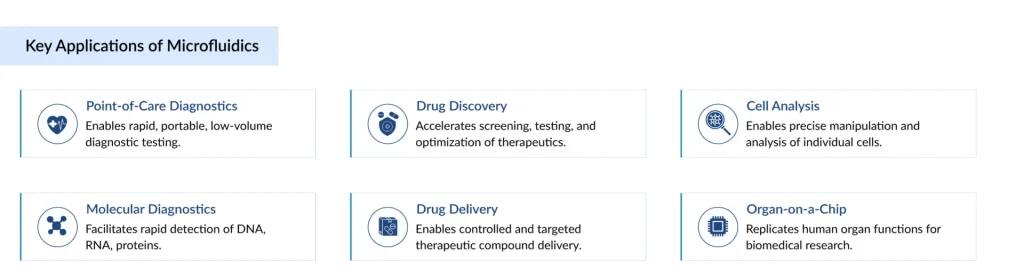
Microfluidics is no longer confined to research benches. Its ability to handle tiny volumes with high precision has made it valuable wherever speed, cost and sample size matter. From a clinic waiting room to a pharmaceutical lab, chip-based systems are replacing bulky equipment with compact, automated alternatives. They also open doors that conventional methods could not, such as modeling human organs on a chip. Here are the major areas where the technology is already delivering value.
Medical Diagnostics and Point-of-Care Testing
This is the best-known use of microfluidics. Cartridge-based molecular tests, blood analyzers and rapid immunoassays use microfluidic channels to prepare a sample, run the reaction and read the result inside one disposable device. Because they need little sample and minimal training, they suit clinics, emergency rooms, pharmacies and remote settings. Infectious disease panels and respiratory tests are well-known examples, and diagnostics is widely reported as the largest application area of the field.
Beyond speed, microfluidic diagnostics help address access gaps. A test that runs on a few drops of blood without a full laboratory can reach rural clinics, community health centers and even home settings. This decentralized model supports faster clinical decisions, since a patient can be assessed and treated in a single visit rather than waiting for results from a distant lab.
Research is also pushing the format further, with paper-based chips, smartphone-linked readers and multiplexed cartridges that check for several markers at once. The main task now is proving that these compact tests match the accuracy of central-lab methods across diverse patient groups.
Drug Discovery and Pharmaceutical Research
Pharma teams use microfluidics for high-throughput screening with far less compound and reagent. Droplet-based systems turn each tiny drop into its own miniature test tube, enabling thousands of reactions or single-cell assays in a short time. Microfluidic mixing is also used to make nanoparticles and lipid-based drug carriers with controlled size, while continuous-flow chip reactors support small-scale chemical synthesis.
Early drug discovery is a numbers game: thousands of candidates must be tested to find the few worth pursuing. By shrinking each experiment to nanoliter or picoliter volumes, microfluidics helps teams test more conditions with less material, which matters when a compound is scarce or expensive to make.
The technology also supports more realistic testing. Chip-based cell culture and gradient generators let scientists expose cells to controlled drug concentrations over time, giving richer data than a single static dose in a well plate.
Cell Biology, Tissue Engineering and Organ-on-a-Chip Systems
Cells in a flat plastic dish do not behave like cells in the body. Organ-on-a-chip devices address this by culturing living cells in microchannels that mimic features such as fluid flow, mechanical stretch and tissue interfaces. Researchers use them to model organs such as the lung, liver, gut and kidney, to study disease, and to test drug safety and efficacy. In tissue engineering, microfluidic channels help deliver nutrients and guide cell growth. Growing regulatory openness to non-animal approaches in drug development adds to the interest.
Because these chips recreate the physical cues cells experience in the body, they can reveal responses that standard cultures miss, such as how a barrier tissue reacts to inflammation or how a drug is processed by liver-like cells. Linking several organ chips together is an active research goal, aimed at studying how a drug affects the body as a connected system.
Organ-on-a-chip is still maturing. Questions about long-term stability, scalability and validation against clinical outcomes remain, but the approach is increasingly seen as a complement to animal studies and traditional cell culture.
Chemical Analysis and Environmental Monitoring
Microfluidic sensors can detect pollutants, heavy metals, nutrients and pathogens in water or air from just a few drops of sample. Compact, low-power chips suit on-site, near-real-time monitoring. In analytical chemistry, microscale separations and reactions deliver fast results with minimal solvent, which also supports greener lab practice.
For environmental teams, the appeal is bringing the lab to the sample. Instead of collecting water from a river or industrial site and shipping it for days, portable microfluidic analyzers can screen on the spot and flag problems early. Combined with low-cost sensors, they could support wider, more frequent monitoring than central labs alone can offer.
The same miniaturization benefits industrial chemistry. Microreactors give tight control over temperature and mixing, which can make reactions safer and more reproducible, particularly for hazardous or fast reactions.
Food Safety, Biotechnology and Personalized Medicine
In food safety, portable chips can screen for bacteria, allergens, toxins or adulterants at the production line instead of waiting days for lab results. In biotechnology, microfluidics powers single-cell sequencing, digital PCR, cell sorting and strain screening. In personalized medicine, it supports tests on small patient samples, such as tumor cells or liquid biopsies, and patient-derived chip models that may one day help match treatments to individuals.
Single-cell tools are a good example of microfluidics at work in biotechnology. By isolating individual cells in tiny chambers or droplets, researchers can study differences between cells that would be hidden in a bulk average, which is central to cancer biology, immunology and developmental research.
For personalized medicine, the goal is to match the right treatment to the right patient using small samples. Microfluidic platforms that capture rare circulating cells or culture patient-derived tissue are being explored for this purpose, although most remain in research or early clinical evaluation.
The Big Wins and the Real Hurdles: Advantages and Limitations of Microfluidics
Microfluidics offer a major advantage by allowing scientists to manipulate extremely small volumes of fluids, often in the microliter to picoliter range, within compact channels and devices. This dramatically reduces the consumption of reagents, samples, and solvents, lowering experimental costs and minimizing waste. Because reactions take place in tiny volumes, mixing, heat transfer, and reaction times can also be highly controlled. These features make microfluidic platforms particularly attractive for applications such as drug discovery, molecular diagnostics, cell analysis, and point-of-care testing, where speed, sensitivity, and efficient use of samples are critical.
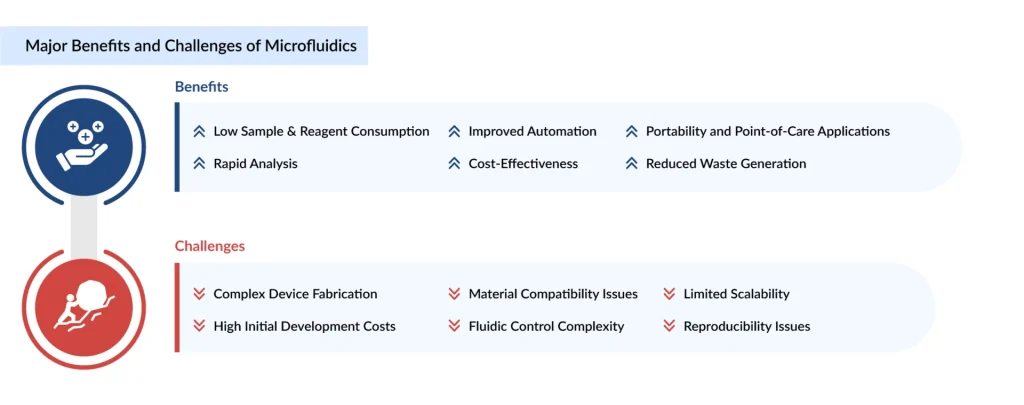
Another significant benefit is the ability to integrate multiple laboratory functions onto a single platform. A microfluidic device can combine sample preparation, mixing, reaction, separation, detection, and analysis within one compact system, creating what is often described as a “lab-on-a-chip.” Automation and precise fluid control can reduce manual intervention and improve reproducibility, while parallelization allows many experiments to be performed simultaneously. Microfluidics can also support real-time monitoring and rapid analysis, opening opportunities for personalized medicine, high-throughput screening, single-cell studies, and decentralized diagnostics.
Despite these advantages, microfluidics is not without challenges. Fabricating complex devices can require specialized materials, equipment, and manufacturing techniques, particularly when channels must incorporate valves, sensors, electrodes, or other functional components. Surface properties can strongly influence fluid behavior, creating problems such as unwanted adsorption, clogging, bubble formation, and nonspecific interactions. Handling biological samples can be especially difficult because cells, proteins, and other particles may behave differently at small scales. In addition, transferring an established laboratory method to a microscale environment is not always straightforward, as processes optimized for conventional volumes may require substantial redesign.
Scalability, standardization, and integration also remain important hurdles before microfluidics can achieve broader adoption. A device that performs reliably under controlled laboratory conditions may face difficulties when exposed to variable clinical samples, environmental conditions, or large-scale manufacturing requirements. Connecting microfluidic systems with conventional laboratory equipment can add complexity and cost, while differences between platforms can make standardization challenging. Thus, the promise of microfluidics lies not simply in making laboratory systems smaller, but in using microscale physics to make them faster, more efficient, automated, and precise, while overcoming the engineering and practical barriers required to translate these benefits into robust, widely deployable technologies.
When Algorithms Meet Channels: How AI Is Supercharging Microfluidics
Artificial intelligence is emerging as a natural partner for microfluidics, as both technologies address complex, data-rich systems that can be difficult to optimize manually. Researchers are increasingly exploring AI to enhance microfluidic design, operation, analysis, and quality control. Machine learning models can predict how different channel layouts and configurations are likely to perform, helping accelerate design and testing cycles that traditionally depend on trial and error. AI is also being applied to droplet and flow control, where algorithms can predict droplet size, monitor fluid behavior in real time, and automatically adjust pressures or flow rates to maintain consistent operating conditions. In addition, computer vision is enabling image-based analysis and sorting by identifying and classifying cells or droplets as they move through a detection area, supporting automated, potentially label-free screening and sorting processes.
AI-based systems can further contribute to quality control and fault detection by identifying early signs of clogs, bubbles, flow instability, or system drift, potentially improving the reproducibility and reliability of microfluidic experiments. Beyond device operation, AI can help interpret the large and complex datasets generated by applications such as single-cell analysis and organ-on-a-chip research, allowing researchers to identify patterns and extract meaningful biological insights more efficiently. Although many of these applications remain at the research or early-adoption stage and depend heavily on access to high-quality, well-labeled datasets, the overall direction is becoming increasingly clear: microfluidic platforms generate substantial amounts of complex data, while AI provides the analytical capabilities needed to transform that data into actionable decisions and more efficient experimental outcomes.
The Road Ahead: Future Outlook for Microfluidics
The global microfluidics market was valued at approximately USD 35.00 billion in 2025 and is projected to reach USD 105.14 billion by 2034. The market is anticipated to grow at a CAGR of 13.0% during 2026–2034, driven by increasing demand for point-of-care diagnostics, the expanding adoption of personalized medicine, the growing use of organ-on-chip platforms, and ongoing advances in microfabrication technologies and materials.
By technology, the lab-on-a-chip segment accounted for the largest share of the microfluidics market, representing approximately 38% of the market in 2025. North America led the global market with a modeled 40% share in 2025, supported by its advanced healthcare and research infrastructure, widespread adoption of point-of-care diagnostics and emerging technologies, substantial investments in research and development, a supportive regulatory landscape for organ-on-chip technologies and alternatives to animal testing, and the presence of major industry participants. Meanwhile, Asia-Pacific is expected to register the fastest CAGR through 2034, fueled by its large population base, rapid development of healthcare and diagnostic infrastructure, rising demand for point-of-care testing, expansion of the life sciences and biotechnology sectors, and increasing government support across China, Japan, India, and South Korea.
The global microfluidics market is moderately concentrated, with Danaher Corporation serving as the leading participant and accounting for more than 10% of the market. Other major companies include Illumina, Inc., Thermo Fisher Scientific Inc., Revvity, Inc., and Agilent Technologies, Inc., with these companies collectively accounting for more than one-third of the market together with Danaher. Other prominent players include F. Hoffmann-La Roche Ltd., Bio-Rad Laboratories, Inc., Abbott Laboratories, Standard BioTools Inc., and bioMérieux SA. The competitive landscape also includes IDEX Corporation, Parker Hannifin Corporation, Fluigent SA, 10x Genomics, Inc., Emulate, Inc., and CN Bio Innovations Ltd.
Looking ahead, several research and development directions could shape the next phase of microfluidics innovation. One major area is the development of more human-relevant models, including multi-organ chips and patient-derived tissue models that can improve the predictive value of drug testing and disease research. At the device level, researchers are increasingly working toward fully integrated platforms capable of performing sample preparation, amplification, and detection on a single chip without relying heavily on external equipment. Wearable microfluidic technologies also represent a promising opportunity, particularly for the continuous collection and analysis of biological fluids such as sweat.
At the same time, advances in manufacturing, including injection molding, 3D printing, and other scalable production techniques, could help reduce costs, improve reproducibility, and support broader commercialization. The establishment of common standards, validation procedures, and performance benchmarks will also be important for making microfluidic results more consistent and comparable across laboratories and applications. Another emerging direction is the integration of artificial intelligence with microfluidic platforms to create closed-loop systems capable of sensing conditions, analyzing data, and automatically adjusting operating parameters in real time.
Overall, microfluidics is transforming the simple principle of doing more with less into a versatile technology platform with applications spanning diagnostics, drug development, genomics, environmental monitoring, and other areas. Although challenges related to manufacturing scalability, standardization, integration, reliability, and commercialization remain, the technology continues to gain momentum. As manufacturing processes mature, common standards become more established, and AI-enabled capabilities advance, microfluidics is increasingly positioned to move beyond specialized research laboratories and become a more routine component of healthcare, biotechnology, and industrial applications.

Downloads
Article in PDF
Recent Articles
- Allumiqs and Prolytix’s Partnership; Setpoint Medical’s Neuroimmune Modulation Platform get...
- Digital Twin Technology – Assessing the Growing Role and Its Evolving Applications in Healt...
- Automated Organoid Culturing: Transforming the Future of Biomedical Research and Drug Discovery
- Evaluating the Key Trends and Developments in the Global Next-Generation Sequencing Market
- Molecular Modelling: The Silent Powerhouse Reshaping Drug Discovery, Development, and Competitive...