Cell and Gene Therapy Manufacturing: Engineering the Future of Medicine
May 27, 2026
Table of Contents
Once confined to the realm of theoretical science fiction, cell and gene therapies (CGTs) have crossed decisively into clinical and commercial reality. In less than a decade, the world has witnessed landmark approvals, from the first CAR-T cell therapies for blood cancers to gene therapies restoring vision in patients with inherited retinal dystrophies, and most recently, gene-editing platforms that offer potentially curative single-dose interventions for conditions like sickle cell disease. Regulators have been keeping pace: the FDA and EMA together have approved over 30 CGT products, with the annual approval cadence accelerating from one or two per year in the early 2010s to nearly a double-digit pace today.
Yet the very brilliance of these therapies is also their manufacturing paradox. Unlike a conventional pill manufactured by the billions in identical batches, cell and gene therapies are often patient-specific, biologics-intensive, and extraordinarily complex to produce at scale. The cost burden tells this story vividly: HEMGENIX (hemophilia B gene therapy) was priced at $3.5 million per patient upon its 2022 approval, while ZOLGENSMA for spinal muscular atrophy remains one of the most expensive medicines ever approved at $2.1 million per dose. Bluebird Bio’s betibeglogene (ZYNTEGLO) launched at approximately $2.8 million. These staggering price tags are not simply profit-driven; they reflect the immense scientific, regulatory, and manufacturing investment required to deliver a living medicine reliably, safely, and at scale.
Downloads
Click Here To Get the Article in PDF

Recent Articles
- Piramal buys; Abbott Buys Glomed; Merck Divesting; Takeda set to sell; Teva gets clearance
- BMS Sells NY Biologics Plant; FDA Approves Mitsubishi Tanabe’s Radicava, Love Pharma Acquires Mic...
- Gene Therapy in Rare Disorders: Acceptance in Europe Faces Challenges
- Notizia
- The promising Pipeline for Gene Therapy In Oncology
For patients, the burden extends beyond cost. Treatment typically requires multi-step journeys: apheresis at specialized collection centers, weeks-long manufacturing cycles, conditioning chemotherapy, infusion at certified hospitals, and intensive follow-up care. For autologous cell therapies, a manufacturing failure or contamination can mean running out of time for a critically ill patient. These realities make manufacturing infrastructure not just an operational concern, but a patient-outcomes imperative. Across the industry, manufacturers, CDMOs, regulators, and investors are converging on a singular challenge: how do you make the most complex medicines in human history, at cost, at speed, and at scale?
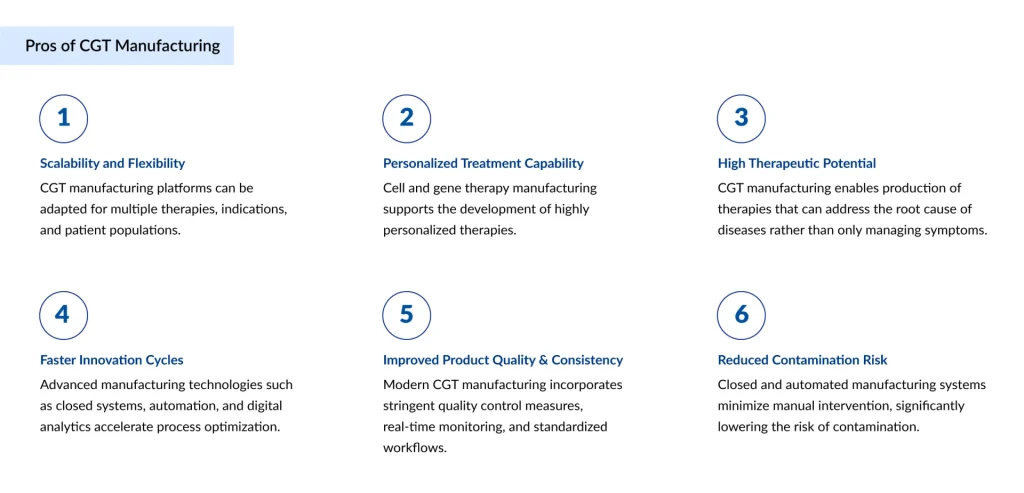
Technologies Driving CGT Manufacturing
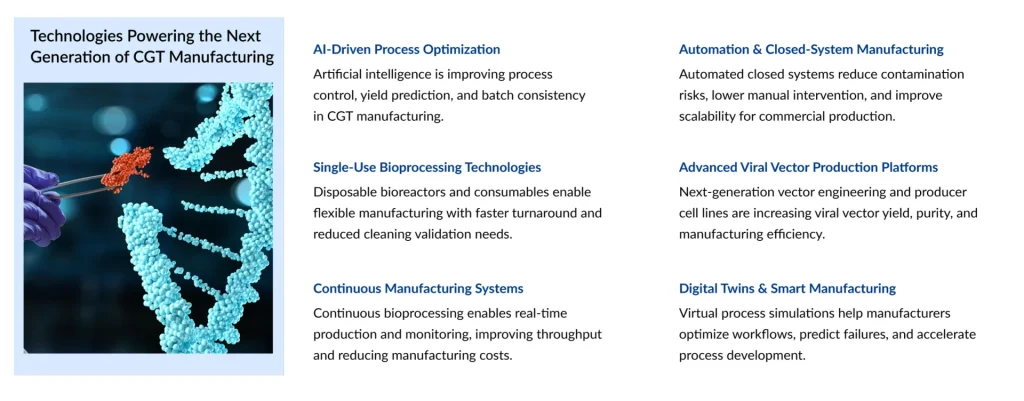
Viral vector manufacturing is central to the CGT ecosystem, as vectors deliver corrective genetic material into target cells. Manufacturing lentiviral vectors (LVVs) and adeno-associated viruses (AAVs) requires complex upstream production in mammalian cell lines and multi-step purification processes to meet clinical quality standards. LVVs, widely used in CAR-T and HSC therapies, face scalability and batch variability challenges, prompting investment in stable producer cell lines and perfusion systems. AAV manufacturing also struggles with low vector yields and the difficulty of separating full from empty capsids at commercial scale.
Non-viral delivery systems are emerging as a major shift in CGT manufacturing. Lipid nanoparticles (LNPs), initially popularized by mRNA vaccines, are now being adapted for CRISPR and genome-editing payloads, while electroporation supports efficient ex vivo editing of T cells and stem cells. These approaches offer more scalable manufacturing but introduce challenges in formulation, stability, and targeted delivery. Closed-system bioprocessing has become essential for modern CGT manufacturing, reducing contamination risks and simplifying cleanroom operations. Automated cell processing platforms further improve consistency by minimizing human intervention, particularly important for autologous therapies where individual patient batches cannot be replaced.
Single-use bioreactors (SUBs) have transformed CGT production economics by replacing traditional stainless-steel systems with disposable, pre-sterilized bioprocessing bags. This reduces turnaround time, lowers contamination risk, and enables flexible multi-product manufacturing, making SUBs highly valuable for CDMOs handling numerous client programs. Cryopreservation technologies are critical for maintaining the viability of living cell therapies across global supply chains. Advanced cold-chain systems combine ultra-low temperature storage, controlled-rate freezing, optimized cryoprotectants, and validated thawing protocols to ensure safe transport and delivery of patient-specific therapies worldwide.
Digital twin technology is also gaining traction in CGT manufacturing. These computational models simulate manufacturing processes such as cell culture and vector production, enabling manufacturers to predict failures, optimize parameters, and reduce costly development runs. Early adoption is already improving process development timelines and operational efficiency.
The CDMO Ecosystem
The complexity and capital intensity of CGT manufacturing have made contract development and manufacturing organizations (CDMOs) not merely convenient but structurally essential to the industry. Most emerging therapy developers, and even many large biopharma companies, lack the specialized facilities, expertise, and regulatory track record to manufacture viral vectors or advanced cell therapies in-house at commercial scale. The demand for specialized CGT CDMOs has consequently surged, fueled by an explosion of clinical-stage programs, with over 3,500 active trials, each requiring manufacturing services across IND-enabling studies, Phase I safety, late-phase scale-up, and commercial launch.
Outsourcing trends in CGT are more nuanced than in traditional biologics. While large pharma may retain certain platform-specific manufacturing in-house (Novartis’s CAR-T manufacturing for KYMRIAH, for example), the majority of small and mid-size therapy developers outsource all or most manufacturing activity, creating a robust and rapidly expanding CDMO demand base. There is also a growing trend of hybrid models: therapy developers building limited internal manufacturing capability for early clinical material while outsourcing commercial-scale production. CDMOs are responding by offering increasingly integrated end-to-end services, from plasmid production and vector manufacturing to fill-finish, QC testing, and cryoshipment logistics, reducing the coordination burden on therapy developers managing multiple manufacturing partners.
Geographically, regional manufacturing hubs are crystallizing with distinct specializations and policy tailwinds driving investment. The United States, the dominant hub, is home to the largest concentration of CGT CDMOs, FDA-aligned GMP infrastructure, and the deepest pool of cell and gene therapy manufacturing talent. Philadelphia, Boston, and the Research Triangle are epicenters.
Europe, the UK, Germany, and Belgium lead with strong academic-to-commercial pipelines. EMA’s ATMP framework has shaped specialized GMP practices. Miltenyi (DE), Cobra Biologics (UK), and OXB (UK) are key players. On the other hand, rapidly emerging China, Japan, and South Korea are investing heavily in domestic CGT manufacturing. China’s NMPA streamlining and South Korea’s K-BIO initiative are accelerating local CDMO capacity growth.
Competitive Landscape Insights
The competitive landscape in CGT manufacturing is a three-front race: commercial therapy developers building and protecting manufacturing moats, established CDMOs racing to expand specialized capacity, and technology innovators disrupting the production model entirely. Novartis, the pioneer of commercial CAR-T with Kymriah, has invested over $1 billion in its internal cell therapy manufacturing network, including a dedicated facility in Morris Plains, New Jersey, while simultaneously managing manufacturing partnerships to support global supply.
Gilead Sciences (Kite Pharma) has taken a similarly vertically integrated stance, building out its own manufacturing sites in El Segundo, California, and Hoofddorp, Netherlands, to support Yescarta and Tecartus. Bristol Myers Squibb, following its landmark acquisition of Juno Therapeutics and Celgene, now operates one of the most extensive commercial CAR-T manufacturing operations in the world, with facilities across the US and Europe supporting BREYANZI and ABECMA. These therapy developers are not simply building manufacturing sites; they are constructing differentiated operational capabilities that serve as durable competitive advantages, given how difficult it is for a competitor to replicate a validated, scaled, GMP-compliant CGT production system.
On the CDMO side, the capacity race is fierce and capital-intensive. Lonza has invested billions over the past five years in viral vector and cell therapy manufacturing, establishing dedicated CGT facilities in Houston, Texas, and expanding its Visp, Switzerland, campus for AAV production. Its acquisition of Synaffix for antibody-drug conjugate capabilities and its partnership investments in gene therapy platforms signal a strategy of broad platform coverage.
Catalent, before its acquisition by Novo Holdings in 2024, had similarly made transformative moves, purchasing Masthercell and MaSTherCell to establish cell therapy CDMO capabilities, and expanding in Maryland and Brussels for viral vector production. Thermo Fisher Scientific, through its acquisition of Brammer Bio for $1.7 billion, cemented its position as a leading viral vector CDMO and continues to expand its CGT service portfolio under the Patheon brand. These moves reflect a broader consolidation dynamic: generalist CDMOs are acquiring specialized CGT capabilities rather than building them from scratch, compressing timelines but raising integration challenges.
The emerging manufacturing technology innovators represent a genuinely disruptive layer of the competitive landscape, one that DelveInsight tracks closely for its implications on future manufacturing economics. Companies like Cellares (with its “Cell Shuttle” fully automated, integrated cell therapy manufacturing platform), Ori Biotech (reimagining bioreactor design specifically for T cell expansion), and Multiply Labs (applying robotic automation to individualized cell therapy manufacturing) are challenging the assumption that CGT manufacturing must be slow, manual, and expensive.
If these platforms succeed at scale, they could compress manufacturing timelines from weeks to days, dramatically reduce per-patient costs, and enable decentralized manufacturing closer to the point of care, fundamentally reshaping the competitive dynamics for both CDMOs and therapy developers. Partnership activity is accelerating: Cellares has announced multi-year agreements with Arcellx, Shoreline Biosciences, and others, while established CDMOs are taking minority stakes or signing technology access agreements with these innovators to future-proof their service offerings.
Role of AI in CGT Manufacturing
Artificial intelligence (AI) is rapidly transforming cell and gene therapy manufacturing by improving process efficiency, product consistency, and scalability across the production workflow. CGT manufacturing is inherently complex, involving highly sensitive biological materials, multi-step processing, and stringent quality requirements. AI-driven platforms can analyze large volumes of manufacturing and process data in real time, enabling predictive analytics, process optimization, and early detection of deviations. Machine learning algorithms are increasingly being used to optimize upstream parameters such as cell culture conditions, transfection efficiency, vector yield, and media composition, thereby reducing batch failures and improving overall productivity.
In downstream processing and quality control, AI is playing a critical role in automating data interpretation and ensuring compliance with regulatory standards. Advanced analytics and computer vision technologies can monitor cell morphology, viability, and contamination risks with greater accuracy than traditional manual methods. AI-enabled digital twins and predictive maintenance tools are also helping manufacturers simulate production environments, anticipate equipment failures, and minimize operational downtime. This is particularly valuable in viral vector manufacturing, where production costs are high and manufacturing timelines are lengthy.
Beyond operational efficiencies, AI is expected to support the long-term commercialization and scalability of CGTs by enabling smarter supply chain management, demand forecasting, and personalized manufacturing approaches. As autologous therapies require patient-specific production, AI-based scheduling and logistics tools can streamline vein-to-vein workflows and improve turnaround times. With increasing investments from biopharma companies and CDMOs, AI integration is emerging as a strategic enabler for accelerating CGT development while reducing manufacturing complexity and costs.
Future Outlook of CGT Manufacturing
The next decade in cell and gene therapy manufacturing will not merely be an incremental improvement on today’s methods; it will be a fundamental reinvention of how living medicines are made, moved, and made accessible. Three powerful forces are converging: the maturation of manufacturing science, the digitization of bioprocessing, and the democratization of production economics.
Process intensification will deliver the first breakthrough. Continuous manufacturing, perfusion bioreactors, and real-time process analytics will replace today’s batch-by-batch approach with flowing, monitored, adaptive production systems. The vision of a fully continuous viral vector production line, from transfection through purification to fill-finish, is no longer theoretical; multiple academic and industry groups are within sight of proving it at GMP scale. When that inflection arrives, the cost-per-dose economics of gene therapy will begin to look, for the first time, like something that health systems outside the wealthiest nations might reasonably absorb.
Decentralized and point-of-care manufacturing represents the most radical frontier. If the robotic, closed, and miniaturized manufacturing platforms currently in development prove reliable at the clinical scale, the era of shipping a patient’s cells across continents for weeks of manufacturing may give way to hospital-adjacent “manufacturing pods” that produce individualized therapies on-site in days. This would collapse cold-chain complexity, eliminate courier-related risks, and bring autologous cell therapies within reach of patients in emerging markets for the first time. Some visionaries in the field describe this as the “pharmacy of the future”, a hospital unit where a nurse enrolls a patient, a robotic system handles collection and manufacturing, and an infusion is ready within the week.
Underpinning all of this will be the full integration of artificial intelligence into manufacturing intelligence, from AI-driven process optimization and predictive quality systems to digital twins that learn from every batch across every facility in a global network. The manufacturers who build these data assets now, who wire their GMP facilities for real-time sensing and model-driven control, will hold structural advantages in a market that rewards speed, consistency, and cost efficiency above all else. The race to define the manufacturing architecture of the next generation of medicine is underway, and for the companies, CDMOs, and innovators who move with urgency and precision, the prize is nothing less than the operating system of 21st-century therapeutics.

Downloads
Article in PDF
Recent Articles
- Gene Therapy in Rare Disorders: Acceptance in Europe Faces Challenges
- Notizia
- Piramal buys; Abbott Buys Glomed; Merck Divesting; Takeda set to sell; Teva gets clearance
- Cambrex acquires Avista; Sobi pays $50M; LEO Pharma signs deal; Boston Scientific remunerates
- Utepreva Announces FDA 510(k) Clearance for Endometrial Sampler Aimed at Early Cancer Detection; ...