DNA Diagnostics: Transforming Precision Medicine and Redefining Disease Detection
Jul 01, 2026
Table of Contents
DNA diagnostics is no longer a niche laboratory technique reserved for research institutions, it has become one of the fastest-growing pillars of modern medicine. By analyzing genetic material to detect mutations, pathogens, and chromosomal abnormalities, DNA-based testing is transforming how diseases are predicted, diagnosed, and treated, often years before symptoms ever appear. The numbers tell a compelling story. The global DNA diagnostics market, valued at roughly USD 13 billion in 2025, and is projected to more than double over the next decade. Adoption has scaled dramatically too, DNA diagnostic testing volumes are estimated to have crossed hundreds of billions of tests globally in 2025 alone, spanning oncology, infectious disease, prenatal screening, and genetic disorder testing. PCR-based diagnostics continue to hold the largest share of the technology landscape, while next-generation sequencing (NGS) is consistently flagged as the fastest-growing segment, fueled by falling sequencing costs, portable devices, and expanding clinical use cases.
This rapid evolution reflects a broader shift in healthcare philosophy, from reactive treatment to predictive, personalized, and preventive care. Hospitals, diagnostic laboratories, and even direct-to-consumer platforms are now embedding genetic insight into everyday clinical decision-making, whether it’s selecting a cancer therapy based on a tumor’s genomic profile, screening a newborn for inherited disorders, or identifying a drug-resistant pathogen within hours instead of days. DNA diagnostics is, in effect, rewriting the rulebook for how medicine identifies risk and responds to it.
Downloads
Click Here To Get the Article in PDF

Recent Articles
- Promising Nephrotic Syndrome Treatments: A Look into the Future
- Polymerase Chain Reaction (PCR) Market: Evaluating the Major Market Dynamics and Key Trends Drivi...
- Companion Diagnostics in Healthcare: Powering the Era of Precision Medicine
- Precision Medicine: An emerging approach to conventional treatment
- Researchers say CRISPR edits to a human embryo worked
Expanding Applications Across Disease Areas
DNA diagnostics has moved well beyond its early roots in rare genetic disorders and paternity testing, and now touches nearly every major disease category in modern medicine. In oncology, genomic profiling has become a standard of care rather than an exception, oncologists routinely order companion diagnostic tests to identify actionable mutations and match patients to targeted therapies. Cancer genetics testing remains the single largest application segment in the DNA diagnostics market, reflecting how deeply genomic testing has been woven into cancer staging, treatment selection, and recurrence monitoring.
Infectious disease testing represents one of the fastest-expanding frontiers. DNA-based assays can identify bacterial, viral, or fungal pathogens with a precision and speed that traditional culture-based methods simply cannot match. This capability has proven critical in conditions like sepsis, where global case counts are estimated at 47–50 million annually, and where every hour of diagnostic delay can worsen outcomes. Tuberculosis testing, drug-resistance profiling, and pandemic-preparedness programs have further accelerated demand for rapid molecular diagnostics in both hospital and point-of-care settings.
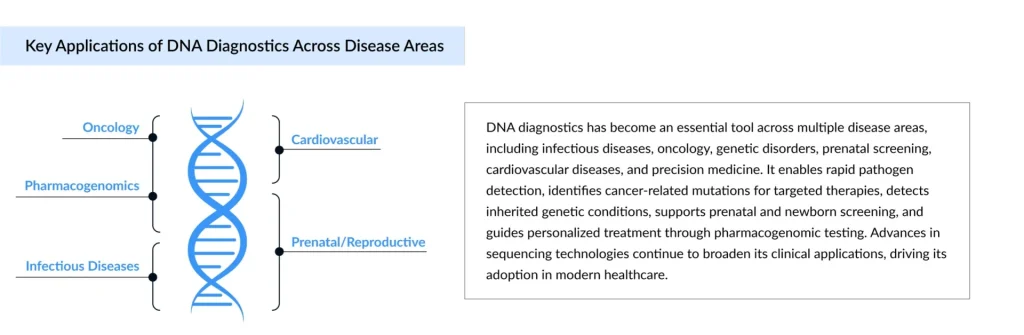
Reproductive and maternal-fetal health has also been reshaped by DNA diagnostics. Non-invasive prenatal testing (NIPT) now allows clinicians to detect chromosomal abnormalities such as Down syndrome from a simple maternal blood draw, eliminating much of the risk associated with older invasive procedures. Newborn screening programs, carrier testing, and preimplantation genetic diagnosis have all expanded in parallel, supported by national health initiatives promoting early genetic screening as a standard part of maternal care.
Beyond oncology, infectious disease, and reproductive health, DNA diagnostics is increasingly applied to cardiovascular disease, neurodegenerative conditions, pharmacogenomics, and rare hereditary disorders. Pharmacogenomic testing in particular is gaining traction as clinicians look to predict how a patient will metabolize a given drug, reducing adverse reactions and improving therapeutic precision. As sequencing costs continue to fall and panels become more comprehensive, the addressable disease landscape for DNA diagnostics will only continue to widen.
Role of AI in DNA Diagnostics
Artificial intelligence has quickly become one of the most consequential forces reshaping DNA diagnostics. Genomic data is inherently massive and complex, and traditional manual interpretation simply cannot keep pace with the volume generated by modern sequencing platforms. AI and machine learning algorithms are now used to sift through this data at scale, identifying disease-linked variants, flagging pathogenic mutations, and surfacing patterns that would be virtually impossible for a human analyst to catch unaided. This has translated directly into faster turnaround times, lower per-test costs, and diagnostic accuracy that continues to improve as models are trained on ever-larger genomic datasets. AI-powered genomics platforms and high-throughput sequencing-based diagnostics together are estimated to account for more than half of all advanced DNA diagnostic testing performed today, underscoring just how central these tools have become to the field.
The impact of AI extends beyond raw data crunching. Cloud-based bioinformatics platforms now allow diagnostic laboratories, even smaller, resource-constrained ones, to access sophisticated interpretation engines without building costly in-house infrastructure, helping democratize access to advanced genomic testing. AI is also playing an increasing role in companion diagnostics, where algorithms help match a patient’s specific mutation profile to the most appropriate targeted therapy, directly supporting the broader shift toward precision medicine. In prenatal and reproductive diagnostics, AI-integrated DNA microarray and screening platforms are improving detection accuracy for chromosomal abnormalities, while in infectious disease testing, machine learning models are accelerating pathogen identification and resistance profiling. As diagnostic laboratories increasingly equip themselves with automated, AI-enabled platforms, the technology is shifting from a competitive differentiator to a baseline expectation across the industry.
DNA Diagnostics Market Dynamics and Emerging Opportunities
The DNA diagnostics market is being propelled by a convergence of demand-side and supply-side forces. On the demand side, the rising global burden of cancer, genetic disorders, infectious diseases, and chronic conditions is driving sustained growth in testing volumes, while expanding prenatal and newborn screening programs are normalizing genetic testing as a routine part of early-life healthcare. On the supply side, technological progress in PCR automation, next-generation sequencing, and AI-driven bioinformatics is making testing faster, cheaper, and more accessible across both centralized laboratories and decentralized point-of-care settings.
Within the product and services segment of the DNA diagnostics market, the reagents and kits category is projected to account for 61.76% of the total market revenue in 2025. This dominance is primarily driven by their recurring demand, broad application across diagnostic procedures, and indispensable role in every testing workflow. Unlike diagnostic instruments, which are typically purchased as one-time capital investments, reagents and kits are consumables required for every test, generating a consistent and recurring revenue stream for market participants.
In the technology segment, the Polymerase Chain Reaction category is expected to hold the largest market share, contributing approximately 51.34% in 2025. Its market leadership is attributed to its exceptional sensitivity, rapid processing time, and cost-effectiveness, making PCR the preferred technology for a wide range of DNA diagnostic applications compared to other advanced molecular diagnostic techniques.
Geographically, North America is projected to hold the largest share of the global DNA diagnostics market, accounting for 43.37% in 2025. The region’s market leadership is driven by its advanced healthcare infrastructure, the strong presence of leading biotechnology and diagnostics companies, and the widespread adoption of cutting-edge technologies such as NGS and PCR. These factors continue to support innovation, improve diagnostic capabilities, and strengthen North America’s position as the leading regional market for DNA diagnostics.
Asia Pacific, meanwhile, is emerging as the fastest-growing region, driven by expanding healthcare infrastructure, rising genetic-testing awareness, and large-scale government screening initiatives. Several disease-specific growth pockets are also opening up: sepsis and tuberculosis testing are boosting demand for rapid molecular diagnostics in critical care, while direct-to-consumer DNA testing kits are tapping into rising consumer interest in personalized wellness, ancestry, and nutrigenomics insights, a trend reinforced by new telehealth-integrated, at-home testing platforms entering the market.
Furthermore, the active participation of leading companies such as Thermo Fisher Scientific Inc., QIAGEN N.V., Illumina, Inc., Agilent Technologies, Inc., Bio-Rad Laboratories, Inc., Roche Diagnostics International AG, Danaher Corporation, Abbott Laboratories, PerkinElmer, Inc., Promega Corporation, Eurofins Scientific SE, Myriad Genetics, Inc., Invitae Corporation, Natera, Inc., Fulgent Genetics, Inc., BGI Genomics Co., Ltd., Takara Bio Inc., New England Biolabs, Inc., Zymo Research Corporation, and others are fueling the market growth.
For industry stakeholders, the opportunity landscape is broad: point-of-care and portable DNA testing platforms that decentralize diagnostics away from centralized labs, AI-powered interpretation software that can be layered onto existing testing infrastructure, and multiplex testing kits capable of screening for multiple conditions simultaneously. Companies that can combine technological innovation with affordability, particularly for resource-constrained healthcare settings, are best positioned to capture share in a market where unmet diagnostic need still vastly outpaces current testing capacity.
Challenges in DNA Diagnostics and the Road Ahead
For all its momentum, the DNA diagnostics field still faces meaningful headwinds. Cost remains a central barrier, next-generation sequencing platforms, high-throughput PCR systems, and AI-driven genomic analysis tools require substantial upfront investment in infrastructure and skilled personnel, limiting adoption in resource-constrained healthcare settings and lower-income regions. Reimbursement gaps compound this problem: in many markets, insurance coverage for advanced genetic testing remains inconsistent, leaving patients and providers to absorb costs that can place sophisticated diagnostics out of reach for routine clinical use.
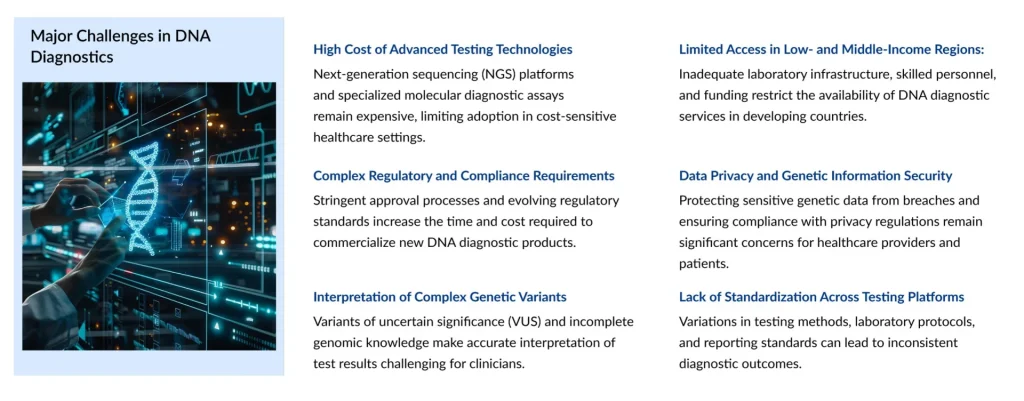
Ethical and regulatory questions are growing alongside the technology itself. Informed consent, data privacy, and the potential for genetic discrimination are increasingly pressing concerns as genomic data becomes more widely collected, stored, and shared, particularly as direct-to-consumer testing and forensic applications like rapid DNA analysis expand into everyday use. Regulatory frameworks in many regions are still catching up to the pace of innovation, creating uncertainty for both established diagnostics companies and emerging entrants.
Looking ahead, the trajectory remains firmly upward. Continued declines in sequencing costs, broader integration of AI-powered interpretation tools, and the maturation of point-of-care molecular platforms are expected to push DNA diagnostics deeper into mainstream clinical practice, and increasingly into the hands of consumers themselves. Success in this next phase will depend on the industry’s ability to pair scientific innovation with affordability, robust data governance, and equitable access, ensuring that the benefits of precision diagnostics extend well beyond the well-resourced healthcare systems that have driven adoption so far.

Downloads
Article in PDF
Recent Articles
- Cancer Diagnostic Market: Evaluating the Major Growth Factors and the Key Developments in the Domain
- BioGX’s ‘pixl’ Portable qPCR Platform; Stryker’s Citrefix Suture Anchor System; Boston Scientific...
- Companion Diagnostics in Healthcare: Powering the Era of Precision Medicine
- Decoding DNA, Redefining Dosage: How Pharmacogenomic Testing Services Are Rewriting the Rules of ...
- Precision Medicine: An emerging approach to conventional treatment