BMS Claims the First CELMoD Crown as ZENBEXUS Raises the Stakes in Multiple Myeloma Treatment
Aug 24, 2026
Table of Contents
Summary
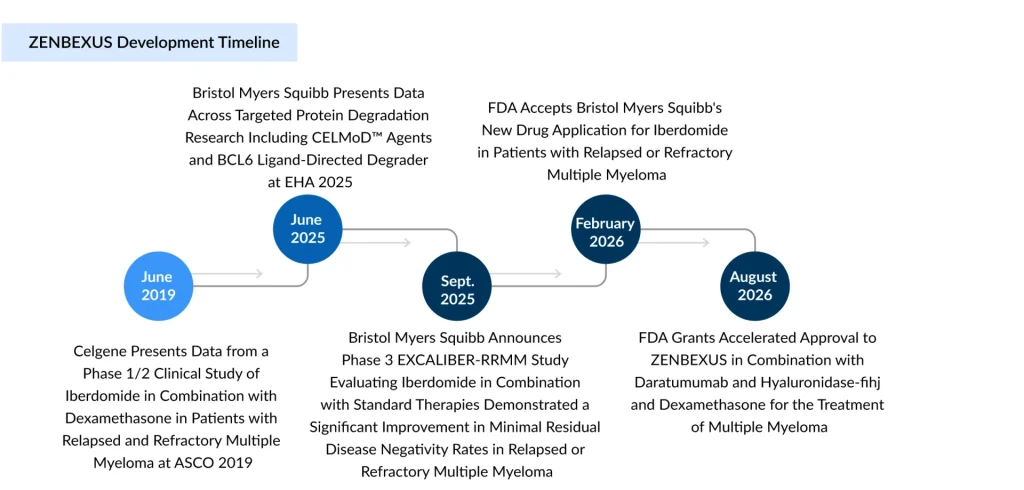
- In August 2026, the FDA granted accelerated approval to Bristol Myers Squibb’s ZENBEXUS (iberdomide), the first-in-class CELMoD, in combination with daratumumab and dexamethasone for adults with multiple myeloma who have received at least one prior line of therapy.
- Approval rests on the Phase 3 EXCALIBER-RRMM study, where ZDd doubled MRD-negative CR rates vs control: 41% vs 21% (p<0.0001), with MRD negativity regarded as a deep, predictive marker of durable response in myeloma.
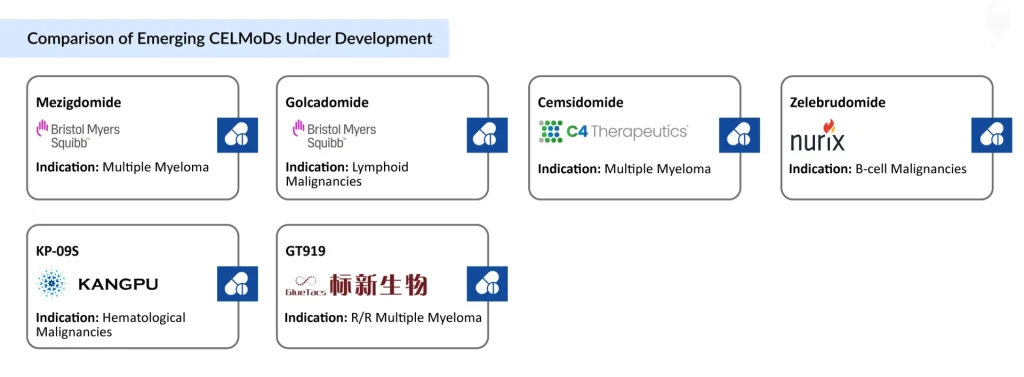
- BMS is continuing to advance its CELMoD portfolio, with mezigdomide under FDA review in combination with carfilzomib and dexamethasone and golcadomide progressing in lymphoma.
- BMS is not alone in pursuing cereblon-based protein degradation. C4 Therapeutics, Nurix Therapeutics, Kangpu Biopharmaceuticals, and Gluetacs are advancing competing targeted protein degradation programs, making CELMoDs an emerging competitive battleground in multiple myeloma.
Bristol Myers Squibb has just claimed a first that the entire multiple myeloma drug development world has been racing toward for years. In August 2026, the FDA granted accelerated approval to ZENBEXUS (iberdomide), BMS’s first-in-class CELMoD, in combination with daratumumab and hyaluronidase-fihj plus dexamethasone (the “ZDd” regimen) for adults with multiple myeloma who have received at least one prior line of therapy. It is the first FDA nod for any CELMoD anywhere, and it is also the first new multiple myeloma drug approval built directly on minimal residual disease (MRD) negativity as a surrogate endpoint, rather than the traditional wait for progression-free survival data. That’s a double milestone, and it’s why this approval is being read as one of the more consequential regulatory decisions among recent breakthroughs in treatment for multiple myeloma.
Downloads
Click Here To Get the Article in PDF

Recent Articles
- 7 Companies at the Forefront of Trispecific Antibody Development
- Bristol Mayer Squibb — The Undisputed Leader in the Molecular Glue Arena
- EC grants; Pfizer cuts; 27 medicines sold; Keytruda nabs
- Leo Pharma’s Hand Eczema Clinical Trial Updates; GSK’s PD-1 inhibitor Jemperli Approval; Ro...
- Synthorx needs IPO; Deerfield puts up $80M; SVB remunerates; Celgene’s deal
For a company facing eroding sales of its legacy IMiDs, REVLIMID and POMALYST, as cheaper generics flood the market, ZENBEXUS is more than a new SKU. It’s a franchise reset, and a signal that BMS intends to remain one of the top pharmaceutical companies for multiple myeloma treatment even as the competitive floor shifts beneath it.
ZENBEXUS is specifically approved in combination with Johnson & Johnson’s DARZALEX (daratumumab) and dexamethasone for the treatment of adults with multiple myeloma who have received at least one prior line of therapy, including a proteasome inhibitor and an immunomodulatory agent. The therapy received Breakthrough Therapy designation and accelerated approval based on the achievement of minimal residual disease (MRD)-negative complete response (CR) at any time in the EXCALIBER-RRMM study. The application was reviewed under the FDA’s Project Orbis initiative, which facilitates concurrent regulatory review by health authorities across multiple countries.
ZENBEXUS’s approval rests on the Phase 3 EXCALIBER-RRMM trial, where the ZDd combination roughly doubled MRD-negative complete response rates compared with a daratumumab-bortezomib-dexamethasone control, 41% versus 21%. Because MRD negativity is considered one of the deepest, most predictive measures of durable response in this disease, the FDA’s willingness to approve on this basis (with confirmatory data still to come) sets a new template for how sponsors might design future refractory multiple myeloma clinical studies. Expect that precedent to ripple across the entire multiple myeloma drug development landscape, encouraging faster, MRD-anchored regulatory pathways for other investigational drugs in multiple myeloma.
Like its IMiD predecessors, ZENBEXUS carries a boxed warning for embryo-fetal toxicity and venous/arterial thromboembolism, and it will be dispensed under a CELMoD REMS (Risk Evaluation and Mitigation Strategy) program, the same guardrail structure that has long governed REVLIMID and POMALYST, designed to prevent fetal exposure and manage clotting risk while keeping the drug accessible to appropriate patients.
The CELMoD Pipeline Race Is Just Getting Started
ZENBEXUS may be first to the finish line, but it won’t be running alone for long. BMS’s own second CELMoD, mezigdomide, is already under FDA review in combination with carfilzomib and dexamethasone (MeziKd) for relapsed or refractory disease, with a PDUFA target action date in May 2027. That filing leans on the Phase 3 SUCCESSOR-2 trial, where MeziKd cut the risk of progression or death by roughly half compared with carfilzomib-dexamethasone alone, one of the more eye-catching readouts among recent advances in multiple myeloma.
A third BMS protein degrader, golcadomide, is advancing in lymphoma, underscoring how central this platform has become to the company’s oncology strategy. An ongoing Phase 3 trial, EXCALIBER-Maintenance, is testing iberdomide head-to-head against lenalidomide as first-line maintenance therapy, a study that, if positive, could push CelMoDs into newly diagnosed multiple myeloma far earlier in the treatment journey than where ZENBEXUS starts today.
BMS isn’t the only one chasing this mechanism, either. C4 Therapeutics’ cemsidomide is advancing through clinical studies in relapsed/refractory multiple myeloma. Nurix Therapeutics is developing Zelebrudomide (NX-2127), an oral small molecule dual degrader targeting Bruton’s tyrosine kinase (BTK) and the cereblon neosubstrates IKZF1 (Ikaros) and IKZF3 (Ailos), which are implicated in B and T cell activity. Kangpu Biopharmaceuticals is developing KPG-818 (epaldeudomide), KPG-121, and KP-09S as targeted protein degraders, while Gluetacs is advancing GT919 and GT929 as emerging candidates designed to selectively modulate disease-relevant proteins through targeted protein degradation.
These rival programs targeting cereblon-based degradation are moving through different clinical trials industry-wide, and any of them could reshape the multiple myeloma drugs list within the next few years. For anyone tracking the multiple myeloma pipeline, the message is clear: CELMoDs are shaping up to be the next battleground class, much like anti-CD38 antibodies and BCMA-targeted therapies were in the prior decade. That makes this an important moment for anyone mapping the multiple myeloma drugs in development or sizing the next generation multiple myeloma therapies market.
How ZENBEXUS Stacks Up Against CAR-T and Bispecific Antibodies
An oral, off-the-shelf pill entering a market already crowded with cell therapies and bispecific antibodies raises an obvious question: where does a ZENBEXUS actually fit? Here’s how the competitive landscape breaks down.
ZENBEXUS vs. Autologous CAR-T: Convenience Meets a Higher Bar
ZENBEXUS’s arrival also raises an inevitable question: how does an oral, off-the-shelf combination regimen stack up against the autologous CAR-T therapies that have become the aspirational standard in relapsed/refractory disease? CARVYKTI (ciltacabtagene autoleucel), Legend Biotech and Janssen’s BCMA-directed CAR-T, is now approved for use as early as first relapse, backed by CARTITUDE-4 data showing a dramatic reduction in the risk of progression or death versus standard-of-care regimens, with a meaningful share of patients achieving treatment-free remission years after a single infusion. Abecma (idecabtagene vicleucel), BMS’s own CAR-T co-developed with 2seventy bio, has likewise moved into third-line use. Both remain the deep-response benchmark in the field.
But CAR-T comes with real friction: cell harvesting, manufacturing turnaround, lymphodepleting chemotherapy, and hospitalization risk for cytokine release syndrome and neurotoxicity. ZENBEXUS, by contrast, is a pill added to an established daratumumab-based backbone, no apheresis, no manufacturing slot, no waiting weeks for a personalized product. For BMS, that positions ZENBEXUS less as a head-to-head CARVYKTI or ABECMA competitor and more as a differentiated, accessible option for patients and physicians who aren’t ready for, or aren’t eligible for, cell therapy. It’s a dynamic worth watching closely for anyone benchmarking the multiple myeloma treatment market, since off-the-shelf convenience is increasingly a competitive weapon in its own right against autologous approaches.
ZENBEXUS vs. Bispecific Antibodies: Two Off-the-Shelf Philosophies Collide
The more direct rivalry may actually be with BCMA-targeted bispecific antibodies, the other major class of off-the-shelf immunotherapy reshaping this disease. TECVAYLI (teclistamab), from Janssen multiple myeloma’s growing immuno-oncology franchise, has already moved into second-line combination use alongside DARZALEX FASPRO, offering T-cell-engaging efficacy without the logistics of cell therapy. Pfizer’s ELREXFIO (elranatamab) is following a similar earlier-line trajectory, making Pfizer another name to watch among competitors of Pfizer multiple myeloma marketed products’ rivals, and, from another angle, a challenger in its own right.
Bispecifics deliver deep, CAR-T-adjacent response rates but bring their own tolerability profile, including cytokine release syndrome risk requiring step-up dosing and inpatient monitoring, plus infection risk from prolonged BCMA suppression. ZENBEXUS sidesteps much of that acute toxicity burden in favor of a chronic, oral, outpatient-friendly regimen, a genuinely different value proposition within the multiple myeloma bispecific antibody landscape. Expect payers, physicians, and patients to increasingly sequence rather than simply choose between these modalities, layering CELMoDs, bispecifics, and CAR-T across different lines and different patient profiles.
A Crowded Field: Who’s Winning the Multiple Myeloma Market?
Put it all together, and the competitive map for multiple myeloma therapeutics is now genuinely three-dimensional. BMS is defending its legacy IMiD base with ZENBEXUS and its CELMoD pipeline while running its own CAR-T franchise in ABECMA. Johnson & Johnson, through Janssen, is pushing on nearly every front at once, DARZALEX as the anti-CD38 backbone nearly every regimen is now built around; CARVYKTI in CAR-T, and TECVAYLI in bispecifics, making it arguably the broadest-portfolio player and a strong claim to being among the best pharmaceutical companies for multiple myeloma treatment today. Pfizer, Legend Biotech, GSK, and Sanofi round out a field where nearly every modality, IMiDs, CELMoDs, monoclonal and bispecific antibodies, ADCs, and CAR-T, now has at least one approved or near-approved entrant.
That density is exactly why the multiple myeloma treatment drugs conversation has shifted from “which drug works” to “which sequence of drugs, in which order, for which patient.” With MRD-based approval now precedent, expect the multiple myeloma drug development pipeline to accelerate further, and expect the multiple myeloma therapy market to keep expanding in both size and complexity through the back half of the decade.
Conclusion
ZENBEXUS’s approval is a genuine inflection point, not just the newest treatment for multiple myeloma to reach the market, but proof that an entirely new mechanistic class can clear the FDA bar on a faster, biomarker-driven pathway. It won’t replace CAR T-cell therapies or bispecifics outright, but it gives physicians a potent, convenient new lever to pull, and it gives BMS a credible answer to generic erosion just when it needed one most. With mezigdomide close behind and rivals racing to match BMS’s protein degradation platform, this is only the opening chapter of the CELMoD story in multiple myeloma.

Downloads
Article in PDF
Recent Articles
- Unleashing the Potential: CD38 Directed Therapies Revolutionize Multiple Myeloma Treatment
- BeiGene’s BRUKINSA Gets FDA Accelerated Approval; GSK’s Positive Results in DREAMM-8 ...
- Multiple Myeloma Day
- EMA to review Cidara Therapeutics’ Rezafungin; EU Approves Gilead Sciences’ Sunlenca; FDA Approve...
- 5 Upcoming Bispecific & Trispecific Antibodies Beyond Oncology