7 Therapies That Could Finally Change the Odds in Multiple Myeloma Treatment
May 18, 2026
Summary
- Multiple myeloma remains one of oncology’s most challenging blood cancers, but the treatment landscape is undergoing a seismic shift.
- With the multiple myeloma market valued at USD 28.7 billion in 2025 and projected to grow steadily through 2036, the pipeline has never been more robust or more consequential.
- Seven late-stage therapies, namely Arcellx/Gilead’s Anito-cel, AbbVie’s ABBV-383, Bristol Myers Squibb/Celgene’s Iberdomide, Mezigdomide, and Arlo-cel, AbbVie and Roche’s VENCLEXTA, and AstraZeneca’s AZD0120, are now closing in on regulatory approval, each representing a distinct and innovative approach to tackling this incurable disease.
Multiple myeloma has long been one of oncology’s most stubborn adversaries, incurable, relapsing, and increasingly complex to treat. But the pipeline has never looked more promising. From next-generation CAR T-cell therapies to precision bispecific antibodies and cereblon modulators, a new wave of late-stage innovations is pushing the boundaries of what’s possible in myeloma care.
The numbers alone tell a compelling story. The multiple myeloma market across the seven major markets was valued at USD 28.7 billion in 2025 and is projected to grow at a CAGR of 3.3% through 2036, fueled almost entirely by next-generation agents now closing in on regulatory finish lines. Behind those numbers is an accelerating wave of innovation, CAR-T therapies moving into earlier lines, bispecifics redefining immune engagement, and next-generation small molecules tackling resistance mechanisms that once seemed intractable.
Downloads
Click Here To Get the Article in PDF

Recent Articles
- Syndax Pharmaceuticals Receives FDA Approval for REVUFORJ; FDA Approves BLENREP for Adults with R...
- The Changing Landscape of Multiple Myeloma Therapies Market
- Kiadis inks license deal with Sanofi; Gilead Ends Hep B Collaboration; Merck & Foghorn inks ...
- Novartis’ Canakinumab for NSCLC; Novartis’s Zolgensma Updates; Trodelvy Prospects in New Breast C...
- Zevra’s MIPLYFFA Niemann-Pick Disease Approval; FASENRA Approved for Eosinophilic Granulomatosis;...
Today’s multiple myeloma treatment arsenal spans proteasome inhibitors (PIs), immunomodulatory drugs (IMiDs), CELMoDs, monoclonal antibodies (including the CD38 workhorses DARZALEX and SARCLISA), antibody-drug conjugates, bispecifics, and CAR-T platforms. Cornerstones like REVLIMID continue to anchor regimens worldwide, even as generics arrived post-2022.
And expert consensus is shifting: as a hemato-oncology expert at DelveInsight, Sadaf Javed noted, CARVYKTI has delivered the strongest CAR-T launch in the space to date, 60–70% of utilization already shifting to earlier lines, while DARZALEX has outperformed efficacy and safety expectations to become an undisputed frontline standard.
What comes next? Below are seven late-stage therapies that analysts, clinicians, and patients should have on their radar.
Arcellx/Gilead’s Anito-cel: The CAR T Challenger Gunning for Earlier Lines
Target: BCMA
Anitocabtagene autoleucel (anito-cel) isn’t just another BCMA-directed CAR T-cell therapy; it’s engineered differently. Built on Arcellx’s proprietary D-Domain binder, anito-cel is designed for rapid, transient BCMA engagement, aiming to deliver strong tumor-killing activity with a cleaner safety profile than its predecessors.
The clinical program is ambitious: the pivotal Phase II iMMagine-1 study targets heavily pretreated (4L+) patients, while the confirmatory Phase III iMMagine-3 trial is enrolling in second-line and beyond. In a significant regulatory milestone, the US FDA accepted Arcellx’s BLA in February 2026 for adult RRMM patients in the fourth-line setting, putting anito-cel firmly on the commercialization path. A Phase III trial in newly diagnosed myeloma (iMMagine-4) is also on the horizon.
AbbVie’s ABBV-383: The Bispecific Built for Balance
Target: BCMA × CD3
AbbVie’s ABBV-383 (etentamig, formerly TNB-383B) takes a nuanced approach to T-cell redirection. This BCMA-directed IgG4 bispecific antibody incorporates a low-activating CD3 domain, one that preferentially fires up effector T cells while leaving regulatory T cells relatively undisturbed, helping to curb the cytokine storm risks that have plagued the class.
Currently in Phase III evaluation for RRMM, AbbVie has mapped out a clear regulatory roadmap: a submission for third-line myeloma is expected in 2027, with pivotal ORR data and Phase I combination readouts in both 2L and 1L disease expected throughout 2026–2027. If the profile holds up, etentamig could become a cornerstone bispecific across treatment lines.
Bristol Myers Squibb/Celgene’s Iberdomide: CELMoD’s Frontrunner With a PDUFA Date on the Calendar
Target: Cereblon E3 Ligase
Iberdomide is BMS’s bid to bring cereblon E3 ligase modulation (CELMoD) squarely into the mainstream. By degrading the transcription factors Aiolos and Ikaros, it shuts down myeloma cell proliferation while simultaneously priming the immune system, a dual punch that preclinical data suggest synergizes powerfully with daratumumab, bortezomib, and dexamethasone.
The regulatory picture looks increasingly favorable. In February 2026, the FDA accepted BMS’s NDA for iberdomide in combination with daratumumab and dexamethasone for RRMM, granting it both Breakthrough Therapy Designation and Priority Review. The PDUFA action date is set for August 17, 2026, and the application is also being reviewed under FDA Project Orbis, opening doors to simultaneous international approvals.
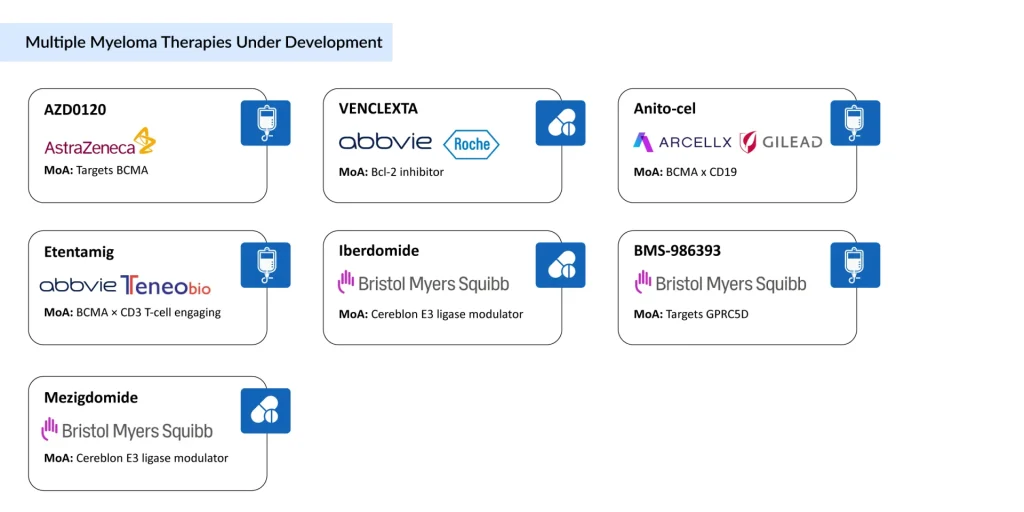
AbbVie and Roche’s VENCLEXTA: The BCL-2 Blocker Making Its Myeloma Move
Target: BCL-2
Already a proven performer in CLL and AML, VENCLEXTA (venetoclax) is now being rigorously investigated across multiple Phase III trials in relapsed or refractory multiple myeloma. As an orally administered BCL-2 inhibitor, it blocks the anti-apoptotic signals that keep myeloma cells alive, making it an especially intriguing candidate for t(11;14)-positive patients, a subgroup with naturally high BCL-2 expression.
If Phase III results translate, venetoclax could become one of the rare oral targeted therapies to earn a dedicated myeloma label, bringing a convenient, well-characterized backbone agent into a class currently dominated by infusion-based regimens.
Bristol Myers Squibb/Celgene’s Mezigdomide: CELMoD, Supercharged
Target: Cereblon E3 Ligase (CRL4-CRBN complex)
Where iberdomide refined the CELMoD concept, mezigdomide pushes it further. This highly potent cereblon E3 ubiquitin ligase modulator drives targeted degradation of substrate proteins with greater efficiency, and BMS is testing it across a broad combination landscape, including alongside elranatamab for RRMM.
The SUCCESSOR-1 and SUCCESSOR-2 Phase III trials are evaluating mezigdomide in second-line and beyond settings, with key data readouts expected between 2026 and 2027. Early Phase I/II combination data (CA057-1040 study) will likely frame how mezigdomide gets sequenced alongside other novel agents as the treatment algorithm grows more complex.
AstraZeneca’s AZD0120: The Dual-Targeting CAR T Rewriting the Rules
Target: BCMA + CD19
Most CAR T therapies pick one target. AZD0120 (formerly GC012F) picks two. This FasTCAR-enabled autologous CAR T-cell therapy simultaneously targets BCMA and CD19, a dual-antigen strategy designed to close the escape routes that allow myeloma cells to evade single-target therapies. The FasTCAR manufacturing platform also preserves naïve and central memory T-cell qualities, potentially enhancing in vivo expansion and durability.
A packed readout calendar is building: Phase II DURGA-3 data are expected in H1 2026, followed by Phase I DURGA-2 results in H2 2026, and Phase I/II DURGA-1 data in 2027, giving the field a comprehensive look at AZD0120’s potential across patient populations and disease settings.
Bristol Myers Squibb/Celgene’s Arlo-cel: First-in-Class GPRC5D CAR T With a 2027 Launch in Sight
Target: GPRC5D
Arlo-cel (BMS-986393) breaks from the BCMA-targeting crowd entirely, going after GPRC5D, a cell-surface receptor highly expressed on myeloma plasma cells. As the first GPRC5D-targeted autologous CAR T-cell therapy in clinical development, it opens a new lane for patients who have relapsed after BCMA-directed treatment.
The clinical program is advancing fast: Phase II QUINTESSENTIAL study registrational data in the 4L+ setting are expected in 2026, with a potential commercial launch projected for 2027. A Phase III program in the 2–4L setting is already underway, with BMS targeting an expansion launch as early as 2029.
These seven therapies aren’t arriving in a vacuum. They’re entering a market that has already been transformed by DARZALEX, CARVYKTI, and ELREXFIO, and they’re doing so with stronger clinical data, smarter mechanisms, and clearer regulatory pathways than many predecessors.
What’s particularly notable is the breadth of mechanisms across this multiple myeloma pipeline. CAR-T therapies are attacking novel antigens (GPRC5D) and dual targets (BCMA+CD19). Bispecifics are refining T-cell engagement to reduce toxicity. CELMoDs are pushing degrader biology into resistance territories that IMiDs couldn’t reach. And established molecules like venetoclax are finally getting their chance to prove value in biomarker-selected myeloma populations.
Multiple myeloma may not yet be curable. But if even half the therapies on this list deliver on their clinical promise, the standard of care in 2027 and 2028 will look substantially different from today.

Downloads
Article in PDF
Recent Articles
- Adagio Raises $336 M; Lyndra’s Schizo Trial; BMS Opdivo for Gastric Cancer; Anixa Ovarian C...
- Regeneron Presents Positive Pivotal Data on Linvoseltamab for Relapsed/Refractory Multiple Myelom...
- Pfizer to acquire Arena Pharma; Takeda’s ‘Wave 2’ multiple myeloma med data; No...
- Sandoz’s Generic Revlimid; Agios’ Pyrukynd; Organon Announces 4Q & Full-year Earnings ...
- Analyzing the Most Promising Drugs That Will Lose Patent in the US & EU in 2022