Rare Disease Drug Approvals: Why Are Ultra-Orphan Therapies Suddenly Big Pharma’s Favorite Gamble?
Sep 07, 2026
Table of Contents
Summary
- Diseases once dismissed as “too rare to matter” (hundreds to low‑thousands of patients globally) are now central to innovation, with regulators, payers, and major companies adapting fast.
- In the first eight months of 2026, the FDA cleared more than 6 first‑in‑class drugs, a pace that historically took a full year, driven largely by rare disease and oncology indications.
- Big names such as AbbVie, Denali, Ascendis, Regeneron, Sentynl, Immedica, Merus, Rocket, Travere, and others are actively pursuing ultra‑rare indications, proving commercial viability at tiny scales.
- Ultra‑orphan is no longer a niche; it’s where some of the most advanced modalities (BBB‑crossing biologics, one‑time gene therapies, biomarker‑led accelerations) are debuting first.
A few years ago, “ultra-orphan” was pharma-speak for skip it. Diseases affecting a few hundred or a few thousand people worldwide didn’t pencil out against blockbusters chasing tens of millions of patients. That math has flipped. In the first eight months of 2026 alone, the FDA cleared more than 6 first-in-class drugs, a pace that historically took a full year. Rare disease and cancer indications, which frequently overlap, accounted for the majority of that innovation. Regulators are moving faster, payers are (slowly) adapting, and some of the biggest names in pharma, AbbVie, Denali, Ascendis, Regeneron, Sentynl Therapeutics, Immedica Pharma, Merus, Rocket Pharmaceuticals, Travere Therapeutics, and others, are now racing into diseases that affect a few hundred patients on the planet.
Downloads
Click Here To Get the Article in PDF

Recent Articles
- Merus’ BIZENGRI: The New Face of NRG1+ Cancer Treatment After FDA Approval
- Denali’s AVLAYAH Win for Hunter Syndrome Marks Turning Point for Rare Disease Innovation
- Travere Turns Setback into Success with FILSPARI Breakthrough in FSGS
- Advancements in IgA Nephropathy (IgAN) Treatment: From Standard-of-care (SoC) to Emerging Therapies
- Travere’s FILSPARI Approval Sparks Rivalry in the IgA Nephropathy Space
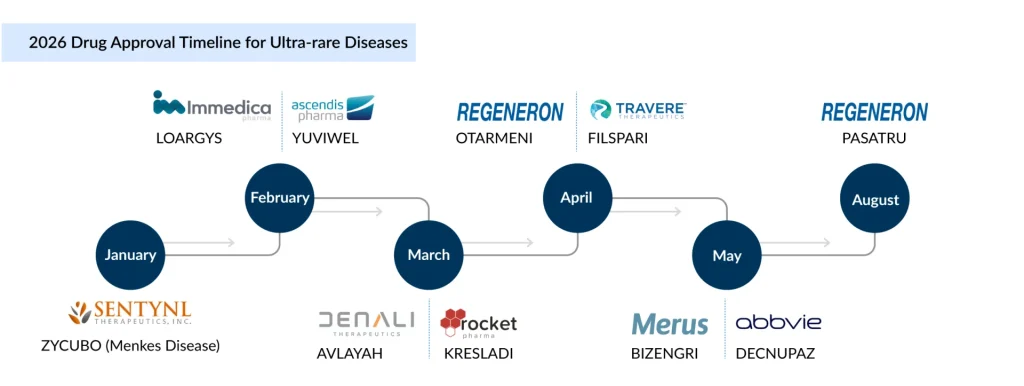
Meet the New Class of 2026: Approvals That Changed the Game
Rare diseases most people have never heard of, and a combined patient population smaller than a mid-sized high school, yet this cohort represents some of the most technically ambitious drug development in the industry today. From a biologic that finally breaches the blood-brain barrier to the first-ever treatment for a disease that kills infants within months, these approvals share a common thread: each one proves that “too rare to matter commercially” is no longer true.
Here’s a closer look at the therapies redefining what’s commercially viable in rare disease.
Sentynl Therapeutics’ ZYCUBO: The First Lifeline for Menkes Disease
Menkes disease (January 2026)
ZYCUBO was the first-ever approved treatment for Menkes disease, showing a roughly 80% reduction in mortality risk when started early. It also came with a Rare Pediatric Disease Priority Review Voucher, a growing feature of ultra-orphan deals, since these vouchers can later be sold or used to speed review of a completely unrelated blockbuster.
Developed by Sentynl Therapeutics (a Zydus Lifesciences company), ZYCUBO restores copper homeostasis via daily subcutaneous injection, bypassing the impaired intestinal absorption caused by ATP7A gene mutations. The approval leaned on pooled data from two open-label, single-arm trials comparing 66 early-treated patients against an untreated external control group: median overall survival came in at roughly 177 months versus just 17.6 months for untreated infants. That’s the difference between most children surviving past age three and most reaching well into adolescence. The path here wasn’t smooth, either; the FDA issued a complete response letter on an earlier version of the application before ultimately clearing the therapy, a reminder that even a slam-dunk unmet-need case can take multiple regulatory rounds to land.
Because Menkes disease is almost always fatal without near-immediate intervention after birth, ZYCUBO’s real commercial and clinical challenge isn’t the drug itself; it’s getting affected infants identified and dosed before the disease’s rapid neurodegeneration takes hold, which is pushing renewed interest in newborn copper-panel screening.
Immedica Pharma’s LOARGYS: Taming Toxic Arginine Before It Turns Deadly
Arginase 1 deficiency (February 2026)
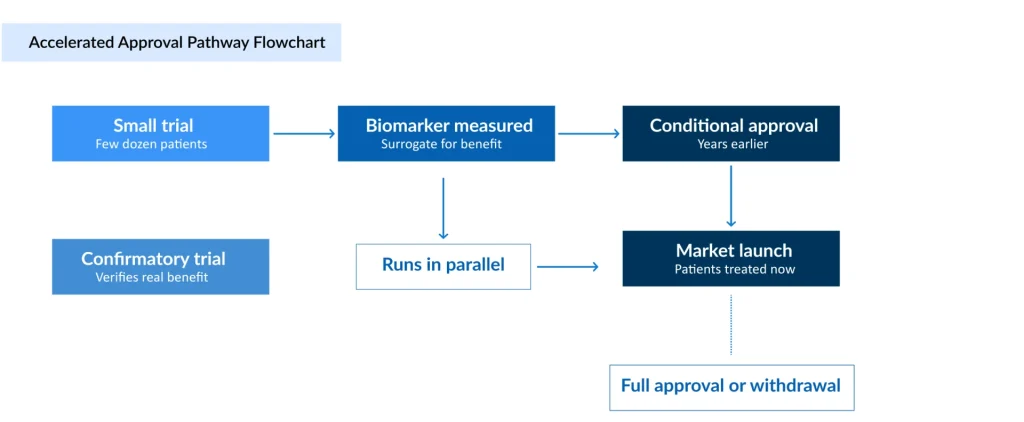
LOARGYS (pegzilarginase-nbln) is the first therapy ever shown to lower plasma arginine in the arginase 1 deficiency population, approved via the accelerated pathway based on a biomarker endpoint rather than a hard clinical outcome. LOARGYS is a recombinant human arginase-1 enzyme, delivered as a once-weekly IV infusion, that converts excess plasma arginine into urea and ornithine, addressing the root metabolic defect behind ARG1-D’s hallmark symptoms of spasticity, seizures, and developmental delay. Its approval by Immedica Pharma came on the back of the randomized, placebo-controlled Phase 3 PEACE trial, which showed a statistically significant reduction in plasma arginine at 24 weeks compared to placebo.
Notably, this wasn’t a first attempt: an earlier sponsor had received the FDA’s harshest form of rejection, a refusal to even file, for pegzilarginase four years prior. Immedica’s success in bringing the same molecule back for a second, successful review illustrates just how much accelerated-approval biomarker pathways have matured for ultra-rare metabolic disease in a few short years. The drug carries a boxed warning for hypersensitivity reactions including anaphylaxis, underscoring a pattern common across this class of enzyme-replacement therapies: real efficacy comes paired with real administration risk, meaning most patients will need treatment in a monitored healthcare setting indefinitely.
Ascendis Pharma’s YUVIWEL: A Once-Weekly Challenger in the Achondroplasia Growth Race
Achondroplasia (February 2026)
YUVIWEL (navepegritide) is the first once-weekly growth therapy for children with achondroplasia, competing directly with the daily-injection incumbent VOXZOGO. Its accelerated approval rested on annualized growth velocity, a surrogate endpoint that let the sponsor skip waiting years for adult-height data. Built on Ascendis Pharma’s TransCon prodrug platform, YUVIWEL delivers a sustained, continuous release of C-type natriuretic peptide (CNP) across the full weekly dosing interval, directly counteracting the overactive FGFR3 signaling that drives achondroplasia’s growth-plate suppression.
The approval package included data from three randomized, double-blind, placebo-controlled trials plus up to three years of open-label extension follow-up, a notably deep dataset for an ultra-orphan indication, reflecting the years Ascendis spent building out its pivotal ApproaCH trial program. Two-year data presented afterward showed continued improvement in growth velocity and body proportionality, with patients who crossed over from placebo to active drug catching up to match outcomes in the originally treated group.
For families and clinicians, YUVIWEL’s real pitch is convenience-as-differentiation: going from 365 injections a year on the incumbent therapy to 52 is a meaningful quality-of-life difference for young children, and it signals how “faster, less burdensome dosing” is becoming its own competitive battleground once a disease already has one approved therapy.
Denali Therapeutics’ AVLAYAH: The Biologic That Finally Cracked the Blood-Brain Barrier
Hunter syndrome (March 2026)
This one is a genuine platform story: AVLAYAH (tividenofusp alfa-eknm) is the first FDA-approved biologic engineered to cross the blood-brain barrier by hijacking the transferrin receptor, and it’s priced at roughly $270,000 to $811,000 a year depending on body weight, a preview of where enzyme-replacement pricing is heading. Denali Therapeutics built AVLAYAH by fusing the missing enzyme in Hunter syndrome, iduronate-2-sulfatase (IDS), onto its proprietary TransportVehicle, engineered to bind the transferrin receptor and hitch a ride into the brain via receptor-mediated transcytosis, something conventional enzyme-replacement therapies have never been able to do.
In the Phase 1/2 trial supporting AVLAYAH approval, 44 evaluable patients showed a 91% average reduction in cerebrospinal fluid heparan sulfate by week 24, with 93% of patients dropping below the upper limit of normal from a baseline where none had. It’s the first meaningful therapeutic advance for the MPS II community in nearly two decades, and Denali executives have been candid that the real prize isn’t just this one indication; it’s proving the TransportVehicle platform works, opening the door to CNS-penetrant therapies for Sanfilippo syndrome and other neurodegenerative lysosomal disorders already in Denali’s pipeline.
Confirmatory data is still pending from the ongoing Phase 2/3 COMPASS trial, a randomized head-to-head against standard enzyme-replacement therapy, meaning payers and physicians are, for now, betting on a biomarker with plausible but not yet fully proven neurologic benefit.
Rocket Pharmaceuticals’ KRESLADI: Betting a Child’s Immune System on a Single Infusion
Severe leukocyte adhesion deficiency-I (March 2026)
Developed by Rocket Pharmaceuticals, KRESLADI is an autologous, lentiviral vector-based gene therapy: a child’s own hematopoietic stem cells are harvested, genetically modified to carry a functional copy of the ITGB2 gene (the gene responsible for enabling white blood cells to reach and fight infection), and reinfused as a one-time treatment. It’s specifically indicated for children without an available HLA-matched sibling donor for a conventional transplant, meaning it targets exactly the patients who previously had no viable treatment path at all. Data from the supporting global Phase 1/2 trial showed 100% overall survival among enrolled patients for at least one year post-treatment, a striking result for a disease that is otherwise near-uniformly fatal within the first two years of life.
Like several other 2026 approvals, KRESLADI’s route to market wasn’t linear; an earlier complete response letter over chemistry, manufacturing, and controls (CMC) details delayed the filing before the FDA ultimately cleared the resubmission, another sign that gene-therapy manufacturing consistency remains one of the toughest hurdles in bringing these one-time treatments to patients.
Regeneron Pharmaceuticals’ OTARMENI: A One-Time Gene Therapy That Restores Hearing — For Free
OTOF-related genetic hearing loss (April 2026)
OTARMENI (lunsotogene parvec-cwha) is the first-ever gene therapy for OTOF-related genetic hearing loss, cleared under the FDA’s new National Priority Voucher pilot in a record-tying 61 days from BLA filing. In an unprecedented access move tied to a broader pricing agreement with the U.S. government, Regeneron committed to providing it entirely free of charge to eligible American patients.
OTARMENI is a dual-AAV1 vector gene therapy delivered as a single surgical infusion directly into the cochlea, restoring a functional copy of the OTOF gene that produces otoferlin, a protein essential for transmitting sound signals from the inner ear to the auditory nerve. In the pivotal CHORD trial, 80% of evaluable participants met or exceeded the primary hearing-threshold endpoint at 24 weeks, and with longer follow-up, 42% achieved what researchers characterize as normal hearing, including the ability to hear whispers. It’s a genuinely rare category of result in gene therapy: not stabilization of decline, but outright restoration of a lost neurosensory function, in a single outpatient-style procedure comparable to receiving a cochlear implant.
OTARMENI’s free-drug model is a live experiment in an alternative to traditional list-price-and-negotiate commercialization, and one that other manufacturers facing ultra-rare pediatric indications will likely be watching closely as a possible template, or a one-off shaped by unique policy circumstances.
Travere Therapeutics’ FILSPARI: An Old Drug Finds a Second Rare Disease to Conquer
Focal segmental glomerulosclerosis (April 2026)
Already approved for IgA nephropathy, FILSPARI picked up a first-ever approved indication for focal segmental glomerulosclerosis (FSGS) in April 2026, a rare and aggressive kidney disease that previously had zero medicines specifically approved to treat it. Travere Therapeutics’ sparsentan is a dual endothelin-A and angiotensin II receptor antagonist that targets podocyte injury, the underlying driver of the proteinuria that leads FSGS patients toward progressive kidney failure. The FILSPARI approval rested on the Phase 3 DUPLEX trial, the largest interventional study ever conducted in FSGS, enrolling 371 patients, which showed a 46% reduction in proteinuria with sparsentan compared to 30% with maximally dosed irbesartan at 108 weeks, along with higher remission rates and fewer progressions to end-stage kidney disease. The label now covers patients as young as eight, expanding FILSPARI’s total addressable population to more than 100,000 patients in the U.S. when combined with its existing IgA nephropathy indication.
FILSPARI’s story is a useful counterpoint to the others on this list: it shows that “ultra-orphan strategy” doesn’t always mean a brand-new molecule for a brand-new disease. Sometimes it means methodically expanding an already-approved drug’s label, disease by rare disease, to compound the value of R&D and commercial infrastructure a company has already built.
Merus’ BIZENGRI: The First Targeted Lifeline for NRG1-Fusion Cancers
NRG1 fusion-positive cholangiocarcinoma (May 2026)
Merus N.V.’s BIZENGRI (zenocutuzumab-zbco) became the first FDA-approved systemic therapy specifically targeting NRG1 fusion-positive cholangiocarcinoma, an exceptionally rare and aggressive form of bile-duct cancer. The May 2026 BIZENGRI approval was particularly notable because it came through the FDA’s new National Priority Voucher pilot, which dramatically compresses review timelines for therapies addressing high-priority unmet needs.
BIZENGRI is a bispecific HER2×HER3 antibody designed to block the signaling driven by NRG1 gene fusions, essentially shutting down a molecular escape route that fuels tumor growth. The therapy had already been granted accelerated approval in December 2024 for NRG1 fusion-positive non-small cell lung cancer and pancreatic adenocarcinoma, making the cholangiocarcinoma decision an expansion into another ultra-small genetically defined population.
The bigger commercial story, however, may be the biomarker. NRG1 fusions are rare enough that identifying the right patients can be as difficult as treating them. BIZENGRI therefore represents the emerging ultra-orphan oncology model in its purest form: a drug aimed at a tiny population, enabled by precision genomic testing, accelerated regulatory pathways and a development strategy that can build value by following the same molecular driver across multiple cancers. The catch is that the original approvals remain accelerated and require confirmatory evidence to verify clinical benefit, while access to reliable NRG1 testing remains an important part of the treatment equation.
AbbVie’s DECNUPAZ: A Precision Strike on an Ultra-Rare Blood Cancer
Blastic plasmacytoid dendritic cell neoplasm (May 2026)
DECNUPAZ (pivekimab sunirine-pvzy) is the first antibody-drug conjugate for blastic plasmacytoid dendritic cell neoplasm (BPDCN), a blood cancer so rare it affects roughly 5 in 10 million people. AbbVie built it as an outpatient-administered ADC, notable because it avoids the inpatient infrastructure many rare hematologic therapies require.
DECNUPAZ targets CD123, a protein overexpressed on BPDCN cells, delivering a DNA-alkylating payload directly into malignant cells while sparing healthy tissue. In the pivotal CADENZA trial, previously untreated patients saw a 69.7% composite complete remission rate, with over a third of responders going on to receive a stem cell transplant, effectively bridging patients to potentially curative therapy who might not have survived long enough to reach it otherwise. Even in the harder-to-treat relapsed or refractory population, response rates held at nearly 16%, respectable for a cancer this aggressive and this rare. It’s AbbVie’s first-ever ADC approved for a blood cancer, and it arrives as the second targeted option for BPDCN after Elzonris (tagraxofusp), giving clinicians and patients a genuine choice for the first time in this disease’s history.
Because BPDCN so often masquerades as bruising or benign skin lesions before racing into the bone marrow and central nervous system, DECNUPAZ’s launch strategy leans heavily on physician education, the drug is only as valuable as the speed with which dermatologists and hematologists learn to recognize it.
Regeneron’s PASATRU: Turning Off the Bone-Building Switch in FOP
Fibrodysplasia ossificans progressiva (August 2026)
Regeneron Pharmaceuticals, Inc.’s PASATRU (garetosmab-grts) became only the second FDA-approved treatment for fibrodysplasia ossificans progressiva, or FOP, one of the rarest and most disabling genetic diseases. Approved on August 19, 2026, PASATRU is designed to reduce the formation of new heterotopic ossification, bone that develops where it absolutely should not, progressively turning muscles, tendons, and ligaments into bone.
The biology is almost as striking as the disease itself. FOP is generally caused by mutations in ACVR1, a receptor involved in regulating bone formation, leaving patients vulnerable to episodes in which soft tissues progressively ossify. PASATRU is an antibody that blocks activation of this abnormal activin A receptor pathway, aiming to interrupt the process before another piece of the patient’s body becomes permanently locked into bone.
The approval was supported by a randomized, double-blind, placebo-controlled study of just 63 adults, tiny by conventional drug-development standards, but substantial for a disease this rare. After 56 weeks, patients receiving 10 mg/kg of PASATRU developed only two new heterotopic-ossification lesions among 23 patients, compared with 19 lesions among 21 placebo-treated patients. The treatment also reduced clinician-assessed disease flare-ups, with nine recorded in the 10-mg/kg group versus 66 with placebo.
PASATRU’s regulatory journey also shows how an ultra-orphan therapy can accumulate multiple accelerators around a tiny patient population. The drug received FDA Breakthrough Therapy, Fast Track, Orphan Drug, and Priority Review designations before approval. Yet the commercial opportunity comes with an equally important constraint: FOP is so rare that identifying patients early and managing treatment over a lifetime becomes central to the value proposition. PASATRU is not simply competing for a slice of a large market; it is competing to become part of the long-term standard of care for a population measured in hundreds to a few thousand patients worldwide.
Taken together, these approvals aren’t outliers. They’re a signal.
Small Populations, Big Strategy: How Rare Disease Is Rewiring Pharma R&D
Three forces are pulling Big Pharma increasingly toward diseases with vanishingly small patient populations. First, the regulatory fast lane is getting even faster. Accelerated approval pathways based on biomarkers such as plasma arginine, CSF heparan sulfate, and annualized growth velocity can allow sponsors to file years earlier than would be possible with traditional clinical-outcomes trials. The FDA’s National Priority Voucher pilot, for example, pushed OTARMENI through review in just 61 days. Meanwhile, new draft guidance around a “plausible mechanism” framework for individualized gene-editing therapies could allow sponsors to treat variant-specific gene editors as part of a single product line rather than requiring dozens of separate trials, a potential game-changer for ultra-rare genetic diseases.
Second, regulatory designations have become a strategic currency in their own right. Orphan Drug Designation provides benefits including market exclusivity, tax credits, and fee waivers, while Rare Pediatric Disease Priority Review Vouchers can potentially be sold on the open market for eight- or nine-figure sums or used to accelerate an entirely unrelated drug elsewhere in a company’s pipeline. In this environment, even an indication affecting only a few hundred patients can become a strategic asset whose value extends far beyond the revenue generated by the disease itself.
Third, pharmaceutical companies are increasingly leveraging platforms that can be applied across multiple rare diseases. Denali’s TransportVehicle technology, used in AVLAYAH, and Ascendis’s TransCon prodrug technology, used in YUVIWEL, are not necessarily one-off inventions; they are reusable engineering platforms that can, in theory, be directed toward additional rare diseases with a fraction of the incremental R&D investment. Once a company develops a platform capable of addressing challenges such as blood-brain-barrier delivery or sustained-release dosing, each subsequent rare-disease program can become less expensive and potentially faster to develop than the one before it.
Taken together, these forces are fundamentally changing the economics and strategic appeal of rare-disease development. What was once viewed as a regulatory afterthought is increasingly becoming a core R&D strategy, with major pharmaceutical companies building dedicated business units and platform capabilities around rare and ultra-rare diseases.
The Million-Dollar Question: Who Actually Pays for These Drugs?
Here’s the tension underneath all of this optimism: drugs that cost hundreds of thousands to millions of dollars per patient each year, yet are tested in fewer than 50 people, present a major challenge for traditional health technology assessment (HTA) frameworks. The problem is largely driven by the growing gap between regulatory and payer requirements. Regulators are increasingly comfortable approving therapies based on surrogate endpoints, single-arm studies, and external control cohorts, while payers have historically built their reimbursement frameworks around large randomized controlled trials and hard clinical outcomes. As a result, many ultra-orphan therapies can secure regulatory approval but then face lengthy reimbursement negotiations that delay patient access for months or even years.
Pricing adds another layer of complexity. Enzyme replacement therapies and gene therapies routinely carry annual price tags of $270,000 or more, with some one-time gene therapies reaching several million dollars per patient. Even well-funded health systems are therefore experimenting with alternative approaches, including outcomes-based agreements, installment payment models, and reinsurance pools designed to distribute the financial risk associated with these high-cost treatments.
At the same time, free-drug and patient-access programs are emerging as another potential pricing strategy. Regeneron’s decision to provide OTARMENI at no cost to eligible U.S. patients represents a notable departure from conventional reimbursement models. By eliminating the upfront cost for a single-dose gene therapy, the approach effectively sidesteps the reimbursement challenge for eligible patients, although it also raises broader questions about long-term sustainability and how manufacturers can ultimately recoup the substantial costs of research and development.
HTA agencies are also working to adapt to the unique challenges posed by rare and ultra-rare diseases. Authorities across the UK, Germany, France, Australia, and other markets are experimenting with dedicated rare-disease pathways and more flexible assessment approaches. However, coordination between countries, and even between regulatory approval and subsequent HTA decisions within individual markets, remains inconsistent. This lack of synchronization can significantly slow global patient access, even after a therapy has received regulatory approval in one or more jurisdictions.
For pharmaceutical companies, the implication is clear: securing regulatory approval is only half the battle. In an increasingly complex rare-disease landscape, commercial strategy and market-access planning need to begin as early as Phase 1, rather than being treated as priorities only after approval. Understanding payer expectations, evidence requirements, pricing constraints, and reimbursement pathways from the outset will be critical to ensuring that promising therapies can translate into meaningful and sustainable patient access.
No Placebo, No Problem: Why Registries and Natural History Data Are the New Clinical Trial
When your addressable population is only 500 people, running a conventional randomized controlled trial with a placebo arm and expecting to achieve adequate statistical power is often unrealistic. This is where patient registries and natural history studies become critical, and, increasingly, they have become almost as important to rare-disease drug development as the therapy itself. Natural history studies establish the untreated course of a disease, providing regulators with a well-characterized benchmark that can increasingly serve as an external control group instead of a traditional placebo arm. This approach was used to demonstrate the survival benefit of ZYCUBO against an untreated historical cohort.
At the same time, patient registries can accelerate trial recruitment in diseases where every eligible patient matters, while generating the long-term safety, efficacy, and durability data that regulators often require as part of accelerated approval pathways. Beyond supporting clinical development, registries can also serve as post-marketing surveillance infrastructure, helping sponsors fulfill confirmatory-trial and durability commitments that increasingly accompany accelerated approvals, as demonstrated by therapies such as AVLAYAH, YUVIWEL, and LOARGYS, which were approved with ongoing confirmatory requirements. These datasets can also create a significant competitive advantage.
A company that has spent years building a comprehensive registry and natural history dataset for a particular rare disease can establish a structural head start over later entrants seeking to develop competing therapies. Recognizing this advantage, advocacy foundations, academic institutions, and pharmaceutical companies are increasingly co-funding registries and natural history initiatives years before a drug approaches regulatory approval. By the time a program reaches Phase 3, the infrastructure, patient relationships, and longitudinal data needed to support development are already in place, because building that foundation from scratch at the late-stage development phase may simply be too late.
The Bottom Line: Approval Is Just the Starting Line
Ultra-orphan disease used to be where drugs went to be ignored. Now it’s where some of the industry’s most technically ambitious science, blood-brain-barrier-crossing biologics, gene therapies dosed once for life, biomarker-driven accelerated approvals, is landing first. Faster regulatory pathways, reusable delivery platforms, and voucher economics have made the math work for Big Pharma in a way it simply didn’t a decade ago.
But approval is the easy part. The real test is whether pricing models, health technology assessment frameworks, diagnostic infrastructure, and global markets can catch up to the pace of innovation, because a therapy that exists but can’t be found, paid for, or reached isn’t really a treatment yet. It’s a headline.

Downloads
Article in PDF
Recent Articles
- Advancements in IgA Nephropathy (IgAN) Treatment: From Standard-of-care (SoC) to Emerging Therapies
- Travere’s FILSPARI Approval Sparks Rivalry in the IgA Nephropathy Space
- Travere Turns Setback into Success with FILSPARI Breakthrough in FSGS
- Denali’s AVLAYAH Win for Hunter Syndrome Marks Turning Point for Rare Disease Innovation
- Merus’ BIZENGRI: The New Face of NRG1+ Cancer Treatment After FDA Approval