The ADC Race in EGFR NSCLC: 5 Contenders Making Big Moves
Jun 05, 2026
Summary
- The EGFR-mutant NSCLC treatment market was valued at USD 6.6 billion in 2025 and is projected to grow at a 7.3% CAGR over the next decade, driven largely by the emergence of targeted biologics and ADCs.
- The recent approval of Dato-DXd marks a major milestone and is expected to accelerate the adoption of ADC-based therapies, while multiple late-stage candidates continue to advance aggressively through clinical development.
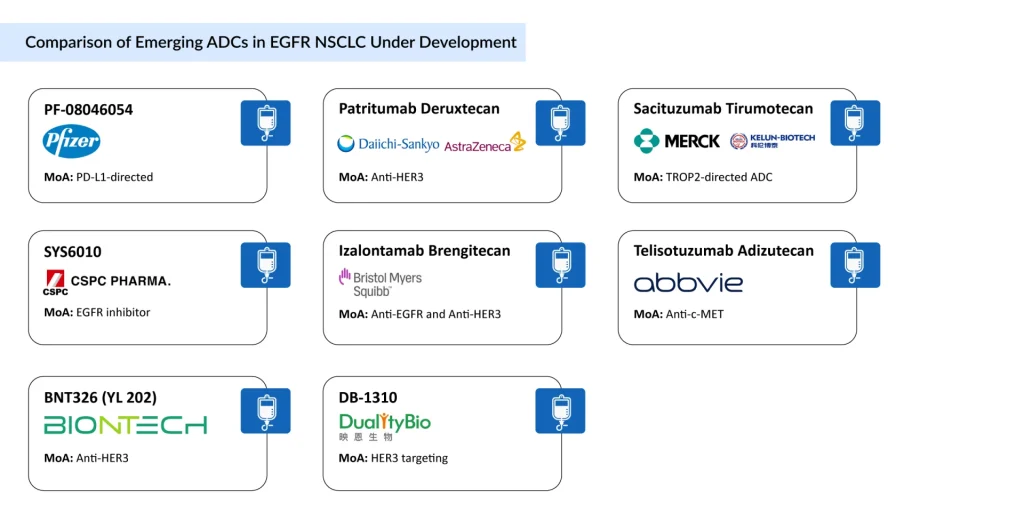
- Key players shaping this landscape include Merck and Kelun-Biotech’s sacituzumab tirumotecan, Pfizer’s PF-08046054, CSPC Pharmaceutical’s SYS6010, Bristol Myers Squibb’s izalontamab brengitecan, AbbVie’s telisotuzumab adizutecan, Daiichi Sankyo/AstraZeneca’s patritumab deruxtecan, BioNTech’s BNT326 (YL-202), DualityBio’s DB-1310, and ALX Oncology’s ALX2004.
- Beyond ADCs, innovation is extending into gene therapy approaches such as Reqorsa in combination with osimertinib, as well as a new wave of next-generation TKIs like sutetinib, silevertinib (BDTX-1535), and JIN-A02, all targeting resistance pathways. The bispecific antibody pamvatamig (MCLA-129) with chemotherapy adds further diversity to the evolving treatment mix.
Non-small cell lung cancer (NSCLC) has long been a battlefield of innovation, but the arrival of antibody-drug conjugates (ADCs) is signaling nothing short of a seismic shift. For years, EGFR-mutant NSCLC was synonymous with tyrosine kinase inhibitors (TKIs). Osimertinib became the gold standard, and the field celebrated each new TKI generation as a triumph. But resistance, as it always does, found a way. Now, the oncology community is turning to a new class of precision weapons, ADCs, that combine the targeting power of monoclonal antibodies with the cytotoxic potency of chemotherapy payloads, and the results so far are impossible to ignore.
NSCLC is increasingly becoming a biomarker-driven market, and EGFR, found mutated in approximately 10–15% of Western patients and up to 40–50% of Asian patients, is one of its most commercially lucrative segments. The EGFR-mutant NSCLC treatment market was valued at USD 6.6 billion in 2025 and is projected to grow at a 7.3% CAGR over the next decade, driven largely by the emergence of targeted biologics and ADCs. With Dato-DXd (datopotamab deruxtecan) already securing regulatory approval and setting the benchmark, the race for ADC dominance in EGFR NSCLC is well and truly on. The ADCs are expected to occupy 19% of the total EGFR NSCLC market share by 2036, as per DelveInsight.
Downloads
Click Here To Get the Article in PDF

Recent Articles
- FDA Approves LEQEMBI IV Dosing for Early Alzheimer’s; Vanda Accepts FDA Hearing on Tradipitant fo...
- EGFR-Mutant NSCLC: From Targeted Therapy Breakthroughs to the Next Era of Precision Medicine
- Antibody-drug Conjugates in Oncology: An Overview of the Current and Future Treatment Landscape
- Kallyope’s Elismetrep Achieves Primary and Secondary Endpoints in Phase 2b Clinical Study; IDEAYA...
- Inozyme Raises $67M; Shanghai Miracogen partners with Synaffix; EdiGENE raises $15M; Antengene an...
Notable contenders include izalontamab brengitecan (Bristol–Myers Squibb), telisotuzumab adizutecan (AbbVie), and sacituzumab tirumotecan-EGFR (Merck), all backed by major pharma players with the resources to drive rapid uptake if data hold.
Below, we spotlight five of the most compelling ADCs emerging in the EGFR NSCLC space, each with a distinct mechanism, a unique clinical story, and the potential to become the next blockbuster in oncology.
CSPC Pharmaceutical’s SYS6010
Expected launch date (US): 2027
While Western pharma giants dominate headlines, SYS6010 from CSPC Pharmaceutical is a compelling reminder that China’s oncology pipeline is maturing rapidly. This novel ADC takes a direct approach, a humanized anti-EGFR IgG1 monoclonal antibody conjugated to the topoisomerase I inhibitor JS-1 via a cleavable glycine-glycine-phenylalanine-glycine (GGFG) tetrapeptide linker. By targeting EGFR directly, the very driver mutation defining this patient population, SYS6010 offers a molecularly logical therapeutic strategy.
The breadth of CSPC’s clinical development program for SYS6010 is impressive. According to the company’s Q2 presentation, SYS6010 is under evaluation in a Phase III study targeting first- and second-line EGFR-mutated NSCLC, a front-line ambition that would directly challenge established TKIs. Additionally, a trial comparing SYS6010 against chemotherapy in third-line and later EGFR-mutant NSCLC is in preparation, as is a separate comparative trial for EGFR-wildtype NSCLC in the 2L+ setting.
This multi-front clinical strategy reflects CSPC’s ambition to establish SYS6010 across the full continuum of NSCLC care, from first-line to heavily pretreated settings. While it still lags behind frontrunners like izalontamab brengitecan and telisotuzumab adizutecan in clinical stage, SYS6010’s EGFR-direct targeting rationale may prove uniquely synergistic with existing TKI-based regimens, and the GGFG linker technology is a well-validated platform that has underpinned some of the most successful ADCs in oncology.
Sadaf Javed, an oncology expert at DelveIsnight, said that we see SYS6010 as a pipeline-building asset that enhances CSPC’s oncology portfolio and provides a foothold in the lucrative ADC market. Its ability to demonstrate clinical differentiation versus ENHERTU and other next-generation HER2-ADCs will be critical to determining whether SYS6010 becomes a regional competitor or evolves into a globally competitive therapy.
Merck and Kelun-Biotech’s Sacituzumab tirumotecan
Expected launch date (US): 2028
Few ADC partnerships have generated as much excitement as the one between Merck and Kelun-Biotech for sacituzumab tirumotecan. This investigational ADC is a precision-engineered triad: sacituzumab, a monoclonal antibody with laser-focused affinity for TROP2; a topoisomerase I inhibitor payload; and an innovative, irreversible yet hydrolyzable linker that leverages proprietary conjugation technology to maximize tumor-specific delivery while minimizing off-target toxicity.
The commercial architecture behind this drug is as impressive as its science. Kelun-Biotech, the biologics-focused subsidiary of Kelun Pharmaceutical, developed the compound, and Merck’s global licensing deal grants it exclusive rights outside Greater China. This east-west partnership model has become a hallmark of ADC commercialization, allowing Asian innovation to be paired with Western commercial infrastructure.
What makes sacituzumab tirumotecan particularly compelling in the EGFR NSCLC context is TROP2’s near-ubiquitous expression across NSCLC subtypes, including those harboring EGFR mutations. This broad applicability could position the drug as both a post-TKI option and a combination partner, a duality that strategic oncologists and payers alike find attractive. If its ongoing clinical program confirms durable efficacy and a manageable safety profile, this asset has the hallmarks of a near-blockbuster entry.
Pfizer’s PF-08046054
Expected launch date (US): 2029
Pfizer’s foray into ADC development for NSCLC takes a distinctly immunological angle. PF-08046054, also known as PDL1V, is designed to target PD-L1-expressing cells, delivering monomethyl auristatin E (MMAE), a potent microtubule-disrupting agent, directly to the tumor microenvironment. This dual-action strategy is what sets PF-08046054 apart: not only does it exert direct cytotoxicity, but it also harnesses bystander killing effects and triggers immunogenic cell death, essentially reawakening the immune system as part of its mechanism of action.
The clinical logic here is sharp. EGFR-mutant NSCLC patients often respond poorly to conventional checkpoint inhibitors, a frustrating paradox given the theoretical immunogenicity of these tumors. By delivering MMAE via a PD-L1-targeted antibody, Pfizer’s approach could sidestep this resistance mechanism while simultaneously creating an immunostimulatory milieu that extends durability of response.
As per Javed, the ongoing Phase III study will be pivotal in confirming its therapeutic value and determining its future positioning within the NSCLC treatment landscape, particularly in the post-immunotherapy setting. Should Phase III results echo the promise seen in earlier trials, PF-08046054 could carve out a meaningful niche in later-line NSCLC, a segment where therapeutic options remain frustratingly limited and unmet need is highest.
Bristol-Myers Squibb’s Izalontamab Brengitecan
Expected launch date (US): 2029
If there is one ADC on this list that could genuinely redefine what precision oncology means in EGFR NSCLC, it is izalontamab brengitecan. A first-in-class bispecific EGFR×HER3 ADC co-developed by SystImmune and Bristol-Myers Squibb, this molecule is architecturally unprecedented: it simultaneously targets EGFR and HER3, two receptor tyrosine kinases that are not only co-expressed in epithelial cancers but frequently upregulated as escape mechanisms when either receptor is individually targeted.
The dual-targeting mechanism represents a paradigm shift. By concurrently blocking both EGFR and HER3 signaling pathways, izalontamab brengitecan aims to cut off the cross-talk and compensatory signaling that have historically driven resistance to EGFR-targeted monotherapies. Upon internalization, the ADC releases its cytotoxic payload to induce genotoxic stress and tumor cell death, and its design supports both monotherapy use and combination with osimertinib, opening doors to transformative combination regimens in EGFR-mutant NSCLC.
Javed notes that the asset’s potential lies in its broad applicability and the substantial unmet need in the resistant NSCLC space, but cautions that its success will hinge on confirming response durability, demonstrating an overall survival benefit, and differentiating itself from competitive assets like amivantamab. With BMS’s global commercial reach behind it, however, izalontamab brengitecan is perhaps the most closely watched pipeline asset across all of EGFR NSCLC development right now.
AbbVie’s Telisotuzumab Adizutecan
Expected launch date (US): 2032
AbbVie’s telisotuzumab adizutecan, also known as Temab-A or ABBV-400, occupies a strategically clever niche in the EGFR NSCLC landscape. Rather than targeting EGFR or HER3 directly, this investigational ADC goes after c-MET, a receptor that is frequently overexpressed or dysregulated in NSCLC and, crucially, is one of the most common bypass mechanisms through which EGFR-mutant tumors escape TKI therapy.
The molecular architecture is elegant: a humanized anti-c-MET monoclonal antibody conjugated through a cleavable linker to a potent topoisomerase I inhibitor payload. Upon binding c-MET-overexpressing tumor cells, the complex is internalized, delivering cytotoxic payload intracellularly while minimizing systemic exposure. This tumor-directed payload release mechanism is precisely what differentiates ADCs from conventional chemotherapy, and in the context of c-MET-amplified NSCLC, which carries a particularly grim prognosis, the targeting specificity could be transformative.
Currently advancing through early- to mid-stage clinical evaluation, telisotuzumab adizutecan is being studied across advanced and refractory NSCLC settings where c-MET overexpression is particularly prevalent. AbbVie’s deep immunology and oncology expertise, combined with its formidable commercial infrastructure, positions Temab-A as a dark horse that could rapidly accelerate up the competitive ladder once robust Phase II or Phase III data emerge.
The five ADCs above are the vanguard, but they are far from alone. The EGFR NSCLC pipeline is experiencing an unprecedented wave of innovation across multiple modalities. Patritumab deruxtecan (HER3-DXd, Daiichi Sankyo/AstraZeneca), BNT326/YL202 (BioNTech), DB-1310 (DualityBio), and ALX2004 (ALX Oncology) are among the promising additional ADCs in earlier development stages. Meanwhile, next-generation TKIs such as sutetinib, silevertinib (BDTX-1535), and JIN-A02 are targeting resistance pathways from a small-molecule angle, and the bispecific antibody pamvatamig (MCLA-129) paired with chemotherapy adds yet another dimension to the competitive mix.
Perhaps most intriguingly, BG-60366 from BeOne Medicines has emerged as a first-in-class Chimeric Degradation Activation Compound (CDAC), a wholly new therapeutic class entering the EGFR NSCLC space. With multiple modalities advancing simultaneously, ADCs, TKIs, gene therapies, and bispecifics, the EGFR NSCLC treatment landscape is poised to become increasingly crowded and competitive, with each novel agent vying for differentiation and market share.
The anticipated approvals of these ADCs will not merely expand the treatment algorithm for EGFR NSCLC; they will fundamentally reconstruct it. For the first time, oncologists may have the tools to address multiple resistance mechanisms simultaneously, extend meaningful responses well beyond what TKIs alone can achieve, and offer patients an escalating ladder of effective options from first diagnosis through salvage therapy.
For patients, the implications are profound. Survival curves that have historically flattened after second- or third-line therapy may begin to extend. For payers and healthcare systems, a new wave of premium-priced targeted therapies will demand innovative value-based frameworks. And for the pharmaceutical industry, EGFR NSCLC, long a cornerstone franchise, is set to become an even more fiercely contested and commercially dynamic arena.
The TKI era gave patients decades of meaningful benefit. The ADC era promises something more: the convergence of targeting precision, payload potency, and mechanistic diversity that could, for the first time, make long-term disease control in EGFR NSCLC a realistic clinical expectation rather than an aspirational goal. The next six years in EGFR NSCLC will not be a footnote in oncology; they will be a defining chapter.

Downloads
Article in PDF
Recent Articles
- Inozyme Raises $67M; Shanghai Miracogen partners with Synaffix; EdiGENE raises $15M; Antengene an...
- Transition of MET-NSCLC From an “Untapped” Segment to One With Significant Pipeline A...
- Antibody-Drug Conjugate: The Smart Biological Bomb
- Antibody-Drug Conjugate Market Outlook, 2015 Report in Market Now!
- EGFR-Mutant NSCLC: From Targeted Therapy Breakthroughs to the Next Era of Precision Medicine