EGFR-Mutant NSCLC: From Targeted Therapy Breakthroughs to the Next Era of Precision Medicine
Jun 22, 2026
Table of Contents
Summary
- Non-small cell lung cancer accounts for ~85% of all lung cancer cases, with incidence rising steadily.
- The EGFR-mutant NSCLC landscape has progressed from 1st/2nd-generation EGFR TKIs (limited by T790M resistance, poor CNS penetration, and toxicity) to more effective 3rd-generation TKIs, with osimertinib leading; however, resistance mechanisms like C797S mutations persist.
- Osimertinib (TAGRISSO) evolved from first-line monotherapy to adjuvant, locally advanced, and chemo-combination settings, extending treatment duration and becoming AstraZeneca’s multibillion-dollar “golden goose” and first-line standard of care.
- Key ADC competitors include BMS’ izalontamab brengitecan (BMS-986507), AbbVie’s telisotuzumab adizutecan (Temab-A), Merck/Kelun’s sacituzumab tirumotecan, Pfizer’s PF-08046054, and Duality Bio’s DB-1310, reshaping post-TKI treatment paradigms.
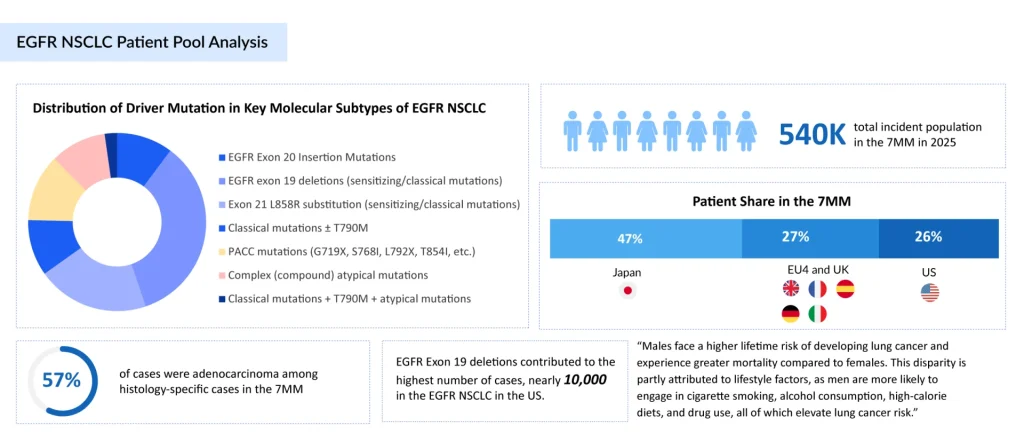
Lung cancer remains a major global health challenge, with non-small cell lung cancer (NSCLC) accounting for nearly 85% of all cases and demonstrating a steady rise in incidence across key regions. According to DelveInsight’s estimates, the 7MM number of NSCLC cases is expected to grow from ~540,000 in 2025 to ~585,000 by 2036. Additionally, around 60% of patients are diagnosed at an advanced stage, which significantly contributes to their high mortality rates. Consequently, NSCLC continues to represent a significant and persistent unmet medical need worldwide.
Downloads
Click Here To Get the Article in PDF

Recent Articles
- From Seagen to Innovent: Inside Pfizer’s Playbook for Oncology Leadership
- Roche’s CD79b ADC POLIVY: Attempt to Change DLBCL Treatment Space
- Antibody-Drug Conjugate: The Smart Biological Bomb
- The ADC Race in EGFR NSCLC: 5 Contenders Making Big Moves
- Antibody–Drug Conjugates: An Emerging Concept in Cancer Therapy
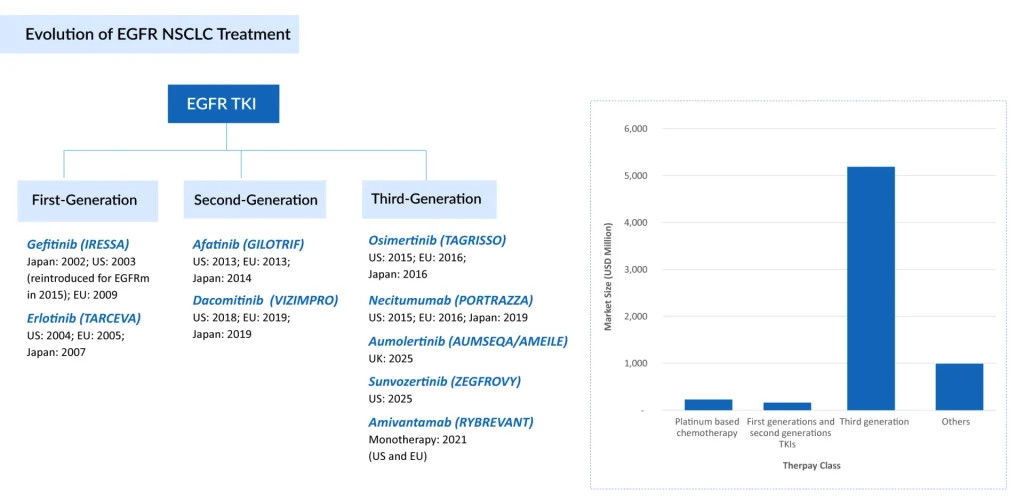
From Breakthrough to Dominance: The Evolution of EGFR-Targeted Therapy in NSCLC
The EGFR-mutant NSCLC treatment landscape has evolved from first- and second-generation EGFR TKIs to more effective third-generation therapies, led by Osimertinib (TAGRISSO), with newer agents and ADCs further expanding treatment options. This evolution reflects ongoing efforts to overcome resistance, improve CNS activity, and address unmet needs across different stages of disease. The limitations of first- and second-generation EGFR TKIs, including acquired resistance (particularly T790M), poor CNS penetration, and treatment-related toxicities, drove the development of third-generation agents such as osimertinib. While third-generation TKIs have significantly improved efficacy and tolerability, the emergence of resistance mechanisms such as C797S mutations continues to highlight ongoing unmet needs in EGFR-mutated NSCLC.
Dominance of third-generation EGFR TKIs in 2025
Osimertinib (TAGRISSO): A Landscape Changing EGFR TKI and golden goose of Astrazeneca
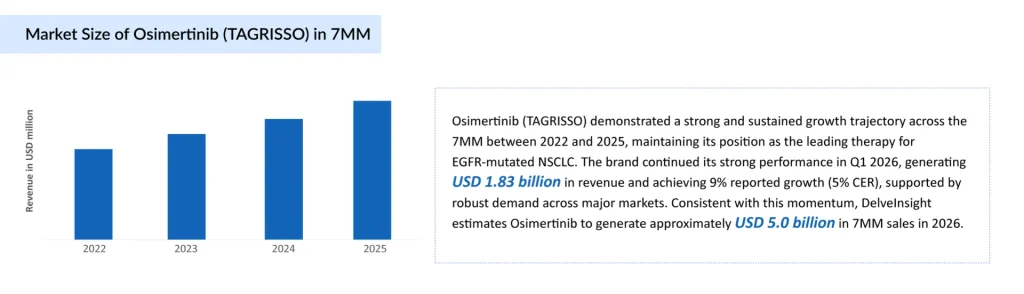
The third-generation EGFR-mutant NSCLC market has been shaped by a deliberate sequence of lifecycle-management strategies centered on osimertinib. Following its initial approval as a first-line monotherapy, osimertinib expanded into adjuvant and locally advanced settings, enabling earlier intervention and substantially increasing treatment duration, which transformed the asset into a multibillion-dollar franchise. The subsequent approval of osimertinib in combination with platinum-based chemotherapy further reinforced its market leadership by extending benefits to a broader patient population.
Amivantamab (RYBREVANT) Drives Transformation of the EGFR-Mutated NSCLC Landscape through Label Expansion and Competitive Differentiation
The EGFR-mutated NSCLC treatment landscape has undergone a significant transformation with the emergence of amivantamab (RYBREVANT), the first bispecific antibody targeting both EGFR and MET pathways in lung cancer. Initially developed for patients with EGFR Exon 20 insertion-mutated NSCLC, amivantamab established itself as a novel treatment option in a patient population with historically limited targeted therapy choices.
The withdrawal of mobocertinib (EXKIVITY) following the failure of its confirmatory Phase III study significantly reshaped the EGFR Exon 20 insertion landscape. The loss of a key oral TKI reduced competition in the segment and accelerated the shift toward alternative treatment approaches, particularly amivantamab. This development created a substantial opportunity for amivantamab to strengthen its position as a leading therapy in Exon 20 insertion-positive NSCLC. Nevertheless, the market remains highly competitive, supported by the recent approval of sunvozertinib (ZEGFROVY) and a growing pipeline of emerging therapies, including zipalertinib, JMT101, furmonertinib (firmonertinib), and pamvatamig (MCLA-129). Among these, zipalertinib has emerged as a particularly notable contender due to its selective targeting of EGFR Exon 20 insertion mutations, favorable tolerability profile, and recent FDA acceptance of its NDA, with a PDUFA action date of February 27, 2027.
At the same time, amivantamab has continued to strengthen its market position by expanding from a second-line treatment option into earlier lines of therapy. Following its initial approval in previously treated EGFR Exon 20 insertion-positive NSCLC, subsequent clinical successes enabled its advancement into the first-line setting, significantly broadening its addressable patient population. More recently, the approval of amivantamab plus lazertinib introduced a chemotherapy-free regimen for EGFR-mutated NSCLC, representing a major milestone in the treatment landscape.
This advancement has also intensified competitive pressure on osimertinib, which has long been the standard of care in first-line EGFR-mutated NSCLC. The approval of the amivantamab–lazertinib combination, supported by superior efficacy outcomes in pivotal studies, has introduced a strong challenger to osimertinib’s market leadership and is expected to influence future treatment sequencing decisions. Looking ahead, competitive differentiation is likely to increasingly depend on factors such as the adoption of subcutaneous (SC) formulations, optimization of sequencing strategies, and the development of effective post-progression treatment approaches. These factors are expected to play a critical role in shaping the next phase of market evolution and competitive dynamics within the EGFR-mutated NSCLC landscape.
Datopotamab Deruxtecan (DATROWAY) in EGFR-Mutated NSCLC: Evolving Positioning in a Competitive ADC Landscape
Datopotamab deruxtecan, developed by AstraZeneca and Daiichi Sankyo, was initially positioned as a broad treatment option in advanced NSCLC across both EGFR-mutated and EGFR wild-type populations. However, early clinical data in unselected/biomarker-agnostic NSCLC showed variable efficacy, alongside rising competition from immunotherapy-based regimens and other emerging ADCs in EGFR NSCLC, limiting its differentiation in a highly crowded market.
Following its approval and clinical expansion, datopotamab deruxtecan has gained renewed importance in previously treated EGFR-mutated NSCLC, particularly in patients who have progressed on EGFR-targeted therapies and platinum-based chemotherapy. Unlike mutation-specific EGFR TKIs, datopotamab deruxtecan follows a mutation-agnostic ADC strategy within EGFR-mutated disease, potentially offering activity across key subgroups such as Exon 19 deletion and Exon 21 L858R mutations.
From a strategic market perspective, its positioning reinforces the growing importance of post-progression treatment sequencing and intensifies competition in the expanding antibody–drug conjugate (ADC) landscape. Key competitors include Izalontamab brengitecan (BMS-986507), Telisotuzumab adizutecan (Temab-A), Sacituzumab tirumotecan, PF-08046054, and DB-1310, collectively reshaping the post-TKI treatment paradigm in EGFR-mutated NSCLC.
Unlocking the Untapped Potential in EGFR-Mutated NSCLC through PACC-Directed Therapies
The EGFR PACC-mutated NSCLC space remains a largely unexploited white space, with limited dedicated clinical development and only a few companies actively pursuing this niche. The key challenge lies in the distinct ATP-binding pocket compression, which reduces the effectiveness of standard EGFR TKIs and necessitates structure-guided drug design.
Next-generation efforts are focused on fourth-generation “MasterKey” inhibitors and mutation-adapted TKIs with improved PACC selectivity, CNS penetration, and safety profiles. Early innovators such as Furmonertinib and Silevertinib highlight the emerging shift toward precision-engineered therapies for non-classical EGFR alterations.
Key ASCO 2026 Takeaways in EGFR NSCLC
- Amivantamab + lazertinib demonstrated durable overall survival benefits in patients with atypical/uncommon EGFR mutations, reinforcing the potential of combination targeted therapy beyond classical EGFR mutations.
- Sunvozertinib achieved positive Phase III results in first-line EGFR exon 20 insertion-positive NSCLC, outperforming platinum-based chemotherapy and strengthening its position as a potential new standard of care.
- Silevertinib showed encouraging activity across non-classical and compound EGFR mutations, highlighting the growing focus on mutation-specific treatment approaches.
- ASCO 2026 data emphasized the industry’s shift from a “one-size-fits-all” EGFR treatment paradigm toward precision therapies tailored to specific EGFR mutation subtypes.
- Emerging therapies are increasingly targeting high-unmet-need populations, including exon 20 insertions, atypical EGFR mutations, and CNS-involved disease.
Future Market Outlook of EGFR NSCLC
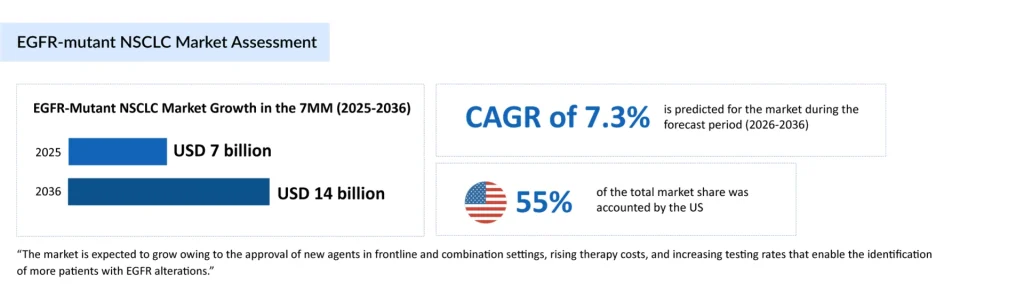
The EGFR-mutated NSCLC market is projected to grow steadily through 2036, reaching approximately USD 14 billion, driven by ongoing drug approvals, anticipated new launches, and expanding development in PACC mutations, which are broadening treatment options and creating new market opportunities. In parallel, emerging therapies such as Ivonescimab (Akeso/Summit Therapeutics), supported by positive Phase III HARMONi data and an FDA PDUFA date of November 14, 2026, are expected to further diversify the competitive landscape through differentiated mechanisms of action. Consequently, the market is evolving toward a more heterogeneous, biomarker-driven, and precision medicine–focused treatment paradigm, reinforcing the growing importance of targeted therapies in EGFR-mutated NSCLC.

Downloads
Article in PDF
Recent Articles
- Antibody-Drug Conjugate: The Smart Biological Bomb
- Unveiling the Potential of TROP-2 Inhibitors: A New Frontier in Cancer Treatment
- Roche’s CD79b ADC POLIVY: Attempt to Change DLBCL Treatment Space
- Antibody–Drug Conjugates: An Emerging Concept in Cancer Therapy
- ADCs in Lung Cancer Treatment: ENHERTU’s Rise, HER3 & TROP-2 Challenges, and What’s Next in ...