FAYUVI’s Comeback Story: How Ultragenyx Turned Rejection Into FDA Approval
Sep 25, 2026
Summary
- On September 17, 2026, the FDA approved Ultragenyx’s FAYUVI (rebisufligene etisparvovec-hopf) as the first treatment targeting the underlying cause of Sanfilippo syndrome type A in pediatric patients with preserved neurodevelopmental function.
- Data from the pivotal Transpher A study and long-term follow-up showed sustained reductions in cerebrospinal fluid heparan sulfate and higher cognitive scores versus an external natural-history cohort.
- FAYUVI was rejected by the FDA in July 2025 because of manufacturing issues involving Ultragenyx’s facility and a third-party site. After resubmission and priority review, the therapy received full approval in September 2026.
- Ultragenyx priced FAYUVI at a $3.95 million wholesale acquisition cost, making it one of the most expensive therapies ever launched and placing it just below Orchard Therapeutics’ $4.25 million LENMELDY.
For decades, a Sanfilippo syndrome type A diagnosis meant families could only manage symptoms. On September 17, 2026, that changed. The U.S. FDA approved Ultragenyx’s FAYUVI (rebisufligene etisparvovec-hopf), the first treatment for children with MPS IIIA that targets the underlying disease. The approval comes after a 2025 rejection, a record price tag, and a turbulent stretch for rare disease drug approval regulation. FAYUVI, formerly known as UX111, is a one-time intravenous gene therapy. It is indicated for the neurologic manifestations of MPS IIIA (Sanfilippo syndrome type A) in pediatric patients with preserved neurodevelopmental function.
The FDA granted standard full approval, not accelerated approval. The therapy uses an AAV9 viral vector to deliver a working copy of the SGSH gene into a patient’s cells. That lets the body make sulfamidase, the enzyme children with MPS IIIA lack. With the enzyme restored, heparan sulfate can be broken down properly instead of accumulating in the brain and body. The FDA has granted FAYUVI orphan drug, fast track, and breakthrough therapy designations.
Downloads
Click Here To Get the Article in PDF

Recent Articles
- Cannabidiol trial; MyoKardia aims; LDL drug data
- In a blind race to cure HIV, can Gene therapy be a deal-breaker?
- Snippet : Genetic Mutation
- AAV Vectors in Gene Therapy: How Recent Clinical Advances are Unraveling New Potentials?
- AstraZeneca and Incyte Collaborate; Tocagen’s therapy; FDA warns companies;FDA Revokes
Sanfilippo syndrome type A is an ultra-rare, fatal lysosomal storage disease. Children typically develop normally at first, then progressively lose cognitive, language, and motor abilities. Ultragenyx estimates about 3,000 to 5,000 patients in commercially accessible geographies, with a median life expectancy of about 15 years. Until this approval, no FDA-approved Sanfilippo syndrome therapy could change the course of the disease. FDA leaders called it a historic moment for families. Patient advocacy groups, including the Cure Sanfilippo Foundation and the National MPS Society, called it the result of decades of advocacy, fundraising, and perseverance.
The approval of FAYUVI is supported by data from the pivotal Transpher A study and long-term follow-up, with available data now extending to nearly eight years. Treatment demonstrated a reduction in heparan sulfate levels in cerebrospinal fluid across all age groups. In the primary efficacy population of 17 patients, treated children achieved cognitive scores approximately 23.5 points higher on the Bayley-III cognitive scale compared with an external natural history cohort of 27 children, according to Ultragenyx, with the company reporting a statistically significant difference of p<0.0001.
Developmental outcomes also showed meaningful differences, with eight younger or earlier-stage children reaching a cognitive developmental age of 36 months, compared with none in the natural history cohort. Among the 10 older or later-stage children, each retained function in at least one of the three assessed developmental areas, contrasting with the decline typically observed in untreated children.
The FDA noted that the study was open-label, single-arm, and multicenter, with treated patients evaluated against untreated historical controls. While this study design is commonly used in ultra-rare diseases, the limitations associated with historical comparisons underscore the importance of continued long-term follow-up and post-marketing data to further characterize FAYUVI’s durability and safety profile. As with other AAV-based gene therapies, FAYUVI carries several important warnings and precautions. Hepatotoxicity was the most common adverse reaction, with elevated liver enzymes reported in 85% of patients, requiring liver function monitoring and corticosteroid treatment before and after infusion. Platelet counts must also be monitored because of the risk of thrombocytopenia, with weekly monitoring recommended for the first four weeks followed by monthly assessments for six months.
Although no cases of thrombotic microangiopathy (TMA) were reported in clinical studies, the FDA includes TMA as an important warning associated with AAV therapies. Patients should also be monitored during and after administration for hypersensitivity and infusion-related reactions. In addition, FAYUVI carries a theoretical long-term malignancy risk because AAV vector DNA may integrate into the genome. Other commonly reported adverse reactions included vomiting in 67% of patients, abnormal behavior in 56%, diarrhea in 48%, and fever in 41%.
Corticosteroid treatment begins one day before FAYUVI infusion and continues for at least eight weeks. Precautions related to vector shedding are recommended for three months following treatment, while vaccinations should be avoided during the 30 days preceding administration. FAYUVI must be administered in a healthcare setting equipped to monitor patients and manage potential infusion-related reactions.
Ultragenyx set a wholesale acquisition cost of $3.95 million, a list price before discounts, rebates, or outcomes-based arrangements. This puts FAYUVI just behind Orchard Therapeutics’ LENMELDY, priced at $4.25 million, among the costliest gene therapies ever launched. Ultragenyx’s other new glycogen storage disease gene therapy, GENGLYCOS, is expected to cost $2.7 million. Access will run through a network of Qualified Treatment Centers in the U.S. Commercial product is expected to ship within 30 to 60 days. The company’s UltraCare program includes gene therapy guides to help families with insurance coverage and treatment logistics.
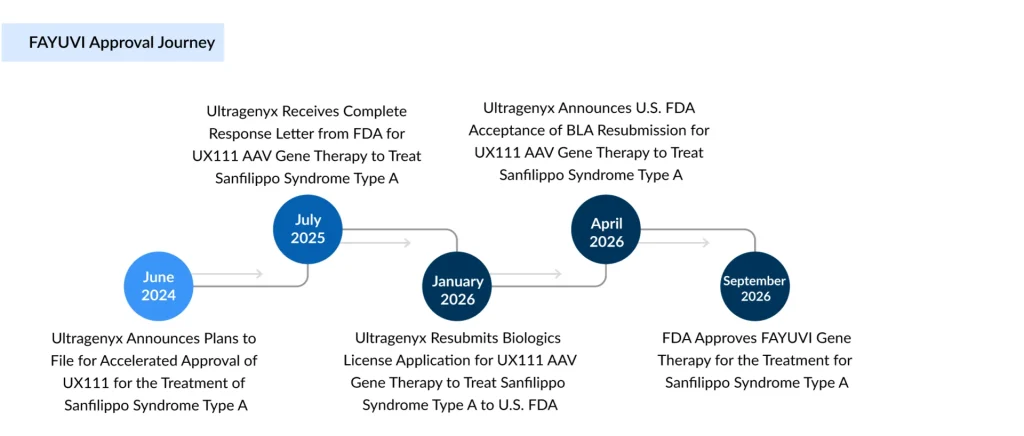
FAYUVI’s path to approval was far from smooth. The gene therapy’s origins trace back to Nationwide Children’s Hospital, where the vector was initially developed and later licensed to Abeona Therapeutics as ABO-102. In 2022, Ultragenyx secured exclusive rights to the program, with Abeona remaining eligible to receive up to $30 million in commercial milestones, along with tiered royalties. The road to approval faced a major setback in July 2025, when the FDA rejected Ultragenyx’s application citing manufacturing issues at both the company’s own facility and a third-party manufacturing site. However, the company resubmitted the application, and in April 2026, the FDA accepted it for priority review. That process culminated in approval on September 17, 2026.
FAYUVI is manufactured in the U.S., with production taking place at Ultragenyx’s facility in Bedford, Massachusetts, and at Andelyn Biosciences in Columbus, Ohio. The approval marks Ultragenyx’s second gene therapy approval in less than a month, following Genglycos for glycogen storage disease type Ia, and represents the company’s sixth FDA approval overall.
The FAYUVI approval also delivers Ultragenyx a second priority review voucher. The company plans to monetize its vouchers. Ultragenyx had $436 million in cash and securities as of June 30, while its shares climbed 13% to $14.50 on the day of the approval. The milestone comes after a difficult period for the company. Ultragenyx’s Angelman syndrome candidate, apazunersen, failed in Phase 3, triggering a more than 43% decline in the company’s stock at the time and prompting “significant expense reductions.”
The timing of FAYUVI’s approval is also notable against a broader debate over the FDA’s approach to rare disease therapies. Earlier this year, rare disease advocates protested at the agency’s White Oak campus over what they viewed as an overly stringent approach to rare disease approvals. Since then, the FDA approved Denali’s AVLAYAH for Hunter syndrome (MPS II) and withdrew a request for a control arm for Regenxbio’s MPS II candidate, although Regenxbio’s subsequent refiling has been delayed by a clinical hold. Against this backdrop, Ultragenyx said it hopes FAYUVI’s approval will help reinvigorate investment in other ultra-rare gene therapies.

Downloads
Article in PDF
Recent Articles
- Snippet : Genetic Mutation
- Zealand Pharma’s Phase III Results of Glepaglutide; FDA Approves Amylyx’s ALS Drug Relyvrio; Novo...
- DelveInsight’s Oncology based Reports, 2015
- Hemophilia B Market: How Pipeline Therapies are Transforming the Treatment Hemisphere?
- C4X Discovery and AstraZeneca Signs Deal; FDA Rejects Spectrum’s Poziotinib; Orphan Drug Designat...