Minimally Invasive Surgical Devices: Transforming Modern Surgery
May 06, 2026
Table of Contents
Modern medicine is undergoing a profound shift toward procedures that reduce patient trauma while maintaining, or even improving, clinical outcomes. At the center of this transformation are minimally invasive surgical (MIS) devices, which enable surgeons to perform complex procedures through small incisions using advanced visualization and precision tools. As healthcare systems increasingly prioritize patient recovery, efficiency, and cost-effectiveness, these technologies are redefining surgical standards across specialties.
Understanding Minimally Invasive Surgical Devices
Minimally invasive surgical devices are specialized instruments designed to perform surgical procedures with minimal disruption to surrounding tissues. Unlike traditional open surgeries that require large incisions, MIS techniques rely on small entry points, often supported by imaging systems such as endoscopes or laparoscopes.
Downloads
Click Here To Get the Article in PDF

Recent Articles
- LivaNova Launched SenTiva DUO; Candela Launched Matrix System; 3M Launched Medical Adhesive; MONA...
- Medtronic Secures FDA Green Light for Affera™ Mapping and Ablation System Alongside Sphere-9™ Cat...
- Seegene USA Advances Infectious Disease Diagnostics with FDA EUA for Multiplex PCR Assay; Synergy...
- eCential Robotics’s Surgical Robotic Platform for Spine Surgery; Baxter Gets 510(k) Clearance for...
- Asensus Surgical Acquired by Karl Storz; Allosource® Launched Aceconnex®; Siemens Healthineers FD...
These devices span a broad spectrum of technologies, including:
- Laparoscopic instruments: Long, thin tools inserted through small ports, guided by a camera (laparoscope) to perform abdominal and pelvic procedures
- Robotic surgical systems: Platforms like da Vinci that translate a surgeon’s hand movements into precise robotic actions with enhanced dexterity and 3D visualization
- Endoscopes and arthroscopes: Flexible or rigid scopes used to visualize and treat conditions inside the gastrointestinal tract, joints, airways, and other cavities
- Electrosurgical devices: Tools that use electrical energy to cut tissue or cauterize blood vessels with minimal trauma
- Stapling and suturing systems: Automated devices that enable precise tissue joining through small access points
Together, these technologies form the backbone of modern surgical care across nearly every clinical specialty.
Key Advantages of Minimally Invasive Surgical Devices
Minimally invasive surgical devices have transformed modern healthcare by enabling procedures that require only small incisions, rather than large open surgeries. This approach significantly reduces trauma to the body, resulting in less postoperative pain, minimal scarring, and a lower risk of complications such as infections or excessive bleeding. Patients undergoing minimally invasive procedures typically experience faster recovery times, allowing them to resume normal activities sooner compared to traditional surgical methods. This improved patient experience has been a major driver behind the widespread adoption of MIS technologies across multiple specialties.
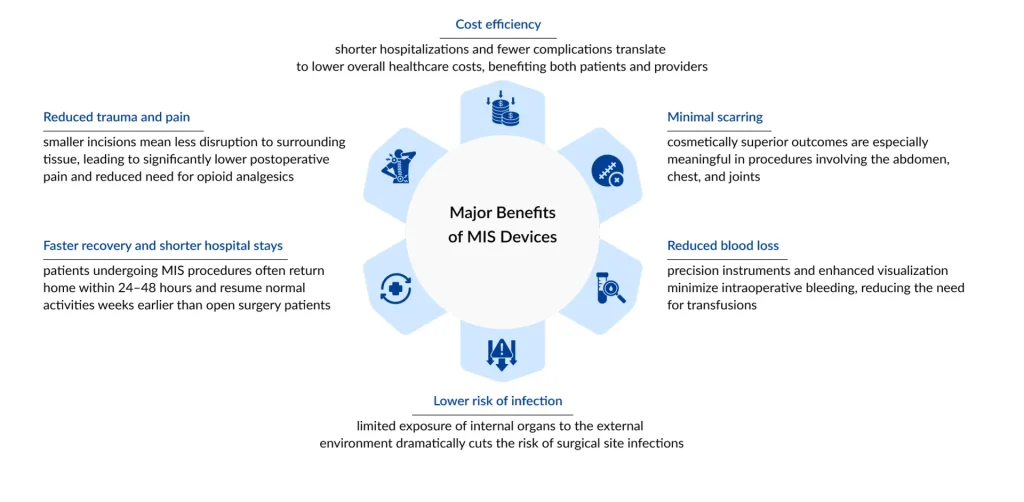
Another key advantage lies in enhanced precision and visualization. Many minimally invasive procedures utilize advanced imaging systems, high-definition cameras, and robotic-assisted tools, which provide surgeons with magnified, real-time views of the surgical site. This level of precision allows for more accurate interventions, reduced damage to surrounding tissues, and improved clinical outcomes. As a result, MIS devices contribute to better surgical consistency and can help lower the likelihood of revision procedures.
From a healthcare system perspective, minimally invasive surgical devices offer significant economic benefits. Shorter hospital stays and reduced need for postoperative care translate into lower overall treatment costs. Additionally, faster recovery times mean patients can return to work earlier, minimizing productivity losses. Hospitals also benefit from increased patient throughput and optimized resource utilization, making MIS an efficient choice in both developed and emerging healthcare settings.
Finally, the versatility of minimally invasive surgical devices continues to expand their applicability across a wide range of medical fields, including cardiology, orthopedics, gynecology, and oncology. Continuous technological advancements, such as robotic-assisted surgery, AI-guided navigation, and improved instrumentation, are further enhancing their capabilities. As innovation progresses, minimally invasive approaches are expected to become the standard of care for an increasing number of procedures, driven by their ability to deliver superior patient outcomes with reduced clinical burden.
Growing Clinical Applications of Minimally Invasive Surgical Devices
The clinical scope of MIS devices has expanded rapidly over the past decade, driven by continuous technological innovation and increasing demand for patient-centric care. These devices, ranging from advanced laparoscopic instruments to robotic-assisted platforms, are now widely used across multiple specialties, including cardiology, orthopedics, oncology, gynecology, and urology. Their ability to enable precise interventions through small incisions has significantly reduced surgical trauma, blood loss, and recovery times, making them particularly valuable in managing complex conditions such as cancer, cardiovascular diseases, and gastrointestinal disorders.
One of the most notable trends is the growing adoption of robotic-assisted surgery and image-guided systems, which enhance surgeon dexterity, visualization, and accuracy. These technologies are facilitating complex procedures that were previously only possible through open surgery, thereby broadening the range of treatable conditions. In oncology, for instance, minimally invasive techniques are increasingly used for tumor resections, biopsies, and targeted therapies, improving clinical outcomes while preserving healthy tissue. Similarly, in cardiovascular interventions, catheter-based devices are transforming the treatment of conditions such as valve disorders and arterial blockages, reducing the need for invasive open-heart procedures.
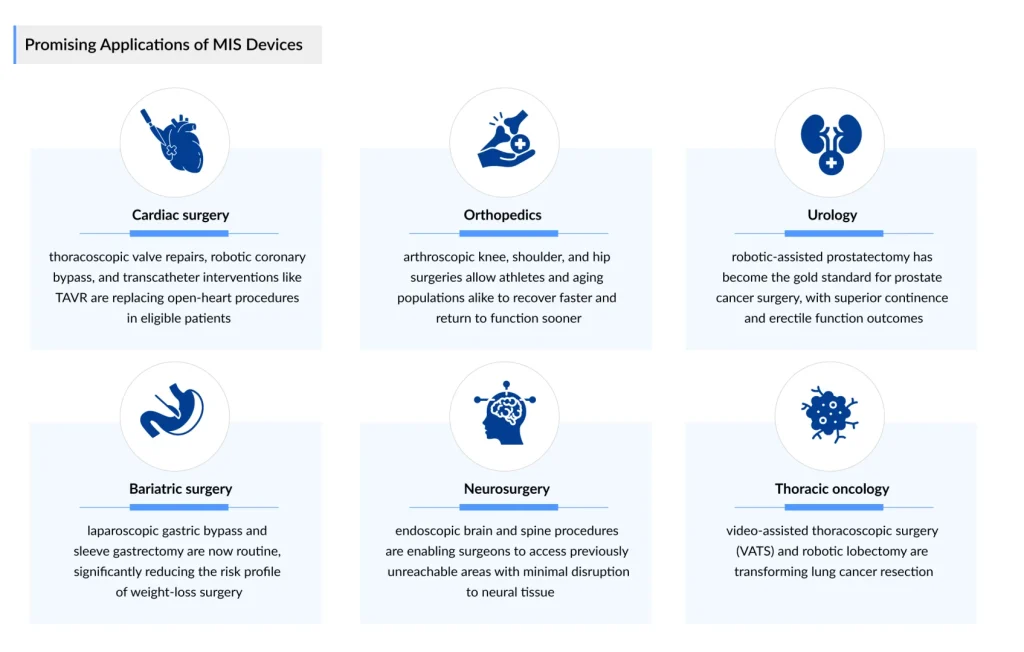
Additionally, the integration of artificial intelligence in healthcare, real-time imaging, and advanced sensor technologies is further accelerating the evolution of MIS devices. These innovations are enabling better intraoperative decision-making, personalized surgical planning, and improved patient monitoring. As healthcare systems continue to prioritize cost efficiency and faster patient recovery, the clinical applications of minimally invasive surgical devices are expected to expand even further, positioning them as a cornerstone of modern surgical practice.
Recent Advancements in the MIS Devices Segment
- In March 2026, Monteris Medical announced that a newly published randomized prospective study in Nature Communications had suggested that laser interstitial thermal therapy (LITT) using NeuroBlate could enhance the effectiveness of the immunotherapy drug pembrolizumab (KEYTRUDA) in patients with recurrent high-grade astrocytoma, including glioblastoma (GBM).
- In January 2026, Butterfly Medical, a developer of a proprietary non-surgical solution for benign prostatic hyperplasia (BPH), announced the successful completion of the final 12-month follow-up for all patients enrolled in its international pivotal clinical study.
- In January 2026, MellingMedical announced a strategic partnership with Applied Medical, a next-generation medical device firm recognized for its innovative minimally invasive surgical technologies. Through this collaboration, the Alexandria-based company will utilize its designation as a Small Business Administration (SBA)-Verified Service-Disabled Veteran-Owned Small Business (SDVOSB) to help deliver Applied Medical’s advanced solutions to federal healthcare providers supporting U.S. veterans, active-duty service members, and their families.
- In September 2025, Brainlab received U.S. FDA 510(k) clearance and launched its Spine Mixed Reality Navigation system. This advanced tool combines mixed reality with optical navigation, giving surgeons real-time, in-field visuals to aid accurate pedicle screw placement, even in complex or minimally invasive procedures.
- In August 2025, Cleveland Clinic Abu Dhabi became the first in the MENA region to use the Artisse Intrasaccular Flow Modulator, a minimally invasive device for treating wide-necked brain aneurysms.
MIS Devices Market Growth and Future Outlook
The global minimally invasive surgical devices market is on a steep growth trajectory, driven by rising surgical volumes, an aging global population, and accelerating technological innovation. The market was valued at over ~USD 31 billion in 2025 and is projected to grow at a CAGR of approximately 7% through 2034.
This growth is underpinned by rising surgical volumes, increasing prevalence of chronic diseases such as cardiovascular disorders and cancer, and a rapidly aging population that requires safer surgical interventions, along with the active participation of key companies such as Abbott, Olympus, Intuitive Surgical Inc., Stryker, JOHNSON & JOHNSON MEDICAL DEVICES COMPANIES, Medtronic, Boston Scientific Corporation, CONMED Corporation, KARL STORZ GmbH, CooperSurgical, Inc., Cook, AngioDynamics, FUJIFILM Corporation, Symmetry Surgical Inc., B. Braun Melsungen AG, BD, Shenzhen Mindray Bio-Medical Electronics Co., Ltd., Zimmer Biomet, Richard Wolf GmbH, Microport Scientific Corporation, and others.
Additionally, strong patient and physician preference for minimally invasive techniques over open surgeries continues to accelerate device adoption across specialties. Technological innovation is another major catalyst shaping market expansion. Advancements in robotic-assisted systems, AI-enabled surgical platforms, high-definition imaging, and precision instruments are significantly enhancing surgical accuracy and outcomes.Looking ahead, the future outlook for minimally invasive surgical devices remains highly favorable, with strong growth anticipated across both developed and emerging markets. Asia-Pacific is expected to be the fastest-growing region due to expanding healthcare access and increasing investments in advanced surgical technologies. The continued evolution of robotic surgery, combined with growing outpatient care models and cost-efficiency pressures on healthcare systems, will further drive adoption. As innovation continues to lower procedural complexity and improve accessibility, minimally invasive devices are set to become the standard of care across a wider range of surgical indications, positioning the market for long-term, innovation-led growth.

Downloads
Article in PDF
Recent Articles
- Medical Robots: Transforming Healthcare in the 21st Century
- Medtronic Secures FDA Green Light for Affera™ Mapping and Ablation System Alongside Sphere-9™ Cat...
- Robotics in Surgery: Has the Revolution Arrived?
- FiberSense CGM System Secures CE Mark; AMDI™ Fast PCR System Achieves FDA 510(k) Clearance and CL...
- Smith+Nephew’s Hip Arthroplasty System; Mammotome Launched the HydroMARK Plus Breast Biopsy Site ...