Orexin Receptor Agonists: A Promising New Wave in Narcolepsy Treatment
Aug 31, 2026
Table of Contents
Summary
- For decades, narcolepsy drugs only managed symptoms (stimulants, sodium oxybate, wake-promoters); none addressed the underlying biology. In 2026, orexin receptor agonists changed the game by directly replacing the missing orexin signal that causes narcolepsy type 1 (NT1).
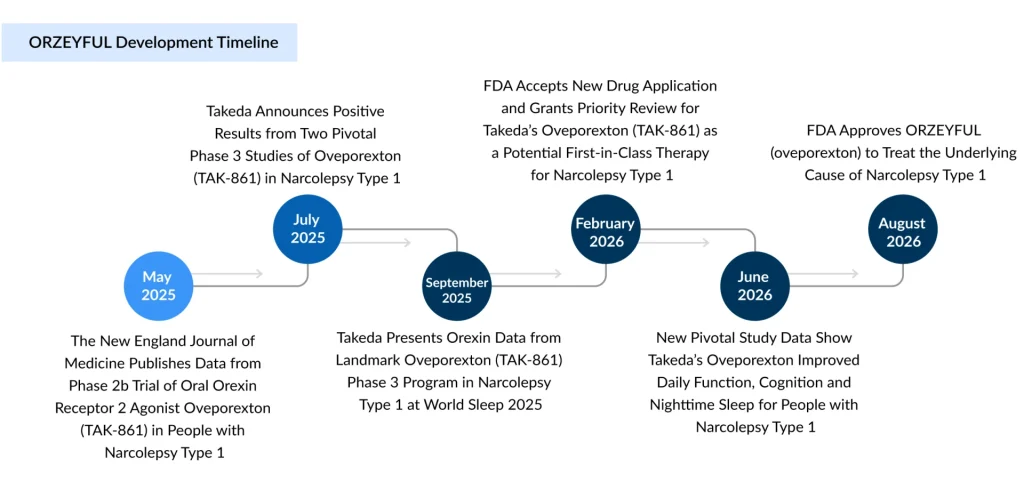
- On August 5, 2026, the FDA approved Takeda’s ORZEYFUL as the first NT1 treatment that targets the root cause (orexin deficiency) and addresses the full symptom spectrum.
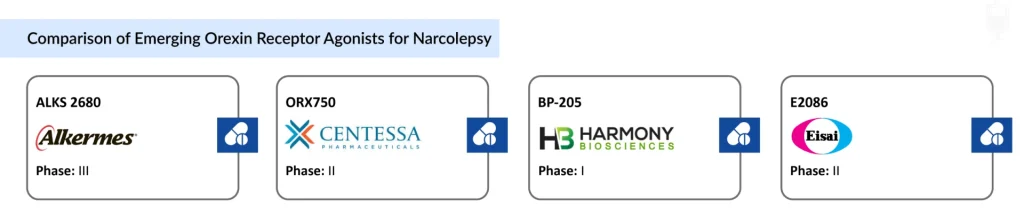
- Emerging challengers to Takeda’s ORZEYFUL include ALKS 2680 (Alkermes), ORX750 (Centessa Pharmaceuticals), BP-205 (Harmony Biosciences), E2086 (Eisai), and others, all of which are advancing through clinical development.
For decades, the narcolepsy medication list looked the same: stimulants to fight daytime sleepiness, sodium oxybate to smooth out nighttime sleep, and wake-promoting agents to get patients through the day. None of these narcolepsy meds actually fixed the problem, they just managed around it. That changed in 2026, and the shift is powerful enough to redraw the entire narcolepsy therapeutic market.
Downloads
Click Here To Get the Article in PDF

Recent Articles
- Sleep Disorders: An Emerging Public Health Issue
- FDA approves Non-Controlled treatment for Excessive Daytime Sleepiness
- Narcolepsy Treatment Market Awakens: A Projected Boom Fueled by Emerging Therapies
- Narcolepsy: Treatment options and market outlook
- Lion TCR Secures Triple FDA Milestones with IND Clearance for Chronic Hepatitis B; Corstasis Ther...
Narcolepsy type 1 (NT1) is caused by the destruction of hypothalamic neurons that produce orexin (also called hypocretin), the neuropeptide that keeps the brain anchored in a stable, waking state. Lose those neurons, and the brain can no longer hold the line between sleep and wakefulness, resulting in excessive daytime sleepiness, cataplexy (sudden muscle weakness), sleep paralysis, hypnagogic hallucinations, and fragmented nighttime sleep. It’s estimated to affect roughly 1 in every 2,000 people in the US, and the burden goes far beyond fatigue, it touches careers, relationships, driving safety, and basic day-to-day independence.
Every drug on the historical list of narcolepsy medications, modafinil, armodafinil, amphetamine salts, pitolisant, solriamfetol, sodium oxybate, worked downstream of the disease. Orexin receptor agonists are different. Instead of masking symptoms, they attempt to replace the missing signal itself by directly activating the orexin-2 receptor (OX2R), essentially telling the brain what a functioning orexin system would say. On the flip side of the same biology, orexin receptor antagonists (like suvorexant and lemborexant) already occupy a growing insomnia niche, quieting overactive orexin signaling to promote sleep, proof that this single neuropeptide pathway can be tuned in either direction. That dual relevance is part of why the orexin receptor antagonist market and the orexin agonist pipeline are both being watched so closely by investors and clinicians alike.
With a first approval now in hand and a stacked orexin receptor antagonists pipeline chasing it, the narcolepsy drugs market is entering its most disruptive stretch in years. Here’s what’s driving it.
Takeda’s ORZEYFUL: The First Drug to Treat Narcolepsy Type 1 as a Whole Disease
On August 5, 2026, Takeda’s ORZEYFUL (oveporexton, formerly TAK-861) became the newest, and most important, name on the list of approved narcolepsy type 1 treatments. The FDA approved ORZEYFUL as the first medicine for narcolepsy type 1 that addresses the condition’s full range of symptoms rather than individual pieces of it, and the first therapy to work by directly targeting the underlying loss of orexin signaling.
ORZEYFUL is an oral, selective OX2R agonist taken as a tablet twice daily. Approval was supported by two randomized, double-blind, placebo-controlled 12-week studies (FirstLight and RadiantLight) involving 273 adults with narcolepsy type 1. The trials showed significant improvement in patients’ ability to stay awake during the day versus placebo, along with meaningful gains across nighttime sleep disruption, hallucinations, and sleep paralysis. The most common side effects reported were insomnia, urinary urgency or frequency, and excessive salivation.
If you’re trying to track ORZEYFUL’s FDA status vs other narcolepsy drugs like WAKIX and SUNOSI, the distinction matters: WAKIX (pitolisant) and SUNOSI (solriamfetol) manage symptoms through histamine and dopamine/norepinephrine pathways respectively, while ORZEYFUL is the first to intervene directly on the orexin deficit that causes NT1 in the first place. That’s a genuinely new mechanism entering an established narcolepsy medication list.
Commercially, the drug isn’t quite on pharmacy shelves yet. Availability is pending a controlled-substance scheduling decision from the DEA, expected within about 90 days of approval, after which ORZEYFUL will roll out through specialty pharmacy channels in the US. Takeda has pegged the drug’s peak sales potential between $2 billion and $3 billion, a number that alone could meaningfully reshape the US narcolepsy market. ORZEYFUL has already been approved in both China and the United States, and Takeda has been candid that this launch is a platform play, not a one-off. The company describes itself as the leader in orexin science, with a broader portfolio of investigational orexin agonists moving through preclinical and clinical stages for other sleep-wake disorders and orexin-linked conditions such as respiration, mood, and metabolism.
That first-mover advantage is real. But it may be short-lived.
Emerging Threats to ORZEYFUL: The Orexin Pipeline Racing to Catch Up
Sadaf Javed, Functional Head of Forecasting & Analytics at DelveInsight, flagged ORZEYFUL’s approval as one of the most significant pharma events of Q3 2026, but also cautioned that Takeda’s lead won’t necessarily hold, given how many OX2R agonists are already advancing through late-stage trials.
If you’re wondering which companies have the most promising orexin agonist pills behind Takeda, four names dominate the emerging therapies for narcolepsy type 1 conversation.
Alkermes’ ALKS 2680: The Closest Challenger
Alkermes’ alixorexton (formerly ALKS 2680) is widely viewed as ORZEYFUL’s most direct competitor. In the phase 2 VIBRANCE-1 study, the drug produced statistically significant, dose-dependent improvements in sleep latency, as measured by the Maintenance of Wakefulness Test, at every dose tested. It has since earned FDA Breakthrough Therapy designation and moved into the phase 3 Brilliance program spanning both narcolepsy type 1 and type 2. A long-term extension study recently showed sustained, clinically meaningful improvements in wakefulness and excessive daytime sleepiness for up to nine months in both NT1 and NT2 patients, the first such long-term data reported for any orexin-2 receptor agonist. Unlike ORZEYFUL’s twice-daily regimen, alixorexton is being developed as a once-daily pill, and its expansion into NT2, a subtype ORZEYFUL isn’t approved for, could give Alkermes a wider addressable slice of the narcolepsy therapeutics market.
Javed has specifically noted that alixorexton’s dosing schedule and broader treatment scope could let it offer real competition to Takeda.
Centessa Pharmaceuticals’ ORX750: The “Best-in-Class” Contender
Centessa’s ORX750, developed using Nxera Pharma’s structure-based drug design platform, is being positioned as a potential best-in-class OX2R agonist across all three orexin-deficiency-linked disorders: NT1, NT2, and idiopathic hypersomnia. Phase 2a data showed statistically significant and clinically meaningful improvements across NT1, NT2, and IH cohorts, with generally mild-to-moderate, transient side effects, most commonly increased urinary frequency, insomnia, dizziness, and headache. Centessa’s leadership has said ORX750 continues to stand out as a potential best-in-class agonist for all three conditions, and possibly the first OX2R agonist approved specifically for NT2 and IH. The company expects to move ORX750 into a registrational program in early 2026, putting it on a credible path toward becoming the third orexin agonist to reach the market.
Harmony Biosciences’ BP-205: The Incumbent’s Insurance Policy
Harmony Biosciences already owns a major share of today’s narcolepsy medication list through WAKIX (pitolisant), which drove $261.3 million in net product revenue in Q2 2026 alone, up 30% year-over-year. Rather than cede the next generation of the market, Harmony is developing its own orexin-2 agonist, BP-205 (also known as BP1.15205), discovered by Teijin Pharma and developed with Bioprojet. Early data describe it as the most potent OX2R agonist currently in clinical development, with a short time-to-peak plasma concentration and dose-proportional exposure that supports once-daily dosing. Phase 1 single-ascending-dose data also showed a mean half-life of roughly 25 hours, reinforcing the case for once-a-day use. With nearly a billion dollars in cash on hand and a commercial narcolepsy franchise already in place, Harmony has both the balance sheet and the sales infrastructure to make BP-205 a serious long-term threat to ORZEYFUL, even from a later starting position.
Eisai’s E2086: The Dark Horse With Antagonist Pedigree
Eisai brings a unique angle: it already commercializes DAYVIGO (lemborexant), an orexin receptor antagonist used for insomnia, meaning it understands both sides of the orexin receptor antagonist market and the emerging agonist opportunity. E2086, Eisai’s in-house selective orexin-2 receptor agonist, was built on the same orexin research platform that produced Dayvigo. Phase Ib data presented at World Sleep 2025 showed that once-daily E2086 has the potential to improve daytime wakefulness in narcolepsy type 1 patients, outperforming both placebo and modafinil in the same trial. Nonclinical studies also demonstrated statistically significant increases in wake time and reductions in cataplexy rates. E2086 has since received orphan drug designation in Japan and moved toward broader phase 2 enrollment, a slower timeline than Alkermes or Centessa, but backed by a company with deep orexin-specific R&D experience.
The Wider Field Isn’t Slowing Down
The threat to ORZEYFUL isn’t limited to four names. Several pharma companies are also evaluating their lead assets in the narcolepsy treatment space. Add in ongoing lifecycle expansion of pitolisant, solriamfetol, and sodium oxybate formulations, and the full narcolepsy meds list is getting longer and more mechanistically diverse by the quarter. DelveInsight analysts are already pricing in this crowding effect.
As per DelveInsight estimates, the narcolepsy therapeutics market was valued at $2.5 billion in 2025, and growing at 5.6% CAGR by the 2034, with orexin receptor agonists repeatedly cited as the primary growth driver because, unlike older drug classes, they target the disease biology itself rather than just its symptoms. The US narcolepsy market specifically, is expected to remain the single largest revenue contributor throughout this window, largely because it’s where these new agonists are launching first.
The Outlook: Orexin Science Is Just Getting Started
ORZEYFUL’s approval is a genuine milestone, the first time a narcolepsy type 1 drug has aimed at the root cause instead of the symptoms sitting on top of it. But its window as the only orexin agonist on the market is going to be short. Alixorexton is already in phase 3 with a broader label ambition. ORX750 is angling for best-in-class status across three indications at once. BP-205 has an established commercial parent ready to defend its narcolepsy turf. E2086 carries the credibility of a company that already understands orexin pharmacology from the antagonist side. And the early-stage entry of several emerging orexin receptor agonists candidates is a reminder that this pathway’s appeal now extends well beyond the sleep-medicine specialists who pioneered it.
For patients, the competitive pressure is good news: more mechanisms, more dosing options, and more companies racing to solve the symptoms that stimulants and sedatives never fully addressed. For Takeda, it means the real work, building a durable, defensible position in a fast-moving orexin market, is only beginning. Whoever manages potency, dosing convenience, and safety best over the next few years won’t just win narcolepsy type 1. They’ll set the template for how the entire orexin drug class expands into type 2 narcolepsy, idiopathic hypersomnia, and beyond.

Downloads
Article in PDF
Recent Articles
- Narcolepsy: Treatment options and market outlook
- Narcolepsy Treatment Market Awakens: A Projected Boom Fueled by Emerging Therapies
- Sleep Aids Market: Examining Cutting-Edge Technologies and Major Breakthroughs
- Lion TCR Secures Triple FDA Milestones with IND Clearance for Chronic Hepatitis B; Corstasis Ther...
- Sleep Disorders: An Emerging Public Health Issue