TYK2 Inhibitors: The Competitive Race Fueling the Next Generation of Autoimmune Therapies
Aug 17, 2026
Table of Contents
Summary
- TYK2 inhibitors are emerging as a major class of oral immunology therapies, aiming to combine biologic-level efficacy with the convenience of a pill and fewer safety concerns than broader JAK inhibitors.
- Bristol Myers Squibb’s SOTYKTU remains the first approved TYK2 inhibitor and expanded its position in 2026 with FDA approval for active psoriatic arthritis.
- Takeda’s zasocitinib has significantly intensified competition after outperforming SOTYKTU in a head-to-head Phase 3 psoriasis trial, with more than 35% of patients achieving complete skin clearance at Week 16.
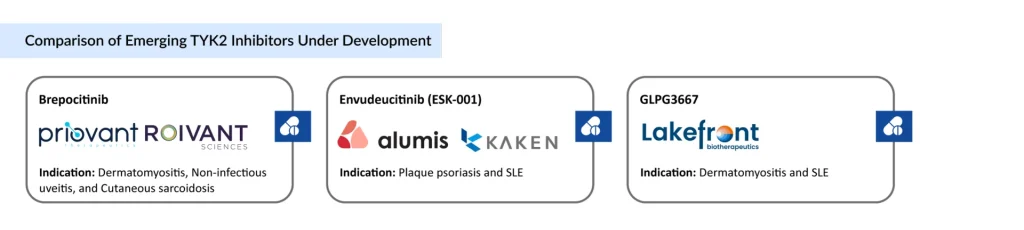
- Other promising candidates, including Alumis and Kaken Pharmaceutical’s Envudeucitinib, Priovant Therapeutics and Roivant Sciences’ Brepocitinib, Lakefront Biotherapeutics’ GLPG3667, and several others, are currently in development and are expected to pose strong competition to BMS’ SOTYKTU if approved.
For years, patients with moderate-to-severe plaque psoriasis and psoriatic arthritis (PsA) faced a frustrating trade-off: injectable biologics that worked well but came with needles, cost, and infusion logistics, or older oral options, like apremilast, that were easier to take but delivered underwhelming skin clearance. TYK2 inhibitors were supposed to close that gap: a pill that could rival biologic-level efficacy without the immunosuppressive baggage of broader JAK inhibition.
Downloads
Click Here To Get the Article in PDF

Recent Articles
- Novartis Secures FDA Traditional Approval for Fabhalta in Primary IgAN; GSK Reports Mixed Phase I...
- Zevra’s MIPLYFFA Niemann-Pick Disease Approval; FASENRA Approved for Eosinophilic Granulomatosis;...
- Emerging Lupus Nephritis Therapies: Addressing Unmet Needs through Innovation and Mechanistic Tar...
- Horizon, Viela Deal; Concert Schizo Drug Flop; Gilead Deals with Arcus and Gritstone
- AstraZeneca Discontinues Phase III eVOLVE-Lung02 Trial of Volrustomig in Metastatic NSCLC; argenx...
That promise is no longer theoretical. In 2026, the TYK2 class has gone from a one-drug story to a genuinely competitive field, with a first-in-class approval expanding into new indications, a head-to-head trial upset that rattled the market leader, and multiple next-generation candidates racing toward regulatory filings. If you’ve been tracking oral immunology, this is the year the competitive landscape for TYK2 inhibitors in immunology got real.
Why TYK2 Inhibitors Are Their Own Category, Not “JAK Inhibitors, Lite”
Tyrosine kinase 2 (TYK2) is one of four members of the JAK family, alongside JAK1, JAK2, and JAK3. Older JAK inhibitors bind the ATP pocket that all four kinases share, which is efficient, but it also means the drug can dial down blood cell production, immune surveillance, and several other pathways it wasn’t aiming for. That broad hit is where much of the class’s boxed-warning baggage (infection, blood clots, major cardiovascular events, malignancy) originated.
TYK2 inhibitors take a different route entirely. Rather than plugging the ATP pocket, molecules like deucravacitinib bind an allosteric site on TYK2’s regulatory (pseudokinase) domain, essentially locking the kinase in an inactive shape instead of blocking its fuel supply. Because that binding site is structurally distinct from JAK1/2/3, the drug can achieve selective allosteric inhibition of TYK2 without meaningfully touching its siblings.
Why does that matter clinically? TYK2 sits downstream of IL-23, IL-12, and type I interferon signaling, three pathways with an outsized role in psoriasis, psoriatic arthritis, lupus, and related autoimmune conditions. Hitting TYK2 selectively lets a drug quiet exactly those pathways while leaving JAK1/2/3-dependent processes largely alone. That distinction is precisely why deucravacitinib reached the market without the boxed warning carried by several pan-JAK drugs, and it’s the design thesis every next-generation TYK2 molecule is now chasing, refining, or trying to out-engineer.
As per Sadaf Javed, Functional Head of Forecasting & Analytics at DelveInsight, this is an exciting class that holds great potential for the development of treatment for autoimmune disorders and other indications. The maturation of current studies over the next few years will lead to a better understanding of TYK2 inhibitors and define their role in the therapy of autoimmune indications.
The Patient Burden Driving TYK2 Innovation
Before diving into the drugs, it’s worth remembering why this matters. Psoriasis affects roughly 8 million people in the U.S. alone, and about one in three of them will go on to develop psoriatic arthritis, a chronic, immune-mediated condition that attacks both skin and joints. In the US, plaque psoriasis is estimated to manifest in 2–3% of the adult population, with moderate-to-severe plaque psoriasis developing in approximately 20% of patients with plaque psoriasis, as per DelveInsight.
Systemic lupus erythematosus (SLE) exhibits a marked gender disparity, affecting women approximately nine times more frequently than men. The disease most commonly develops during the reproductive years and occurs less often after menopause, indicating that estrogen may play a role as a susceptibility factor in its development. According to DelveInsight’s estimation, the diagnosed prevalent cases of SLE in 7MM in 2025 were nearly 936K.
The growing burden of psoriasis, psoriatic arthritis, and systemic lupus erythematosus highlights the urgent need for therapies that provide sustained efficacy while minimizing safety concerns associated with long-term immunosuppression. This unmet need has positioned TYK2 inhibition as one of the most promising therapeutic approaches in autoimmune disease management.
SOTYKTU’s Big Year: From First-in-Class to First-in-PsA
Bristol Myers Squibb’s deucravacitinib (SOTYKTU) has spent nearly five years as the only approved TYK2 inhibitor on the market, first clearing the FDA in 2022 for moderate-to-severe plaque psoriasis. In March 2026, the drug picked up a second, arguably more important nod: the FDA approved SOTYKTU for adults with active psoriatic arthritis, making it the first and only TYK2 inhibitor authorized for PsA in the United States.
The approval leaned on two pivotal Phase 3 trials, POETYK PsA-1 and POETYK PsA-2, which together enrolled nearly 1,300 patients, some biologic-naïve, others who had already cycled through biologic DMARDs. Both studies were placebo-controlled and ran out to 52 weeks, and BMS reported that 54% of patients on the once-daily 6 mg dose hit an ACR20 response, a standard bar for meaningful improvement in joint disease activity. The safety profile in PsA patients tracked what BMS had already logged in psoriasis: acne, folliculitis, elevated creatine phosphokinase, herpes simplex infections, oral ulcers, and upper respiratory infections, a familiar, largely manageable list rather than a new red flag.
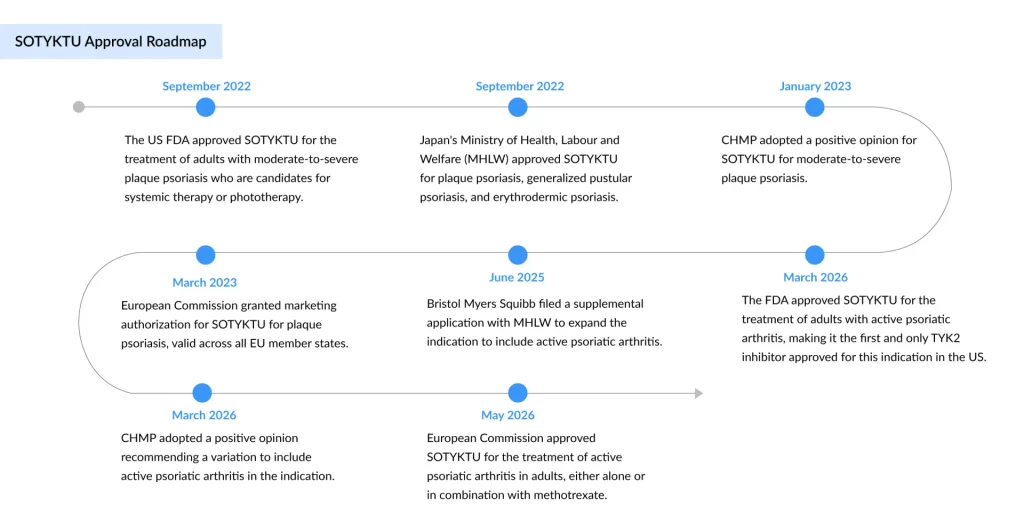
Strategically, the timing matters. SOTYKTU’s psoriasis launch never quite hit BMS’s own $4 billion peak-sales projection, with 2025 revenue landing around $291 million against stiff payer pushback in the U.S. market. A second, differentiated indication, one where oral options are still relatively scarce compared with injectable biologics, gives BMS a fresh commercial lever, and it cements deucravacitinib’s role as the reference drug every newer TYK2 molecule now gets measured against.
Takeda’s Zasocitinib Beats SOTYKTU Head-to-Head, And Changes the Conversation
If SOTYKTU’s PsA approval was the class’s validation moment, Takeda’s mid-2026 data readout was its disruption moment. Takeda’s zasocitinib (formerly TAK-279), acquired from Nimbus Therapeutics for $4 billion upfront back in 2022, went directly at BMS in a head-to-head Phase 3 trial in moderate-to-severe plaque psoriasis, not a cross-trial comparison, an actual apples-to-apples study against SOTYKTU itself.
Zasocitinib won. At Week 16, more than 35% of patients on zasocitinib achieved PASI 100 (complete skin clearance), described by Takeda as more than 2.5 times the response rate seen with SOTYKTU in the same trial. The drug also cleared every key secondary endpoint against BMS’s pill, echoing earlier cross-trial signals that had already hinted zasocitinib could outperform; Takeda’s Phase 3 program had shown PASI 100 rates as high as 33.4%, well above the roughly 10–14% ceiling BMS had reported for SOTYKTU.
Takeda now plans to file for FDA approval and aims to launch zasocitinib in plaque psoriasis in the first half of 2027, with psoriatic arthritis and inflammatory bowel disease studies advancing behind it. The company has pointed to zasocitinib’s pharmacology, allowing 24-hour target binding at doses that stay selective for TYK2 without spilling into JAK1 activity, as the mechanistic reason for the gap in efficacy. Whether or not that specific explanation holds up under more scrutiny, the headline is simple and important: a second TYK2 inhibitor has now beaten the first-in-class drug in a real head-to-head trial, and that’s a very different competitive dynamic than the one BMS enjoyed for its first four years on the market.
TYK2 Inhibitors in Development: Who Else Is Racing to the Finish Line?
Beyond the BMS-Takeda rivalry, a broader wave of TYK2 inhibitors in development is pushing the category into new molecules and new diseases entirely.
Alumis and Kaken Pharmaceutical’s Envudeucitinib: The New Efficacy Benchmark?
Alumis and Kaken Pharmaceutical’s envudeucitinib, formerly ESK-001, delivered some of the strongest oral psoriasis data seen to date. The drug showcased positive Phase 3 data from its ONWARD1 and ONWARD2 psoriasis trials in early 2026, reporting PASI 90 response rates around 60–68% by Week 24 and roughly 40% of patients reaching PASI 100. The company’s pitch centers on precision-engineered, sustained 24-hour TYK2 occupancy, the claim being that most competing molecules don’t fully saturate the target around the clock, and that “maximal inhibition” is what separates good responses from great ones. Alumis is preparing a psoriasis NDA filing for the second half of 2026, alongside a potentially pivotal Phase 2b readout in systemic lupus erythematosus expected in Q3 2026, with Sjögren’s disease and cutaneous lupus erythematosus flagged as the next indications in line.
Priovant Therapeutics and Roivant Sciences’ Brepocitinib: The Dual TYK2/JAK1 Bet
Not every next-generation candidate is chasing pure TYK2 selectivity. Brepocitinib deliberately inhibits both TYK2 and JAK1, on the theory that certain severe, poorly served autoimmune diseases need broader pathway coverage than TYK2 alone provides. That bet paid off in dermatomyositis: the Phase 3 VALOR trial showed brepocitinib 30 mg hit its primary endpoint and swept all nine key secondary endpoints, with benefits apparent by Week 4 and sustained through 52 weeks, alongside meaningful glucocorticoid tapering, a genuinely difficult goal in this disease. The FDA granted Priority Review, with a PDUFA target date at the end of September 2026, positioning brepocitinib to become the first approved therapy with a novel mechanism specifically for dermatomyositis treatment. A parallel lupus program is also underway.
Lakefront Biotherapeutics’ GLPG3667: A Cautionary Data Point
Not every TYK2 story is a clean win. Lakefront Biotherapeutics’ GLPG3667 hit its primary endpoint in a Phase 3-enabling dermatomyositis study but missed statistical significance on the primary endpoint in a companion systemic lupus erythematosus trial, even though it showed numerical improvement on several secondary measures. Galapagos is now weighing its options, including a search for a development partner, a reminder that TYK2 selectivity alone doesn’t guarantee a positive readout, and that indication choice, dosing, and trial design still matter enormously.
The Adjacent Threat: Oral IL-23 Receptor Blockers
It’s worth noting that TYK2 inhibitors aren’t only competing with each other. Johnson & Johnson and Protagonist Therapeutics’ oral IL-23 receptor antagonist also beat SOTYKTU in head-to-head psoriasis testing on its way to a 2026 FDA approval. It works through a different mechanism entirely, but it’s chasing the same prize: a convenient, effective, biologic-caliber oral pill for psoriasis. For anyone mapping the full competitive landscape TYK2 inhibitors immunology now sits within, oral IL-23 blockade is the parallel track worth watching just as closely.
Market Implications: A Multi-Billion-Dollar Fight for the Oral Immunology Crown
The dollars underline how seriously the industry is taking this class. Takeda paid $4 billion upfront for zasocitinib before it had a single Phase 3 readout. Alumis is guiding toward a combined psoriasis-plus-lupus opportunity it estimates north of $50 billion by 2030. BMS built its entire cardiovascular-immunology franchise plan around SOTYKTU’s multi-indication potential. And that’s before counting Priovant/Pfizer’s rare-disease bet on brepocitinib or Lakefront Biotherapeutics’ now-uncertain path with GLPG3667. What does that mean practically for anyone mapping the competitive landscape TYK2 inhibitors immunology stakeholders are now navigating?
The TYK2 inhibitor market is evolving rapidly, with competition shifting beyond simple first-to-market advantage. While SOTYKTU’s early approval provided regulatory precedent and established physician familiarity, its lead is no longer insurmountable. The strong head-to-head performance demonstrated by zasocitinib highlights that superior clinical data can quickly reshape the competitive landscape.
Another defining trend is the strategic sequencing of indications. Rather than concentrating on identical development programs, companies are expanding into differentiated disease areas to maximize commercial opportunities. Bristol Myers Squibb is advancing into psoriatic arthritis, Takeda is focusing on inflammatory bowel disease, Alumis is targeting lupus and Sjögren’s syndrome, and Priovant is pursuing dermatomyositis. This diversified approach is likely to broaden the overall TYK2 market instead of concentrating competition within a single indication.
Commercial success will increasingly depend on market access as much as clinical performance. Despite strong uptake, SOTYKTU’s U.S. growth has faced pressure from payer access restrictions, underscoring that pricing, reimbursement strategies, and formulary positioning may ultimately prove just as important as efficacy once multiple TYK2 inhibitors compete for the same patient population.
Finally, the continued shift toward oral therapies remains one of the strongest market drivers. Across the pipeline, developers are betting that patients and physicians will increasingly favor the convenience of an oral treatment over injectable biologics. Emerging clinical evidence suggests that next-generation TYK2 inhibitors may deliver highly competitive efficacy while preserving the convenience advantage of oral administration, further accelerating this transition.
What’s Next for Oral Immunology Drugs?
TYK2 inhibitors have crossed the threshold from “promising new mechanism” to a genuinely competitive therapeutic class, complete with a first approved head-to-head loser, multiple billion-dollar bets, and an indication map that now stretches from skin and joints to lupus, dermatomyositis, and beyond.
Aparna Thakur, Project Manager of Forecasting & Analytics at DelveInsight, said that the future development of non-selective Tyk2 inhibitors will be focused on diseases where therapeutic benefit outweighs potential safety concerns, as illustrated by the current indications pursued for brepocitinib (SLE, dermatomyositis, and uveitis). On the other hand, Thakur said, the future seems bright for selective Tyk2 inhibitors that maintain the safety profile of deucravacitinib and provide improved efficacy in psoriasis, perhaps comparable to that of biologic agents targeting the regulatory cytokine IL-23, and in other potential indications.
Selective allosteric inhibition was the theoretical advantage on paper in 2022; in 2026, it’s showing up as measurable, head-to-head clinical superiority and real regulatory momentum. For patients, that means more oral options with a cleaner safety profile than older JAK drugs. For the industry, it means the race to define the next great oral immunology franchise is very much still open.

Downloads
Article in PDF
Recent Articles
- Zevra’s MIPLYFFA Niemann-Pick Disease Approval; FASENRA Approved for Eosinophilic Granulomatosis;...
- Merck to Acquire Harpoon Therapeutics; Novo Nordisk Enters Into Collaborations with Omega Therape...
- Emerging Lupus Nephritis Therapies: Addressing Unmet Needs through Innovation and Mechanistic Tar...
- The Next Wave in Peripheral T-Cell Lymphoma Treatment: 4 Late-Stage Drugs Making Their Mark
- Is Hydroxychloroquine the answer to all the COVID-19 questions?