Systemic Lupus Erythematosus: Mapping the Burden of a Complex Autoimmune Disease
Jul 22, 2026
Table of Contents
Summary
- Systemic lupus erythematosus is a highly unpredictable autoimmune disease characterized by fluctuating flares affecting multiple organs, impacting ~5 million people globally and ~513,000 diagnosed cases in the US (2025), with numbers expected to rise through 2036.
- Diagnosis is complex and lengthy, often taking 3–6 years, with over half of patients initially misdiagnosed with conditions such as rheumatoid arthritis or fibromyalgia.
- Key gaps in systemic lupus erythematosus treatment include lack of predictive biomarkers, limited curative options, and disparities in access to advanced treatments.
- Emerging therapies include diverse immunomodulators and advanced approaches such as CAR T-cell therapies, which show potential for durable remission or functional cures.
Systemic lupus erythematosus (SLE) doesn’t follow a script. One week a patient feels almost normal; the next, a flare sends joints, skin, kidneys, or even the brain into open revolt. For the estimated 5 million people living with some form of lupus worldwide, roughly 1.5 million of them in the United States, this unpredictability is the defining challenge of the disease. According to DelveInsight’s estimates, the US had approximately 513,000 diagnosed prevalent cases of SLE in 2025. The diagnosed patient population is expected to grow through 2036, supported by increasing disease awareness and the adoption of standardized diagnostic criteria, reflecting a sustained rise in disease recognition.
Downloads
Click Here To Get the Article in PDF

Recent Articles
- Aelis Farma pockets $30M; Alcyone unveils $23M for AAV gene therapies; Progentec and GSK collabor...
- Novo Nordisk Seeks FDA Approval for CagriSema; EU Approves Subcutaneous Self-administration of SA...
- HUTCHMED’s NDA Submission to FDA for Fruquintinib; Cytokinetics to Discontinue ALS Drug Candidate...
- Pfizer & Lilly’s JAK Inhibitors Drug; FDA Approves Lilly’s Bebtelovimab; GSKR...
- CAR-T Beyond Cancer: Resetting Immunity in Autoimmune Diseases
Women continued to bear the greatest disease burden, accounting for nearly 91% of diagnosed cases in 2025, while men represented approximately 9%, underscoring the well-established female predominance associated with hormonal and immunological factors. Real-world evidence further suggests that achieving sustained remission in SLE remains challenging. A considerable proportion of patients continue to experience ongoing disease activity despite available therapies, often requiring treatment intensification, emphasizing the significant unmet medical need and the demand for more effective therapeutic options.
It’s also why the systemic lupus erythematosus market has become one of the most closely watched spaces in autoimmune drug development, as physicians, patients, and pharmaceutical companies alike push for therapies that do more than manage symptoms.
A Disease That Hides in Plain Sight
SLE doesn’t announce itself with a single, unmistakable symptom. Instead, it shows up as a constellation: persistent fatigue, unexplained fevers, joint pain and swelling, photosensitivity, and, in a subset of patients, the classic butterfly-shaped rash across the cheeks and nose. Because these signs overlap so heavily with other conditions, the path from “something’s wrong” to “it’s lupus” is rarely a straight line.
Biology adds another layer of complexity. Hormonal factors, including estrogen and X-chromosome-linked immune regulatory genes, drive heightened immune activation in women, who tend to present with more classic, earlier-recognized symptoms like joint pain and rash. Men, though diagnosed far less often, tend to present later and with more severe organ involvement, such as kidney or cardiovascular disease, a pattern that makes the disease’s burden anything but uniform across the patient population.
The Diagnostic Odyssey: Years Lost to Uncertainty
Perhaps the single greatest burden SLE patients carry isn’t a symptom at all, it’s time. Many patients wait two to five years before they even see a physician equipped to investigate the possibility of lupus, and the journey from suspicion to a confirmed diagnosis can stretch three to six years in total. Along the way, misdiagnosis is disturbingly common. Studies suggest that well over half of eventual SLE patients are misdiagnosed at least once, frequently with conditions that share overlapping symptoms:
- Rheumatoid arthritis
- Fibromyalgia
- Sjögren’s Syndrome
- Scleroderma
- Chronic Fatigue Syndrome
- Undifferentiated Connective Tissue Disease (UCTD)
Antinuclear antibody (ANA) testing remains the standard first screen, positive in the vast majority of true SLE cases, but a positive result only opens the door to further, more specific testing (anti-double-stranded DNA, anti-SSA/Ro, anti-Smith antibodies), imaging, complement levels, and sometimes biopsies. Each additional test is another appointment, another wait, another point where a patient’s story can stall. This diagnostic uncertainty doesn’t just delay peace of mind; it delays treatment initiation and narrows the early therapeutic window that’s often most valuable for limiting long-term organ damage.
As per Sadaf Javed, Functional Head of Forecasting & Analytics at DelveInsight, ANA testing is the initial screening test for SLE, with indirect immunofluorescence as the gold standard; ANA is positive in >97% of patients, providing high sensitivity but low specificity, where a negative result makes SLE unlikely and a positive result requires further evaluation.
Where Systemic Lupus Erythematosus Treatment Still Falls Short?
Despite significant advances in the management of SLE, substantial unmet needs continue to limit optimal patient outcomes. The disease’s highly heterogeneous nature, involving multiple organ systems and fluctuating disease activity, makes timely diagnosis and personalized treatment particularly challenging. While corticosteroids, immunosuppressants, antimalarials, and newer biologics have improved disease control, many patients continue to experience recurrent flares, progressive organ damage, treatment-related toxicities, and incomplete or inadequate responses.
Javed highlighted that ~90% of patients diagnosed with SLE receive active treatment, with most initiating first-line therapy consisting of antimalarials with or without glucocorticoids and immunosuppressants. However, real-world outcomes indicate that sustained disease control remains challenging, with a significant proportion of patients experiencing persistent disease activity or recurrent flares. As a result, many patients require treatment escalation, with a substantial share progressing to second-line therapies such as biologics to achieve improved disease control and reduce corticosteroid dependence.
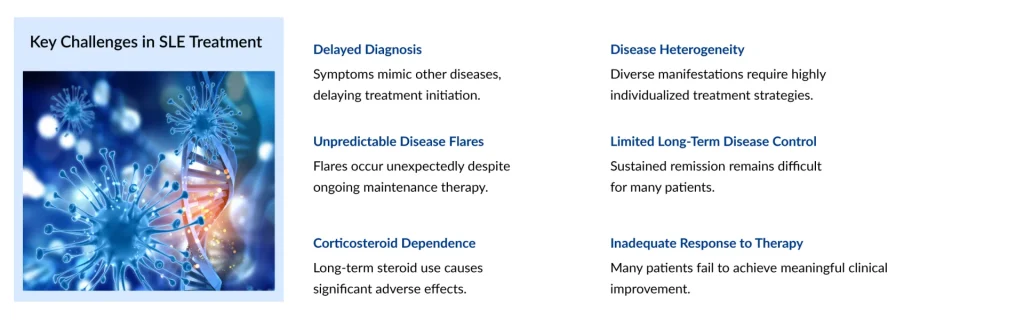
Long-term reliance on corticosteroids remains a major concern due to their association with serious adverse effects, underscoring the need for effective steroid-sparing therapies. In addition, limited biomarkers for predicting disease progression and treatment response, disparities in access to advanced therapies, and the lack of curative options further highlight the gaps in current SLE management. Continued research into targeted immunomodulatory therapies, precision medicine approaches, and novel biomarkers is expected to play a critical role in addressing these persistent challenges and improving long-term outcomes for patients with SLE.
The Systemic Lupus Erythematosus Market Working to Close the Gap
Patient burden and market dynamics are, in the end, two sides of the same coin. As diagnostic criteria have standardized and disease awareness has grown, the diagnosed population, and the systemic lupus erythematosus market size attached to it, has expanded accordingly. In the US alone, diagnosed prevalent cases numbered close to half a million in 2025, a figure expected to keep climbing through 2036, and the US systemic lupus erythematosus treatment market was valued at roughly USD 2.5 billion that same year, on a steady upward trajectory.
For over a decade, the systemic lupus erythematosus marketed drugs landscape stayed remarkably static, anchored by belimumab (BENLYSTA) as the only widely approved biologic. That began to shift with the arrival of anifrolumab (SAPHNELO), and the broader systemic lupus erythematosus (SLE) drugs market is now diversifying quickly. The competitive map spans large, established players and newer entrants alike, from GSK and AstraZeneca’s marketed biologics to systemic lupus erythematosus competitors Johnson & Johnson marketed products, such as J&J Innovative Medicine’s nipocalimab, now advancing toward Phase III development following positive Phase II results. As the field matures, companies long associated with adjacent autoimmune and inflammatory disease portfolios, including Sanofi’s systemic lupus erythematosus (SLE) ambitions and the broader conversation around Gilead’s competitors’ systemic lupus erythematosus marketed products, are increasingly part of the strategic picture, reflecting how crowded and closely watched this space has become.
Behind these corporate maneuvers sits a genuinely rich pipeline of systemic lupus erythematosus drugs: mechanistically diverse candidates including obinutuzumab, ianalumab, dapirolizumab pegol, upadacitinib, deucravacitinib, litifilimab, and enpatoran, alongside a new frontier of CAR T-cell therapies, rapcabtagene autoleucel, zolacabtagene autoleucel, resecabtagene autoleucel, and obecabtagene autoleucel among them, that aim for durable, drug-free remission rather than lifelong immunosuppression. Roughly half of specialists surveyed believe CAR T-cell therapy, if approved, could come closest yet to a functional cure for a subset of patients, even as questions around cost and long-term safety remain unresolved.
Why Does the Patient Story Still Matter Most?
Market growth, SLE pipeline diversity, and expanding treatment options are genuinely encouraging signals. But none of it changes the day-to-day reality for someone newly navigating unexplained fatigue and joint pain, wondering if this appointment will finally have an answer. Closing the gap between diagnosis and treatment initiation, validating biomarkers that can guide therapy sooner, and designing treatments that reduce, rather than trade, the burden of steroid dependence are the challenges that will define the next decade of SLE care.
The systemic lupus erythematosus treatment market is undeniably evolving. The real measure of success will be whether that evolution translates into fewer years lost to misdiagnosis, fewer flares that go uncontrolled, and a materially lighter burden for the patients living with this disease every single day.

Downloads
Article in PDF
Recent Articles
- 5 Upcoming Bispecific & Trispecific Antibodies Beyond Oncology
- TYK2 Inhibitors: The Competitive Race Fueling the Next Generation of Autoimmune Therapies
- Roche’s GAZYVA Extends Indications Into Lupus, Strengthening Immunology Pipeline
- BENLYSTA vs GAZYVA: Who Wins the Battle for Lupus Nephritis Treatment?
- Systemic Lupus Erythematosus Treatment Market: How Are the Leading Companies Countering the Risin...