JUVMO Enters the Parkinson’s Disease Treatment Arena: How AbbVie’s First-in-Class Drug Stacks Up Against Today’s Treatments and Tomorrow’s Pipeline?
Oct 09, 2026
Table of Contents
Summary
- On September 28, 2026, the FDA approved AbbVie’s JUVMO (tavapadon) as the first selective dopamine D1/D5 receptor agonist for adults with Parkinson’s disease, introducing a new dopaminergic approach after decades dominated by levodopa and D2/D3 agonists. The approval was supported by findings from the TEMPO-3 trial.
- Its closest established competitors include generic pramipexole and ropinirole, as well as rotigotine and other dopamine agonists.
- JUVMO will also compete with levodopa formulations, MAO-B inhibitors, COMT inhibitors, istradefylline, amantadine, and device- or infusion-based therapies.
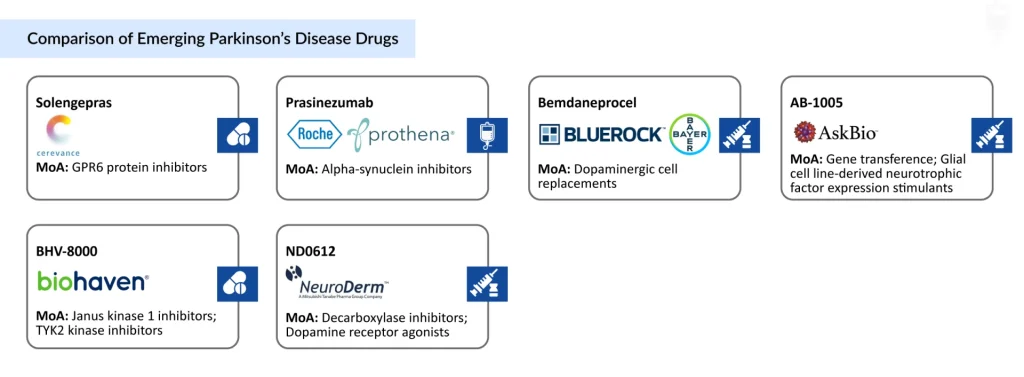
- More than 200 therapies, including Cerevance’s Solengepras, Roche/Prothena’s Prasinezumab, BlueRock/Bayer’s Bemdaneprocel, Asklepios BioPharmaceutical’s AB-1005, Biohaven’s BHV-8000, and NeuroDerm’s ND0612, are currently in development and could emerge as potential competitors to AbbVie’s JUVMO upon approval.
For decades, Parkinson’s disease treatment has run on one idea: replace the dopamine the brain is losing. Levodopa has anchored care since the 1960s, and dopamine agonists have supported it since the 1990s. Neither has delivered a clean solution. On September 28, 2026, that changed in at least one respect. The FDA approved AbbVie’s JUVMO (tavapadon). It is the first and only selective D1/D5 receptor agonist approved for adults with Parkinson’s disease. A once-daily pill, it enters a market with more treatment options than ever, and it arrives just as the pipeline moves toward therapies that could change the disease itself.
Downloads
Click Here To Get the Article in PDF

Recent Articles
- Navigating the Healthcare Horizon: Odyssey of Mergers, Funding, and Acquisitions in 2024
- PTC Therapeutics’ Gene Therapy Upstaza; Sanofi and Regeneron’s Dupixent; Bayer CAR-T Collaboratio...
- Key Updates on Phase 1 Trial of AB-1005 Gene Therapy for Multiple System Atrophy-Parkinsonian Typ...
- Gene and Cell Therapies in CNS Disorders: Miracle Cure? Opportunities Galore!
- Reprogrammed cells relieve Parkinson’s symptoms in trials
JUVMO is an oral tablet taken once a day. The label covers monotherapy in early Parkinson’s disease and add-on therapy to levodopa in patients with motor fluctuations. One drug therefore spans two very different stages of the disease. AbbVie expects it to be available in the US in October 2026. AbbVie acquired the drug through its purchase of Cerevel Therapeutics in 2023. The deal was valued at about $8.7 billion. Parkinson’s is a large market with no shortage of unmet need, which helps explain the price.
AbbVie’s chief scientific officer described the approval as the first dopaminergic breakthrough for Parkinson’s in decades. That is a company statement, and companies like superlatives. Still, nothing with this mechanism has reached patients before, so the claim has some basis.
Dopamine acts through five receptor subtypes, grouped into two families. Nearly every dopamine agonist on the market today, including pramipexole, ropinirole, and rotigotine, targets the D2/D3 family. These drugs work, but they carry a familiar set of problems: sleepiness, nausea, swelling, hallucinations, and impulse-control disorders such as compulsive gambling, shopping, and eating. JUVMO takes a different route. It targets dopamine D1 and D5 receptors and acts like dopamine to help improve everyday movement. AbbVie argues that selective D1/D5 targeting reduces the difficult trade-offs of D2/D3-selective agonists. That is a hypothesis in marketing form, not a proven advantage.
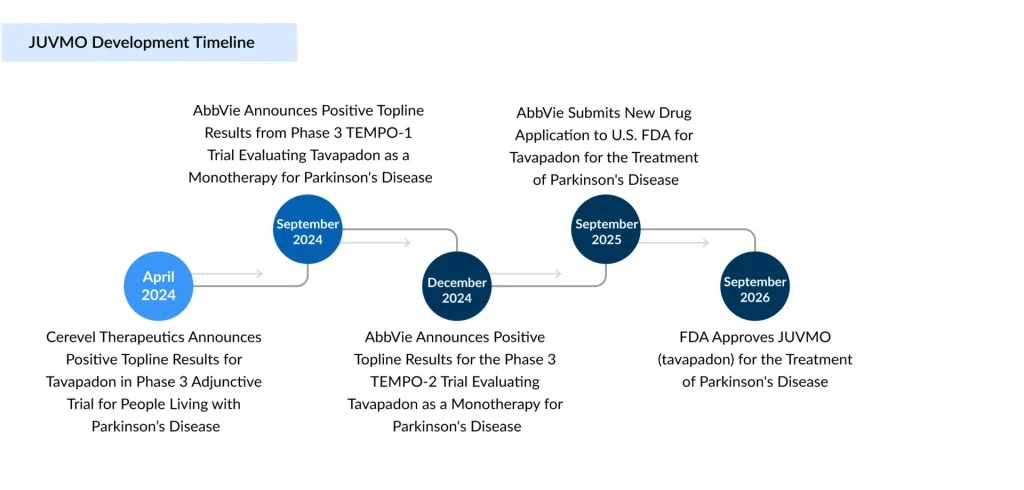
JUVMO’s approval is supported by results from the Phase 3 TEMPO program, which evaluated the treatment across both early and advanced Parkinson’s disease. TEMPO-1 and TEMPO-2 enrolled patients with early Parkinson’s disease who were not receiving oral levodopa, while TEMPO-3 evaluated JUVMO as an add-on to levodopa in patients experiencing motor fluctuations. In TEMPO-1, at week 26, both the 5 mg and 15 mg doses produced statistically significant improvements in daily-living activities, as measured by MDS-UPDRS Part II, compared with placebo, with scores improving by approximately 22–23% from baseline, whereas the placebo group experienced a 12% worsening.
TEMPO-2 similarly demonstrated a significant improvement in daily-living scores versus placebo at week 26, while combined measures of daily-living activities and motor function improved significantly in both trials. In patients with advanced Parkinson’s disease and motor fluctuations, TEMPO-3 showed that adding JUVMO to levodopa increased daily “on” time without troublesome dyskinesia by 1.7 hours, compared with 0.6 hours with placebo plus levodopa. JUVMO also reduced daily “off” time by 1.9 hours, versus a 0.9-hour reduction with placebo. Overall, these results represent a net improvement of approximately one hour in “on” time compared with placebo, indicating a clinically meaningful benefit for patients, although the magnitude of improvement does not appear to represent a substantial advance over existing add-on therapies.
Most adverse events in the trials were non-serious and mild to moderate. Without levodopa, the most common were nausea, headache, dizziness, fatigue, altered taste, vomiting, dry mouth, and anxiety. With levodopa, the most common were nausea, dyskinesia, dizziness, headache, hallucinations, and orthostatic hypotension.
The label also warns about low blood pressure, unusual urges (gambling, compulsive eating, shopping, increased sex drive), hallucinations, and dyskinesia. Impulse-control warnings are a hallmark of the D2/D3 agonist class, so JUVMO does not escape them entirely. Whether real-world rates of these problems are meaningfully lower than with pramipexole or ropinirole is a question the market will answer over the next few years. I found no head-to-head comparison data in the approval materials.
Competing Within Its Class: JUVMO vs. D2/D3 Dopamine Agonists
JUVMO’s nearest rivals are the dopamine agonists that neurologists have prescribed for decades. Pramipexole (MIRAPEX) and ropinirole (REQUIP) are oral tablets that have been available as low-cost generics for years. Rotigotine (NEUPRO) delivers the same D2/D3-targeting approach through a once-daily skin patch. Apomorphine (APOKYN as an injection, ONAPGO as an infusion) gives patients with advanced disease a fast-acting rescue option or continuous delivery. These Parkinson’s disease drugs share a mechanism, and they share a reputation for side effects such as daytime sleepiness, swelling, nausea, hallucinations, and impulse-control problems like compulsive gambling, shopping, and eating. AbbVie describes the existing agonists as primarily D2/D3-targeted and notes that their use may be limited by tolerability concerns. That framing is the foundation of JUVMO’s pitch.
JUVMO’s strategy is to be the differentiated premium option, not the cheapest one. It is the first selective D1/D5 agonist approved for Parkinson’s, and AbbVie says its different target reduces the trade-offs associated with D2/D3-selective agonists. The most natural patients are those most worried about the known agonist side effects: people with a history of impulsive behavior, older patients, and those with cognitive or psychiatric concerns. JUVMO also has a label covering both early monotherapy and add-on use with levodopa in patients with motor fluctuations, which few agonists can claim with evidence from large Phase 3 trials. The levodopa-sparing data support the story as well. After 85 weeks, 93% of participants on JUVMO plus levodopa had not raised their levodopa dose, and 94% of early-stage participants had not started levodopa. Those figures come from an open-label extension, so they are encouraging, not conclusive.
The obstacles are mostly economic and evidentiary. Generic pramipexole and ropinirole cost a small fraction of what a branded novel therapy will, and payers know it. If insurers impose step therapy and require patients to fail a generic agonist first, JUVMO’s early uptake will depend on prescribers documenting intolerance and on how well AbbVie’s patient-support programs smooth access. AbbVie has not disclosed pricing in the materials reviewed for this article. There is also a scientific caveat. The JUVMO label still warns about low blood pressure, hallucinations, dyskinesia, and unusual urges, the same issues that plague the older class, and the approval materials do not include head-to-head data against existing agonists. Until real-world experience shows whether the D1/D5 approach produces fewer of these problems in practice, the tolerability advantage remains a promising hypothesis, not a proven edge.
Competing Across Classes: Approved Alternatives
Beyond other agonists, JUVMO competes with nearly every category of Parkinson’s drug, starting with levodopa. Oral levodopa remains the foundation of Parkinson’s disease treatment, and no one expects JUVMO to replace it. Many patients eventually need higher and more frequent doses, which can contribute to dyskinesia, and about 70% have their dose increased within the first year. JUVMO’s role is to complement levodopa and, if its long-term data hold up, delay that escalation. The levodopa category is also far from static. Extended-release formulations such as RYTARY AND CREXONT, DHIVY, and inhaled levodopa (INBRIJA) all target the problem of wearing-off, so JUVMO will be judged against a steadily improving standard of care, not a static one.
In early disease, the most direct competition comes from MAO-B inhibitors such as rasagiline (AZILECT) and safinamide (XADAGO). They are inexpensive, well tolerated, and widely used for newly diagnosed patients, but their symptomatic effects are modest. If JUVMO’s gains in daily function and motor scores translate into everyday practice, it competes for the same patients with a stronger efficacy story, though at a much higher price. In the add-on setting, JUVMO faces COMT inhibitors like opicapone (ONGENTYS) and entacapone, the adenosine A2A antagonist istradefylline (NOURIANZ), and extended-release amantadine (GOCOVRI). All of them aim to reduce “off” time or manage dyskinesia. JUVMO’s add-on benefit of about an hour more “on” time without troublesome dyskinesia than placebo is useful, but it is not a leap beyond what these options already offer, so its case will rest on mechanism and tolerability more than raw efficacy.
The most interesting overlap is with device-aided and infusion therapies. VYALEV, AbbVie’s own subcutaneous levodopa-based infusion, along with DUOPA, ONAPGO, and deep brain stimulation, serves patients whose oral regimens no longer control their symptoms. JUVMO sits earlier in the treatment pathway and is a pill, not a pump or a procedure. If it delays the point at which patients need these more invasive options, it benefits patients and keeps them on simpler regimens longer. For AbbVie, it also creates a coherent portfolio: JUVMO for early and mid-stage disease, Vyalev for those who progress anyway. Few competitors can offer that continuum, and it may prove JUVMO’s strongest strategic advantage in the approved-drug landscape.
The Pipeline Threat: What’s Coming Next
The Parkinson’s disease pipeline is crowded. Several leading companies are evaluating their lead assets to enter the Parkinson’s disease therapeutic segment. The most relevant to JUVMO’s future:
Cerevance’s Solengepras: A Non-dopaminergic Add-on
Solengepras is the pipeline drug most likely to compete directly with JUVMO’s add-on indication. It is a once-daily oral GPR6 inhibitor that acts on the indirect dopamine pathway, so it works without stimulating dopamine receptors. In a Phase 2 study of patients with motor fluctuations, solengepras reduced average daily OFF time by 1.3 hours versus placebo after 27 days, with a low incidence of dopaminergic adverse events. The pivotal Phase 3 ARISE trial has enrolled 341 patients across the United States, Europe, the United Kingdom and Australia, who receive 75 mg, 150 mg, or placebo alongside standard medications over 12 weeks. Cerevance has said it expects topline data later in 2026, and a recent $20 million Series C is expected to fund operations into mid-2027.
The result matters for JUVMO in both directions. A positive readout would give neurologists a non-dopaminergic add-on that avoids the hallucinations, impulse-control issues, and dyskinesia worries that come with dopamine-related drugs, which would directly challenge JUVMO’s tolerability narrative. It might also become a partner drug, since the two work through different mechanisms. A failed or lukewarm result would help JUVMO’s relative position. Analysts have noted that the Phase 2 data covered only four weeks, so durability through 12 weeks is the real test, and Cerevance is a small company that would likely need a partner or acquirer to commercialize at scale.
Roche/Prothena’s Prasinezumab: A Possible Disease Modifier
Prasinezumab is a potential first-in-class antibody being developed for Parkinson’s disease, designed to target specific epitopes in the C-terminal region of alpha-synuclein through a global collaboration with Roche. It is the first anti-α-synuclein antibody to demonstrate slowed Parkinson’s disease progression on clinical measures in a Phase 2 trial, supporting its potential to modify underlying disease pathology and delay clinical decline. Prasinezumab continues to be evaluated in the open-label extensions of the Phase 2 PASADENA and Phase 2b PADOVA trials, both conducted by Roche. Roche has also initiated the Phase 3 PARAISO trial to assess prasinezumab in patients with early Parkinson’s disease.
Prasinezumab is a different kind of threat from solengepras. It would not replace a symptomatic drug like JUVMO. If it works, it could change the whole Parkinson’s disease treatment paradigm by making early, long-term treatment the standard and pushing symptomatic therapies into a supporting role. That would raise the stakes for JUVMO’s early-stage monotherapy label, since patients and doctors might prioritize a disease-modifying drug first and add symptomatic relief afterward. The caveat is that earlier results for this antibody were mixed, and slowing progression in a slow-moving disease requires long, expensive trials. Any commercial impact is therefore several years away and far from certain.
BlueRock/Bayer’s Cell Therapy Bemdaneprocel
Bemdaneprocel is a cell therapy that implants dopamine-producing neurons derived from stem cells into the brain. It aims to restore the neurons the disease destroys instead of merely compensating for their loss, and it is described as the most advanced stem cell therapy for Parkinson’s. The first patient has been treated in the Phase 3 exPDite-2 trial.
Even if it succeeds, bemdaneprocel is unlikely to compete with JUVMO for the typical patient. It is a surgical procedure that will require specialist centers, careful patient selection, and substantial cost, so it will serve a narrow population for years. Its more likely rivals are deep brain stimulation and device-aided infusions in advanced disease. Its larger significance is long-term: a positive Phase 3 result would validate regenerative medicine for Parkinson’s and may reshape how the field thinks about treating the disease at the root.
AB-1005 and Other Gene Therapies
AB-1005 is a GDNF gene therapy in Phase 2 that aims to deliver a protein supporting the survival of dopamine neurons directly to the brain. It follows a long line of attempts to use neurotrophic factors in Parkinson’s, an area with a history of promising ideas and disappointing trial results. Other gene therapies for Parkinson’s disease, such as AAV-GAD, which aims to rebalance abnormal brain circuitry, and Capsida’s programs using engineered capsids designed to cross the blood-brain barrier, are earlier still.
These approaches face major hurdles: delivery precision, long-term safety, manufacturing complexity, and cost. They are best viewed as long-horizon competition for the most advanced patients, alongside surgery and infusion therapies, not as near-term threats to an oral drug like JUVMO. They also remind us how many shots on goal there are. If even one gene therapy produces durable benefit, it could eventually shrink the pool of patients who need a lifetime of pills.
Other Candidates
Beyond these headline programs, the pipeline is crowded. DevleInsight analyses count more than 200 pipeline Parkinson’s disease drugs from over 150 companies. Several are more relevant to JUVMO’s neighborhood than the rest. ND0612, a subcutaneous levodopa/carbidopa delivery system, competes with infusion therapies like Vyalev. P2B001, a once-daily combination of low-dose pramipexole and rasagiline, targets early-stage patients and would compete directly with JUVMO’s monotherapy label. Buntanetap, from Annovis Bio, aims to reduce the production of neurotoxic proteins linked to neurodegeneration.
A second group targets the biology behind the disease. ACI-7104 and UB-312 are immunotherapy approaches aimed at alpha-synuclein, and emrusolmin targets protein aggregation. GT-02287 focuses on the lysosomal enzyme GCase, BHV-8000 is aimed at neuroinflammation, and dapansutrile is an anti-inflammatory candidate. Most are early or mid-stage, and the history of Parkinson’s drug development is full of promising mid-stage candidates that failed in Phase 3. The practical takeaway is that JUVMO has a window of several years as the newest symptomatic oral therapy with a novel mechanism, but the pipeline suggests the Parkinson’s disease treatment landscape will look quite different by the end of the decade.
The Bottom Line
JUVMO is a real step forward in mechanism, not a cure and not a game-changer in effect size. Its likely path is to win a meaningful share of patients who need an agonist but fear the side effects, and to become a levodopa-sparing option in the early and middle stages of the disease. It will not displace levodopa, and it faces tough economics against generics.
The bigger story is what its approval signals. After years of incremental reformulations, a new dopaminergic mechanism has cleared the FDA, while non-dopaminergic drugs, antibodies, and cell and gene therapies for Parkinson’s disease advance behind it. For people with Parkinson’s and their families, the practical message is simple: options are expanding, and it is worth discussing them with a neurologist, especially if current medications cause intolerable side effects or wear off too quickly.

Downloads
Article in PDF
Recent Articles
- Evolving Landscape of Multiple System Atrophy Treatment: Recent Developments and Future Directions
- PTC Therapeutics’ Gene Therapy Upstaza; Sanofi and Regeneron’s Dupixent; Bayer CAR-T Collaboratio...
- Reprogrammed cells relieve Parkinson’s symptoms in trials
- What Lies Ahead For Parkinson’s Disease Psychosis Treatment Market?
- Roche Announces Positive Interim Results for Sefaxersen in IgA Nephropathy; Lilly’s Olumiant Rece...