GLP-1 Drugs Are Moving Beyond Weight Loss—But How Big Can the Opportunity Become?
Oct 26, 2026
Table of Contents
Summary
- GLP-1 therapies are evolving beyond diabetes and obesity management into a multi-indication cardiometabolic drug platform, with expanding applications across cardiovascular disease, chronic kidney disease (CKD), metabolic dysfunction-associated steatohepatitis (MASH), and obstructive sleep apnea (OSA).
- Oral GLP-1 therapies, including Novo’s semaglutide, Eli Lilly’s orforglipron, and Structure Therapeutics’ aleniglipron, could drive market growth by improving convenience, adherence, and accessibility beyond injectable treatments.
- The development pipeline is becoming increasingly competitive and diversified, with Eli Lilly’s retatrutide, a triple GLP-1/GIP/glucagon receptor agonist, advancing alongside orforglipron and other candidates. Novo Nordisk’s CagriSema, cagrilintide, and amycretin, together with Amgen’s MariTide and Viking Therapeutics’ VK2735, further intensify competition across oral therapies, combination treatments, and longer-acting formulations.
Five years ago, GLP-1 receptor agonists were a diabetes story with a weight-loss subplot. Today, that subplot has become several new headlines of its own. Cardiologists are prescribing them to cut heart attack risk. Hepatologists are using them to reverse liver scarring. Nephrologists are watching them slow kidney decline. Sleep specialists are studying their effect on apnea severity. And neurologists are now asking, cautiously, whether they might do something for the brain.
Downloads
Click Here To Get the Article in PDF

Recent Articles
- The Latest Breakthroughs in Obesity Treatment: A New Era of Weight Loss Innovation
- Sanofi Strengthens Amlitelimab’s Position in Atopic Dermatitis; Corcept Announces Statistically S...
- ACC.25 Highlights: Groundbreaking Advances in Cardiovascular Medicine and Emerging Therapeutics
- Autologous cell therapy market: A new paradigm for kidney diseases
- Cytokinetics Announces Results From SEQUOIA-HCM Clinical Trial of Aficamten; FDA Approves Chiesi’...
What began as a treatment for type 2 diabetes mellitus (T2DM) has evolved into one of the broadest, fastest-expanding drug platforms in modern pharmacology. The industry increasingly describes GLP-1 receptor agonists not as an obesity drug class, but as a multi-indication cardiometabolic platform, and the label expansions, GLP-1 obesity drugs pipeline data, and GLP-1 market size forecasts all back that framing up.
From Glycemic Control to Global Phenomenon: A Quick Recap
The first injectable GLP-1 receptor agonist was approved for T2DM roughly a quarter-century ago. Weight management followed just over a decade later, and that approval is what turned semaglutide (OZEMPIC/WEGOVY) and tirzepatide (MOUNJARO/ZEPBOUND) into household names and anchored today’s GLP-1 receptor agonist market. Since then, the pace of label expansion has accelerated sharply: secondary cardiovascular risk reduction, obstructive sleep apnea, and metabolic dysfunction-associated steatohepatitis (MASH) have all been added to GLP-1 labels in rapid succession.
The other major inflection point has been the arrival of oral GLP-1 medications. For years, the entire class was injectable-only, which limited uptake among needle-averse patients. That changed with oral GLP-1 drugs for weight loss such as oral semaglutide (RYBELSUS, and now the higher-dose WEGOVY 25 mg pill), and more decisively with orforglipron (FOUNDAYO), Eli Lilly’s new oral GLP-1, the first oral small-molecule GLP-1 of its kind, which removed the food-and-water timing restrictions that made earlier oral GLP-1 drugs cumbersome. The entry of oral GLP-1 for weight loss matters commercially as much as clinically: it collapses the biggest adoption barrier in the category and is a major reason analysts expect oral GLP-1 medications to be the fastest-growing segment of the GLP-1 market through the next decade. Structure Therapeutics’ aleniglipron and Novo Nordisk’s own oral candidates mean GLP-1 oral competition is now one of the most closely watched fronts in the entire GLP-1 drug market.
The strategic logic is straightforward. Obesity, insulin resistance, and chronic low-grade inflammation sit upstream of an enormous share of chronic disease, cardiovascular, renal, hepatic, respiratory, orthopedic, and possibly neurological. A therapy that intervenes at that metabolic root has a plausible mechanistic case for benefit across all of those downstream conditions. That is exactly the case GLP-1 manufacturers are now making, trial by trial, and it is reshaping how the GLP-1 receptor agonist market itself is segmented and forecast.
Expanding Beyond Weight Loss: The Growing Therapeutic Potential of GLP-1s
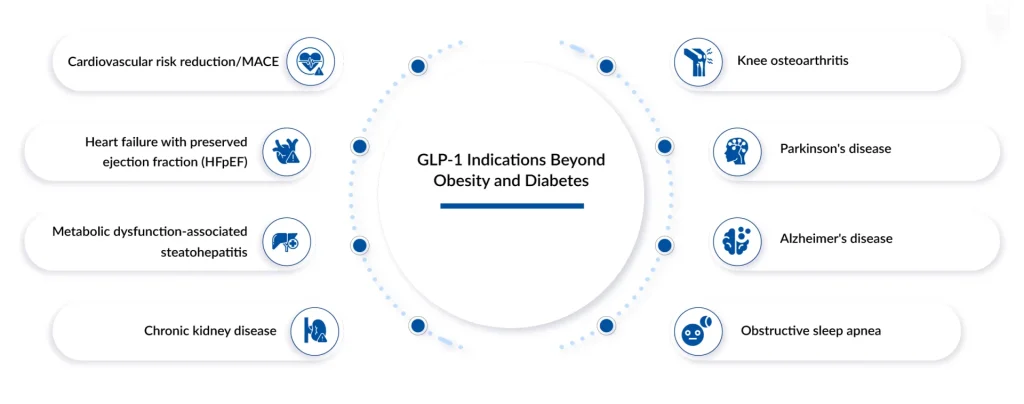
GLP-1-based therapies are rapidly evolving beyond diabetes and obesity management, with emerging evidence supporting their potential across multiple chronic diseases. Cardiovascular disease, MASH, chronic kidney disease, and obstructive sleep apnea are expanding the clinical and commercial scope of this drug class, while neurological disorders and substance use disorders represent promising areas of investigation. By targeting underlying metabolic dysfunction, these therapies may address interconnected disease pathways and improve long-term patient outcomes. This broader therapeutic potential is also reshaping payer perceptions, reimbursement priorities, and the commercial outlook for GLP-1-based treatments.
Cardiovascular Disease: The Indication That Changed the Payer Conversation
The single most consequential expansion has been cardiovascular. Trials establishing that semaglutide reduces cardiovascular risk in overweight adults, independent of diabetes status, fundamentally shifted how payers and physicians think about these drugs. GLP-1 therapy is no longer a “lifestyle” or cosmetic intervention in the eyes of insurers; it is a cardioprotective one, and that reframing has real implications for reimbursement policy. Tirzepatide is following the same path. Data from Eli Lilly’s cardiovascular outcomes program show a meaningful reduction in major adverse cardiovascular events (MACE), heart attack, stroke, and cardiovascular death, in patients with T2DM, with an FDA decision on this new indication expected in 2026.
Heart failure with preserved ejection fraction (HFpEF), a notoriously difficult-to-treat condition with few effective therapies, is another frontier. Emerging data suggest GLP-1 and dual-agonist therapies can meaningfully outperform older standards of care on relative risk reduction in HFpEF populations, while also improving symptoms and functional capacity.
The patient burden behind this expansion is enormous. Cardiovascular disease remains the leading cause of death worldwide, responsible for roughly 18 million deaths a year, and a large share of that burden sits squarely in patients who are also living with obesity, insulin resistance, or T2DM, the exact population GLP-1 therapy was originally designed for. In the US alone, an estimated 6.7 million adults are currently living with heart failure, a figure projected to climb past 8.7 million by 2030 and beyond 11 million by 2050, with lifetime risk now estimated at nearly 1 in 4 people.
HFpEF in particular has historically been a frustrating diagnosis for patients and clinicians alike: it disproportionately affects older adults and those with obesity, carries a high hospital readmission rate, and until recently offered few therapies that meaningfully improved how patients actually felt day to day, as opposed to just stabilizing lab values. A drug class that can simultaneously address the metabolic driver and the downstream cardiac strain represents a rare chance to reduce hospitalizations, caregiver burden, and long-term disability in a population that has had very few good options.
MASH and the Liver: Reversing Damage, Not Just Managing Risk
Metabolic dysfunction-associated steatohepatitis (MASH), formerly known as NASH, has emerged as one of the most closely watched new GLP-1 indications. Unlike many chronic disease targets, MASH trials are showing something rarer: evidence of fibrosis improvement, not just risk-factor management. Semaglutide at higher doses has demonstrated the potential to resolve liver fibrosis in trial populations, a result that matters enormously in a therapeutic area with almost no approved pharmacological options until recently. For a disease projected to become one of the leading causes of liver transplantation, a GLP-1-based approach that treats the metabolic driver rather than just the hepatic endpoint is a genuinely differentiated value proposition, and one competitors in the MASH space are now racing to match.
The burden MASH places on patients is easy to underestimate because the disease is often silent until it is advanced. Globally, an estimated 1.3 billion people, roughly one in six adults, now live with the broader spectrum of fatty liver disease (MASLD), a figure that has grown by more than 140% since 1990 and is projected to reach 1.8 billion by 2050. As per DelveInsight analysis, MASH affects an estimated 1.5–6.5% of US adults, representing approximately 9–15 million individuals, with MASH prevalence projected to increase by 63% by 2030.
A meaningful subset of that population progresses to MASH, the more aggressive, inflammatory form of the disease that drives fibrosis.
Many of these patients live for years with progressive liver scarring without symptoms, only to present with cirrhosis, liver failure, or a diagnosis of hepatocellular carcinoma once the damage is largely irreversible. Because MASH tracks so closely with obesity and T2DM, patients are often managing multiple chronic conditions simultaneously, multiplying appointments, monitoring, and the cumulative toll of disease on daily life. A therapy that can halt or reverse fibrosis earlier in that trajectory doesn’t just change a lab value; it changes whether a patient eventually needs a liver transplant at all.
Chronic Kidney Disease: Renal Protection Independent of Glucose Control
Chronic kidney disease (CKD) is shaping up to be another major growth vector. Clinical evidence increasingly points to renal-protective effects that occur independently of a patient’s glycemic status, suggesting the mechanism runs deeper than glucose control alone, likely involving reduced inflammation, better hemodynamics, and less metabolic strain on the kidneys.
Given how frequently CKD, T2DM, obesity, and cardiovascular disease cluster in the same patients, a single therapy addressing all four simultaneously is a compelling proposition for value-based and bundled-payment care models, where reducing total disease burden per patient, not treating one diagnosis at a time, is the goal.
CKD is one of the most under-recognized chronic conditions in terms of patient burden, largely because early-stage kidney decline produces few noticeable symptoms. Global estimates now put CKD prevalence at nearly 800 million people, more than double the figure recorded in 1990, making it one of the fastest-growing non-communicable disease burdens worldwide, with kidney disease linked to a death roughly every 20 seconds. As per DelveInsight analysis, in 2025, there were approximately 82.5 million prevalent and nearly 14.5 million diagnosed prevalent cases of CKD in the 7MM.
By the time patients experience fatigue, swelling, or other overt signs, meaningful kidney function has often already been lost. For patients who progress to end-stage kidney disease, the burden escalates dramatically: dialysis several times a week, transplant waitlists that can run years, and a sharply reduced quality of life. Slowing that progression earlier, especially in the diabetic and obese populations where CKD most often takes hold, could meaningfully delay or prevent some of the most burdensome and costly outcomes in all of chronic disease care.
Obstructive Sleep Apnea: The Newest Approved Frontier
Obstructive sleep apnea (OSA) has become one of the more recently approved indications, with tirzepatide showing significant reductions in apnea-hypopnea index alongside its weight-loss effect. This is a particularly clean example of the “treat the root cause” thesis: a large share of OSA cases are driven by excess adipose tissue around the airway, so a drug that reduces that tissue produces a downstream respiratory benefit almost as a matter of physiology.
OSA’s burden is often dismissed as a quality-of-life nuisance rather than a serious medical condition, but that undersells it considerably. Global estimates suggest close to 1 billion adults worldwide have some degree of obstructive sleep apnea, with roughly 425 million living with moderate-to-severe disease severe enough to warrant treatment, and a large share of cases remain undiagnosed. Untreated OSA is linked to elevated cardiovascular risk, daytime fatigue that affects safety at work and on the road, and a steady erosion of sleep quality that compounds over years. Many patients struggle with adherence to the standard CPAP therapy, finding it cumbersome or uncomfortable for nightly use. A pharmacological option that addresses the excess tissue driving airway obstruction gives patients and clinicians a genuinely new lever to pull, particularly for those who have already failed or abandoned device-based therapy.
The Neurological and Behavioral Frontier: Alzheimer’s, Parkinson’s, and Addiction
This is the most speculative and most closely watched area of GLP-1 expansion. Observational research has associated long-term GLP-1 use with meaningfully reduced dementia risk in some patient populations, and active trials are now testing GLP-1 therapy directly in Alzheimer’s disease and Parkinson’s disease. The proposed mechanisms include reduced neuroinflammation, improved cerebral glucose metabolism, and vascular protection, though it’s worth noting this evidence is still early, and causality has not been established the way it has for cardiovascular or renal outcomes.
Equally striking is the growing interest in GLP-1 therapy for substance use disorder. Preclinical and early clinical signals suggest these drugs may dampen reward-pathway activity tied to alcohol, nicotine, and other substances, plausible given that GLP-1 receptors are expressed in brain regions tied to craving and reward. Pharmacy and clinical conference sessions in 2026 have specifically flagged chronic kidney disease and substance use disorder as the next frontier for the class, alongside orthopedic and osteoarthritis applications, where semaglutide and tirzepatide have both shown meaningful pain reduction, though it remains debated how much of that benefit is simply weight-related joint offloading versus a separate anti-inflammatory effect.
The burden here is almost impossible to overstate. Worldwide, more than 55 million people are estimated to be living with dementia, of which Alzheimer’s accounts for an estimated 60–80% of cases; in the US alone, roughly 7.4 million adults aged 65 and older currently live with clinical Alzheimer’s dementia, a number projected to nearly double to 13.8 million by 2060 absent a disease-modifying breakthrough. Parkinson’s disease affects an estimated 11.7 million people globally, a figure that has more than doubled since 1990 and is projected to exceed 14 million by 2040, with its own long, degenerative course of motor and non-motor symptoms that worsen over years and few therapies that slow the underlying disease process rather than just masking symptoms.
Dementia and Alzheimer’s also place an enormous and often underappreciated strain on family caregivers who absorb much of the day-to-day burden. Substance use disorder, meanwhile, remains chronically undertreated relative to its prevalence, in part because existing pharmacological options are limited and relapse rates remain high. Even a modest, well-validated effect in any one of these areas would represent a meaningful addition to a treatment landscape that has seen relatively little pharmacological innovation in decades.
The Pipeline: What’s Coming After Semaglutide and Tirzepatide
The next generation of the GLP-1 drug market is being built around three strategic axes, more efficacy, less burden, and broader mechanism, and the competitive race to own that next wave has only intensified through 2026. Eli Lilly’s pipeline beyond tirzepatide is now its most closely watched growth story: retatrutide, a triple agonist hitting the GLP-1, GIP, and glucagon receptors, remains the efficacy leader in the class, having reported more than 28% weight loss in Phase 3 obesity trials, with three additional Phase 3 obesity readouts and active MASH trials expected before the end of 2026. Alongside it, orforglipron, Lilly’s new oral GLP-1 and the first oral small-molecule GLP-1 drug of its kind, is moving toward regulatory filings for obesity, with the ATTAIN-MAINTAIN study assessing how well patients maintain weight loss after switching from injectable semaglutide or tirzepatide to the pill. Lilly’s mid-stage bench is also deepening, with bimagrumab, eloralintide, and mazdutide all advancing as it builds out a GLP-1 obesity drugs pipeline that extends well past its current blockbusters.
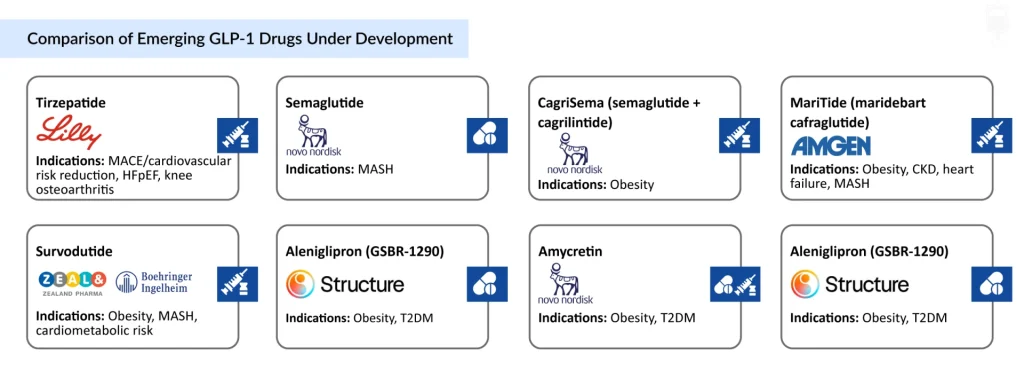
Lilly is no longer running unopposed, though. The latest round of emerging-therapy news has centered on Structure Therapeutics’ oral candidate aleniglipron, which posted Phase 2b data showing 11.3% placebo-adjusted weight loss at its 120 mg dose and 15.3% at 240 mg, strong enough that the company is planning late-stage studies around mid-2026, and strong enough that Lilly’s own share price dipped on investor concern about a more crowded oral GLP-1 field. Novo Nordisk, for its part, continues to press its own next-generation lineup: an oral version of WEGOVY, the amylin-GLP-1 combination CagriSema, a standalone cagrilintide program, and amycretin are all advancing, while Amgen’s MariTide, a monthly antibody-peptide conjugate notable for weight loss that persisted even after dosing stopped in Phase 2, and Viking Therapeutics’ VK2735, now in two late-stage subcutaneous studies with oral development alongside it, round out a pipeline that has genuinely diversified beyond a single dominant mechanism.
More than 20 candidates are now in Phase 2 or Phase 3 development, spanning dual agonists, triple agonists, oral small molecules, and monthly injectable formats. That diversity is the clearest signal yet that next-generation GLP-1 drugs are no longer just a race to out-dose semaglutide; they’re a genuine platform competition, with format (oral versus injectable), durability, and breadth of indication all now just as commercially important as raw weight-loss percentage.
The Market Opportunity: Why “Multi-Disease” Is a Commercial Strategy, Not Just a Clinical One
The global GLP-1 therapies market is valued at approximately USD 62.83 billion in 2025 and is forecast to reach USD 254.19 billion by 2034. Market growth is primarily driven by the increasing use of GLP-1 therapies for obesity and long-term weight management, the strong commercial performance of tirzepatide- and semaglutide-based treatments, and the introduction of oral GLP-1 formulations. The global GLP-1 therapies market is expected to expand at a CAGR of 16.8% during the forecast period from 2026 to 2034.
The strategic rationale behind this growth is as much commercial as clinical. Indication diversification insulates GLP-1 manufacturers from reimbursement pressure or pricing scrutiny in any single therapeutic category, while simultaneously expanding the addressable patient population well beyond people who qualify for an obesity or diabetes diagnosis alone. With more than a billion people globally living with obesity, and only a small fraction currently on pharmacotherapy, the total addressable market for a genuinely multi-indication platform dwarfs what diabetes treatment alone could ever support.
Type 2 diabetes still represents the largest single application segment of the GLP-1 drug market today, but its relative share is expected to shrink as MASH, sleep apnea, cardiovascular, and Alzheimer’s-related indications carve out growing slices of the pie. Oral GLP-1 drugs and long-acting formulations are expected to be the fastest-growing product segments of the GLP-1 market size through the next decade, driven by adherence and access advantages over weekly injections, a dynamic that is already reshaping how GLP-1 manufacturers prioritize their own pipelines.
What’s Next: The Direction of Travel
Two things seem clear heading into the second half of the decade. First, the GLP-1 receptor agonist market is no longer competing primarily on weight-loss percentage points; it’s competing on breadth of evidence, durability of effect, and oral versus injectable format convenience. Second, the indications furthest from the original diabetes and obesity core, Alzheimer’s, Parkinson’s, substance use disorder, are exactly where the next wave of differentiation and headline-grabbing data is likely to come from, even though they carry the highest scientific uncertainty today.
For an industry accustomed to single-indication blockbusters, GLP-1 receptor agonists represent something structurally different: a platform technology being validated one organ system at a time. The weight-loss story got the world’s attention. The multi-disease story, and the GLP-1 obesity drugs latest developments that keep extending it, is what will determine how large and how permanent this therapeutic category ultimately becomes.

Downloads
Article in PDF
Recent Articles
- The Rise of Energy Drinks: Power in a Can or a Health Hazard?
- AstraZeneca’s Voydeya FDA Approval; Akebia’s Vafseo FDA Approval; Bristol Myers Squibb’s Phase II...
- Cytokinetics Announces Results From SEQUOIA-HCM Clinical Trial of Aficamten; FDA Approves Chiesi’...
- WEGOVY: A Leader in the Obesity and Weight Loss Treatment
- From NASH to MASH: Unraveling the Evolution and Future of Liver Disease Treatment