7 Promising Late-Stage SLE Drugs & New SLE Treatments Expected to Enter Therapeutic Domain
May 29, 2026
Table of Contents
Systemic lupus erythematosus (SLE) is a chronic autoimmune condition that can affect multiple parts of the body. In 2025, it was estimated that around 512,000 individuals in the United States were living with SLE, as per DelveInsight analysis, with new treatments for SLE urgently needed as 40% of treated SLE patients relapse on first-line drugs for SLE. The prevalence is significantly higher in females, who account for over 90% of all cases. Currently, FDA-approved SLE treatment drugs include only belimumab (BENLYSTA) and anifrolumab (SAPHNELO), while rituximab remains off-label. The SLE drug development pipeline features promising SLE drugs in Phase III, including litifilimab, ianalumab, and dapirolizumab pegol. These new SLE treatment candidates could reshape the SLE drugs market in coming year’s.
7 Emerging SLE Treatment Drugs in Late-Stage Development: Latest SLE Drug News
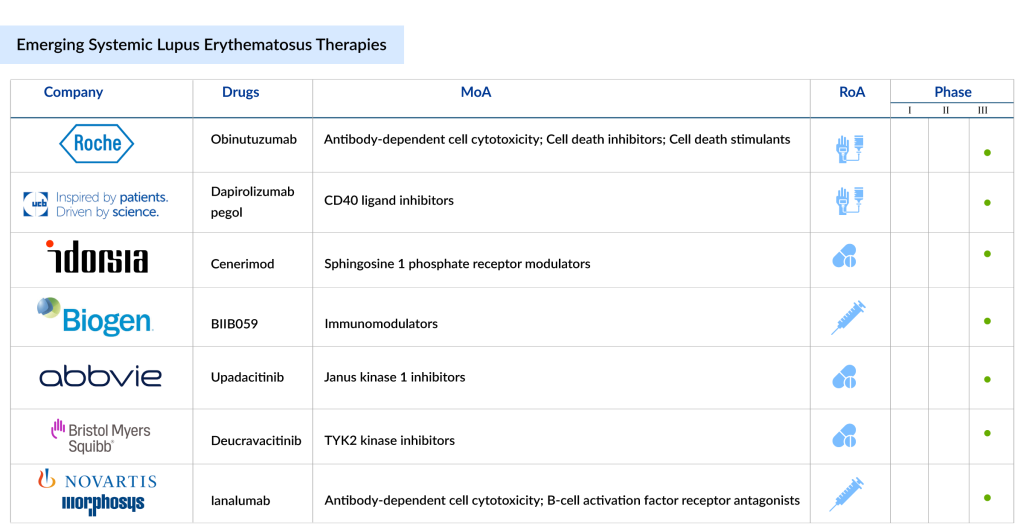
SLE pipeline possesses some drugs in late-stage developments to be approved in the near future. The emerging SLE treatment landscape holds a diverse range of therapeutic alternatives, including Litifilimab (Biogen), Ianalumab (Novartis), Cenerimod (Idorsia/Viatris), Dapirolizumab pegol (UCB/Biogen), Nipocalimab (Johnson & Johnson), RINVOQ (AbbVie), Deucravacitinib (Bristol-Myers Squibb), and others in different lines of treatment. The expected launch of these therapies shall further create a positive impact on the market.
Downloads
Click Here To Get the Article in PDF

Recent Articles
- CAR-T Beyond Cancer: Resetting Immunity in Autoimmune Diseases
- TYK2 Inhibitors: The Competitive Race Fueling the Next Generation of Autoimmune Therapies
- BENLYSTA vs GAZYVA: Who Wins the Battle for Lupus Nephritis Treatment?
- The Evolution of Systemic Lupus Erythematosus Treatment: From Symptom Control to Targeted Therapies
- Systemic Lupus Erythematosus Treatment Market: How Are the Leading Companies Countering the Risin...
Let’s take a closer look at these emerging SLE drugs.
Biogen’s Litifilimab
Litifilimab (BIIB059) is a humanized IgG1 monoclonal antibody developed by Biogen that targets blood dendritic cell antigen 2 (BDCA2). It is being studied for its potential to treat systemic lupus erythematosus (SLE) and cutaneous lupus erythematosus (CLE), both chronic autoimmune diseases. This antibody binds specifically to BDCA2, a receptor found exclusively on plasmacytoid dendritic cells (pDCs), and blocks the production of type-I interferon (IFN-I) and other pro-inflammatory cytokines. This action is significant because pDCs are a major source of IFN-I in response to immune triggers, contributing to the inflammation observed in lupus. Currently, BIIB059 is in Phase III clinical trials for SLE treatment. The company expects the Phase III study data readout to be accelerated to the Q4 2026.
Novartis/MorphoSys’ Ianalumab
Ianalumab, a Novartis-developed antibody, one of the most promising novel agents for systemic lupus erythematosus, it targets the B-cell activating factor receptor (BAFF-R) to inhibit BAFF-R-mediated signaling and eliminate B cells via antibody-dependent cellular cytotoxicity. It is currently undergoing Phase III clinical trials for SLE, with the company expecting data readout of Phase III study in 2027 and regulatory submission in 2028.
Idorsia Pharmaceuticals/Viatris’s Cenerimod
Cenerimod is a highly selective modulator of the sphingosine-1-phosphate receptor 1 (S1P1), administered as a once-daily oral tablet. Although the exact cause of SLE remains unclear, T and B lymphocytes are believed to be key immune cells involved in its development, with S1P1 receptors present on their surfaces. In February 2024, Idorsia Pharmaceuticals entered into a major global research and development partnership with Viatris for the advancement and commercialization of two Phase III candidates, selatogrel and cenerimod. Viatris anticipates a potential regulatory submission expected by 2027 for cenerimod, once get approved it can change systemic lupus erythematosus treatment market trends by becoming the first oral treatment.
UCB/Biogen’s Dapirolizumab pegol
Dapirolizumab pegol is an innovative investigational treatment made up of a humanized, Fc-free antigen-binding (Fab’) fragment attached to polyethylene glycol (PEG). It functions by inhibiting CD40L signaling, which has been shown to reduce B cell activation, limit autoantibody production, decrease type 1 interferon (IFN) secretion, and suppress the activation of T cells and antigen-presenting cells (APCs).
In September 2024, UCB and Biogen announced that the Phase III PHOENYCS GO trial met its primary objective, demonstrating clinical improvements in patients with moderate-to-severe systemic lupus erythematosus. Additionally, key secondary endpoints, evaluating disease activity and flare-ups, also showed clinical benefits.
Following the positive results from the PHOENYCS GO study, UCB and Biogen are initiating a second Phase III trial of dapirolizumab pegol in 2024, named PHOENYCS FLY. Participants from the PHOENYCS GO study will continue to be monitored in a long-term open-label extension. The company expected Phase III readout in 2028.
AbbVie’s Upadacitinib (RINVOQ)
As the patent of AbbVie’s mega blockbuster HUMIRA expired last year, the company has high hopes for their immunology successors RINVOQ and SKYRIZI. Upadacitinib inhibits Janus kinase (JAK) enzymes within the JAK-STAT signaling pathway, which is involved in the release of pro-inflammatory cytokines. The FDA has authorized its use for treating eight autoimmune disorders: atopic dermatitis, ankylosing spondylitis, axial spondyloarthritis, Crohn’s disease, psoriatic arthritis, rheumatoid arthritis, ulcerative colitis, and polyarticular juvenile idiopathic arthritis. Upadacitinib is being evaluated in the Phase III trials for SLE treatment with a potential regulatory submission expected by 2027.
Bristol Myers Squibb SOTYKTU
Bristol Myers Squibb SOTYKTU (deucravacitinib) is an oral, selective allosteric inhibitor of tyrosine kinase 2 (TYK2) with a distinct mechanism of action, representing a new class of small molecules. It is the first selective TYK2 inhibitor being tested in clinical trials for various immune-mediated diseases. Deucravacitinib targets TYK2 to block the signaling of interleukin (IL)-23, IL-12, and Type 1 interferons (IFN), which are key cytokines involved in the development of several immune-mediated diseases. By binding to the regulatory domain of TYK2, deucravacitinib achieves high selectivity, leading to allosteric inhibition of TYK2 and its downstream effects. At therapeutic doses, it specifically inhibits TYK2 without affecting JAK1, JAK2, or JAK3. Currently, deucravacitinib is in the late stages for SLE treatment.
Roche’s Obinutuzumab
Obinutuzumab (GAZYVA/GAZYVARO) is the first glycoengineered, type II, humanized monoclonal antibody targeting CD20. It operates differently from other anti-CD20 antibodies, such as MabThera/Rituxan, and was specifically designed to target the CD20 protein on B cells with high affinity, binding to the cell surface in a type II configuration. GAZYVA has received approval in 100 countries for the treatment of various lymphoma types. In the United States, it is involved in a partnership between Genentech and Biogen.
Currently, obinutuzumab is being evaluated in the Phase III ALLEGORY study for systemic lupus erythematosus, and based on the positive study results, Roche has submitted and secured FDA acceptance of regulatory applications, with a US approval decision expected by December 2026.
SLE Treatment Options Latest: What Lies Ahead in SLE Drug Development?
The treatment landscape for systemic lupus erythematosus is undergoing significant transformation, driven by advances in understanding its pathophysiology and the development of targeted therapies. Historically, SLE management has focused on immunosuppressive agents like corticosteroids and antimalarials to control inflammation and prevent flare-ups.
However, these therapies often come with side effects and limited efficacy in certain patient subsets. Recent breakthroughs in biologics, such as belimumab and voclosporin, have shown promising results, targeting specific immune pathways involved in SLE. Additionally, the emergence of targeted small molecules and the growing understanding of biomarkers are paving the way for personalized treatment approaches that aim to reduce disease activity while minimizing adverse effects.
DelveInsight estimates that the market size for SLE is expected to grow from USD 3.2 billion in 2025 with a significant CAGR by 2036. This growth is mainly driven by ongoing clinical research and better diagnostic tools that might improve the prognosis of the disease.
Looking ahead, the future of SLE treatment lies in the refinement of combination therapies, better patient stratification, and advancements in precision medicine. Researchers are focusing on developing therapies that not only target B cells and T cells but also modulate the complement system, cytokine pathways, and other key immune responses implicated in disease progression.
The goal is to achieve sustained remission and improve long-term outcomes for SLE patients, especially for those with refractory disease. With ongoing clinical trials and the rapid expansion of new drug classes, there is optimism that the next decade will bring more effective and individualized treatment options, offering better disease control and an improved quality of life for those affected by this complex autoimmune disorder.

FAQs
Nearly 40% of treated SLE patients relapse or become refractory to first-line therapy. Novel candidates like litifilimab, ianalumab, and deucravacitinib are designed to hit unique immune targets, potentially delivering efficacy in patient subsets left underserved by BENLYSTA and SAPHNELO.
Biogen’s litifilimab (targeting BDCA2 on plasmacytoid dendritic cells) and Novartis’ ianalumab (blocking BAFF-R signaling) are strong contenders, while AbbVie’s RINVOQ and BMS’s deucravacitinib bring oral small-molecule convenience into a space dominated by injectables.
The 2024 alliance between Idorsia and Viatris for cenerimod highlights how collaborations are accelerating late-stage development and commercialization, a trend likely to define competitive positioning in the SLE market.
Positive Phase III results from the PHOENYCS GO trial showed improvements in disease activity and flare reduction, making it one of the most advanced candidates to challenge current standards and expand options for moderate-to-severe SLE.
Yes. With biomarker-driven patient stratification, combination approaches, and therapies targeting B cells, T cells, and cytokine pathways, the next decade is expected to usher in more personalized regimens with the goal of sustained remission.
The SLE market was valued at USD 3.2 billion in 2023 and is projected to grow significantly by 2034, fueled by late-stage biologics and small molecules targeting specific immune pathways beyond traditional corticosteroids and immunosuppressants.
Downloads
Article in PDF
Recent Articles
- Aurinia’s Lupkynis for Lupus; FDA Fast Track Designation for Toripalimab; Wren Therapeutics...
- Horizon, Viela Deal; Concert Schizo Drug Flop; Gilead Deals with Arcus and Gritstone
- Novo Nordisk Seeks FDA Approval for CagriSema; EU Approves Subcutaneous Self-administration of SA...
- 5 Upcoming Bispecific & Trispecific Antibodies Beyond Oncology
- BENLYSTA vs GAZYVA: Who Wins the Battle for Lupus Nephritis Treatment?