Patent Cliff Panic: 7 Pharma Deals Rewriting the Industry in 2026
Nov 18, 2026
Table of Contents
Summary
- More than $300 billion in branded drug revenue is expected to face patent expirations by 2032, prompting pharmaceutical companies to accelerate acquisitions and pipeline replenishment.
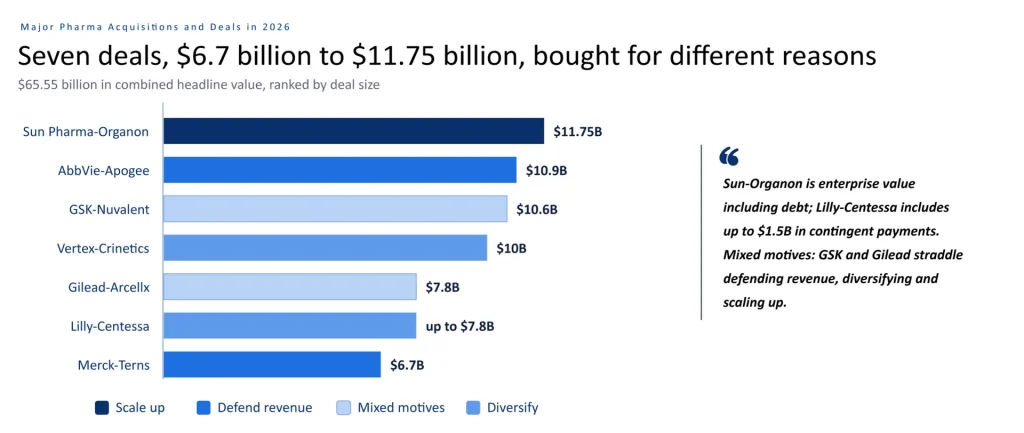
- Sun Pharma–Organon ($11.75B), AbbVie–Apogee ($10.9B), GSK–Nuvalent ($10.6B), Vertex–Crinetics ($10B), Gilead–Arcellx ($7.8B), Lilly–Centessa (up to $7.8B) and Merck–Terns ($6.7B), measured by headline value.
- Chinese biotech licensing transactions are increasingly contributing to pharmaceutical pipeline expansion, with major agreements involving AstraZeneca, Eli Lilly, and Roche demonstrating growing reliance on China-origin innovation.
Every blockbuster has an expiry date, and in 2026 Big Pharma is finally acting like it can read the calendar. More than $300 billion in branded drug revenue is set to lose patent protection by 2032, Merck’s KEYTRUDA and AbbVie’s SKYRIZI and RINVOQ among them, and no lab can build replacements in time. So drugmakers are doing the one thing that works fast: writing cheques. One tracker counts 44 acquisitions of $1 billion or more this year and $138.9 billion in upfront value through September, already more than all of 2025.
Downloads
Click Here To Get the Article in PDF

Recent Articles
- Rapid Global Expansion of Chinese PD-1/PD-L1 Key Players
- Payers block EpiPen; Allergan charged; AbbVie’s Humira; Baxter paying $18M
- Novo petitions FDA;J&J invests; Xarelto’s trial; Roche’s Tecentriq
- PD-1 and PD-L1 inhibitors – Competitive Landscape, Pipeline and Market Analysis, 2015
- Merck’s Keytruda sales; Valeant on name change; Pfizer – BMS; Amgen puts Repatha outcomes for deal
7 Pharma Deals Rewriting the Industry in 2026
Not every deal on this list is a patent-cliff rescue, and the differences matter. Some buyers are defending revenue: Merck and AbbVie are refilling pipelines years before their biggest drugs lose exclusivity. Some are diversifying: Eli Lilly and Vertex are using the profits of one franchise to build a second and third. Others are scaling up: Sun Pharma is buying its way into the global top 25. GSK and Gilead sit across these lines, paying up for late-stage drugs that could reach patients within months.
Sun Pharma Swallows Organon: India’s $11.75 Billion Leap onto the Global Stage
The year’s largest pharma deal came from an unexpected direction. On April 26, 2026, India’s Sun Pharmaceutical Industries agreed to buy US-listed Organon for $14.00 per share in cash, at an enterprise value of $11.75 billion. The equity itself is worth roughly $3.99 billion; the rest of the headline figure is Organon’s debt. It is the largest overseas acquisition ever made by an Indian drugmaker, and it carried a premium of about 24% to the prior close.
Organon, spun out of Merck in 2021, sells more than 70 products across women’s health and general medicines in around 140 countries. Its best-known names include the Nexplanon contraceptive implant and the fertility drug Follistim, and it also has a biosimilars business. The company reported $6.2 billion in 2025 revenue and $1.9 billion in adjusted EBITDA.
For Sun, the logic is scale and mix. The company has long been associated with generics, and has been building a branded portfolio in dermatology, ophthalmology, and oncodermatology. Organon instantly lifts combined revenue to about $12.4 billion, places Sun among the top 25 pharma companies globally, and gives it a claimed top-three position in women’s health and a top-10 spot in biosimilars. Sun says it will fund the purchase with cash and committed bank financing, and expects net debt to EBITDA of 2.3x after closing.
AbbVie’s $10.9 Billion Apogee Bet: Planning Life After HUMIRA
On June 22, 2026, AbbVie announced a $10.9 billion all-cash deal for Apogee Therapeutics at $135.11 per share, a premium of nearly 50% to the previous close. It was AbbVie’s largest buyout in more than five years and is being funded with debt. The prize is zumilokibart, a long-acting antibody that targets IL-13, a protein involved in allergic skin and airway inflammation. It is being developed for atopic dermatitis, asthma, and eosinophilic esophagitis, and it is positioned as a rival to Sanofi and Regeneron’s DUPIXENT, which is typically dosed every two weeks.
Zumilokibart is being studied at intervals of roughly three to six months. In a Phase 2 trial, 65.9% of patients on the mid dose reached a 75% improvement in eczema severity at 16 weeks, a 41.9-point gain over placebo. Phase 3 trials are due to start in 2026, with a launch anticipated around 2029. The context is AbbVie’s long recovery from the HUMIRA cliff. Its immunology unit generated more than $30 billion in 2025, up 14%, as SKYRIZI and RINVOQ growth more than offset a 49% fall in HUMIRA sales. But those two successors will eventually lose exclusivity too, which is why AbbVie keeps buying. CEO Robert Michael called Apogee’s pipeline a potential “mega-blockbuster” opportunity, which AbbVie defines as more than $10 billion in annual sales.
AbbVie is refilling its immunology franchise years before the next cliff, not after it. The catch is time: AbbVie expects the deal to add to adjusted earnings per share only in 2032, and it adds to a debt load that was already heavy after the Allergan purchase. The deal was expected to close in the third quarter.
GSK Pays $10.6 Billion for Nuvalent: The Lung Cancer Land Grab
GSK’s June 9 announcement was its biggest acquisition in more than a decade, and the first major move under new CEO Luke Miels, who took over from Emma Walmsley in January. GSK offered $124 per Nuvalent share in cash through a tender offer, a 40% premium, for an equity value of $10.6 billion. Net of Nuvalent’s cash, GSK’s investment is about $9.4 billion.
Nuvalent is a clinical-stage company with no approved products, which makes the price striking. What GSK is buying is a trio of lung cancer programs. Zidesamtinib targets ROS1-positive non-small cell lung cancer and neladalkib targets ALK-positive disease. Both have FDA Breakthrough Therapy and Orphan Drug designations. A third asset, NVL-330, is an early-stage HER2 inhibitor. If approved, the first two could launch this year, and GSK describes them as multi-blockbuster opportunities. They are designed to offer better brain penetration, tolerability, and mutation coverage than current options.
The deal also gives GSK a commercial platform in lung cancer ahead of Ris-Rez, its B7-H3 antibody-drug conjugate now in Phase 3. GSK expects the deal to be accretive to core operating profit in 2027 and to core EPS in 2029, and says it supports its ambition of more than £40 billion in annual sales by 2031.
Vertex Writes the Biggest Cheque in Its History: $10 Billion for Crinetics
Vertex built its fortune on cystic fibrosis, which still supplies most of its roughly $12 billion in annual revenue. On July 6, 2026, it announced the largest acquisition in its history: Crinetics Pharmaceuticals, for $85 per share in cash. That is about $10.0 billion in equity value, or $8.8 billion net of cash, and a 100% premium to the previous close. Crinetics shares doubled on the news. The deal has since closed.
Unlike most big biotech buyouts, this one comes with a marketed product. PALSONIFY (paltusotine) is the first once-daily oral treatment for acromegaly, a rare condition caused by excess growth hormone. The FDA approved it in September 2025, and the European Medicines Agency followed in April 2026. Behind it sits atumelnant, an oral drug in Phase 3 for congenital adrenal hyperplasia, with potential in Cushing’s syndrome. Vertex estimates the two together could exceed $5 billion in annual sales at peak. Vertex financed the purchase with cash on hand and debt, backed by $4.5 billion of committed bridge financing, and expects the deal to become accretive to non-GAAP operating income in 2029.
Gilead’s $7.8 Billion Arcellx Play: Owning the Next CAR-T Blockbuster
Gilead’s February 23 deal turned a partnership into ownership. Through its Kite unit, Gilead had co-developed anito-cel, a BCMA-directed CAR-T therapy for multiple myeloma, with Arcellx since 2022. Now it bought the rest: $115 per share in cash, plus a contingent value right of $5 per share payable if cumulative global anito-cel sales reach $6 billion by the end of 2029. The headline value is about $7.8 billion, and the cash price was a 68% premium to Arcellx’s 30-day average share price. Gilead already held about 11.5% of the company.
The timing is deliberate. The FDA has accepted the application for anito-cel as a fourth-line treatment, with a decision date of December 23, 2026. Analysts see it as a potential “multi-billion dollar product” with a safety profile that could compare well with Johnson & Johnson and Legend’s CARVYKTI, which brought in about $1.9 billion in 2025. Full ownership also removes profit-sharing, milestones, and royalties, and gives Gilead access to Arcellx’s D-Domain binder for future in vivo cell therapy and bispecific programs. Gilead expects the deal to boost earnings per share from 2028.
Eli Lilly Buys Centessa for Up to $7.8 Billion: Building an Empire Beyond Obesity
No company shopped harder in 2026 than Eli Lilly. By one count, it announced 10 acquisitions worth about $25 billion by June, more than half of the $46.38 billion spent by the top 12 pharmas combined. The biggest was Centessa Pharmaceuticals, announced March 31: $38 per share in cash (about $6.3 billion), plus a contingent value right worth up to $9 per share, or $1.5 billion, tied to regulatory milestones. The total tops out at $7.8 billion. The upfront price was a 40.5% premium to Centessa’s 30-day average, and it was Lilly’s largest deal since the $8 billion Loxo Oncology purchase in 2019.
Centessa’s lead drug, cleminorexton, is an orexin receptor 2 agonist, designed to restore the brain’s wake signal that is missing in narcolepsy type 1. It is in Phase 2a for narcolepsy types 1 and 2 and idiopathic hypersomnia, and further assets reach into neurological and neuropsychiatric conditions. Centessa has no approved drugs, and rivals are ahead: Takeda’s oveporexton received FDA priority review in February. Lilly’s other 2026 purchases include Ventyx Biosciences ($1.2 billion, January), Orna Therapeutics ($2.4 billion, February) and Kelonia Therapeutics ($7 billion, April).
Merck’s $6.7 Billion Terns Deal: A Lifeline Thrown Across the KEYTRUDA Cliff
Merck is the clearest example of a company buying its way around a cliff. KEYTRUDA generated more than $31 billion in 2025, nearly half the company’s revenue, and faces patent expiry as soon as 2028. On March 25, 2026, Merck agreed to buy Terns Pharmaceuticals for $53 per share in cash, a 31% premium to its 60-day average price, for roughly $6.7 billion. It follows Merck’s 2025 purchases of Verona Pharma (about $10 billion) and Cidara Therapeutics ($9.2 billion).
The centerpiece is TERN-701, an oral allosteric inhibitor of BCR-ABL1 for chronic myeloid leukemia. It works the same way as Novartis’s SCEMBLIX, which earned about $1.3 billion last year. In an early study, the drug produced a 75% major molecular response rate in heavily pretreated patients. Merck also restructured its human health business into separate oncology and infectious disease divisions, and has said it aims for $70 billion in annual sales in the next decade, after KEYTRUDA loses exclusivity.
The risk is plain. TERN-701 is still in Phase 1/2; late-stage trials are not expected before late 2026 or early 2027, and Merck is paying a steep premium on thin data. Analysts argued, in fact, that the offer did not fully capture the drug’s potential.
The China Connection and Other Deals That Almost Made the List
Big pharma is increasingly buying assets from Chinese biotechs rather than whole companies. Licensing deals for China-origin assets reached $92 billion in the first half, and China-origin assets made up 40% of big pharma in-licensing in 2025. One deal database lists AstraZeneca’s agreement with CSPC Pharmaceutical (up to $18.5 billion, January), Eli Lilly’s deal with Innovent Biologics (up to about $8.85 billion, February), and Roche’s agreement with Hansoh Pharma (over $15 billion, October). These figures are headline values that include milestone payments, not cash paid upfront.
What 2026’s Deal Spree Means for 2027?
The deals above point in one direction: pharma is buying proven science, fast, and paying up for it. Premiums of roughly 30% to 100% were common among this year’s biotech targets. Cash-rich companies such as Lilly are shifting from a defensive posture to an offensive one, while patent cliff-exposed companies such as Merck and AbbVie are refilling pipelines years before revenue falls. Outsiders such as Sun Pharma and Vertex are using M&A to jump into new tiers.
Three things to watch next. First, regulatory decisions: GSK’s neladalkib (November 27) and Gilead’s anito-cel (December 23) will show whether premium prices were justified. Second, integration and debt: AbbVie, Vertex and Sun are all leaning on financing, and returns on these deals arrive slowly. Third, the next targets: with valuations resetting upward, analysts expect more bolt-ons in oncology, immunology, neuroscience and obesity.
The patent cliff is not a crisis for the companies that can afford to act. It is a forcing mechanism, and 2026 is the year the industry stopped hesitating.

Downloads
Article in PDF
Recent Articles
- The Business Cocktail
- ADCs in Lung Cancer Treatment: ENHERTU’s Rise, HER3 & TROP-2 Challenges, and What’s Next in ...
- Rapid Global Expansion of Chinese PD-1/PD-L1 Key Players
- Novartis joins; Sanofi weighs Actelion; Valeant and Takeda’s $10B deal; Astellas scouts pip...
- FDA approval for Nubeqa; Biodesix, Immodulon collaborates on Cancer treatment; Cancer asset right...