Systemic Lupus Erythematosus Treatment Market: How Are the Leading Companies Countering the Rising Prevalence?
Jul 21, 2026
Table of Contents
Summary
- Systemic lupus erythematosus, once considered highly unpredictable and difficult to treat, is undergoing a major therapeutic transformation driven by biologics, small molecules, and cell-based therapies.
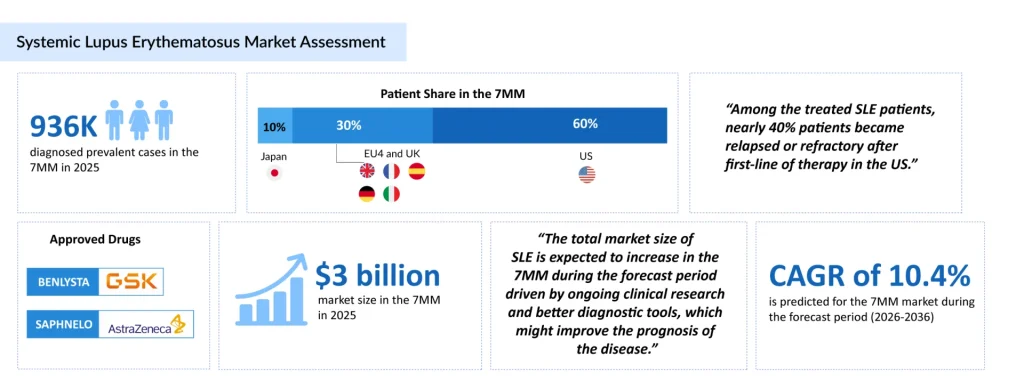
- The SLE market is valued at around USD 3 billion in 2025 across the 7MM and is projected to grow at a CAGR of 10.4% through 2036, fueled by rising prevalence, improved diagnosis, and increasing treatment innovation.
- The current market is anchored by a limited number of approved biologics: GSK’s BENLYSTA (belimumab) and AstraZeneca’s SAPHNELO (anifrolumab).
- Gilead is positioning itself as a future competitor through strategic deals and internal R&D (e.g., IRAK4 inhibitor Edecesertib), despite not yet having an approved SLE therapy.
- TLR7/8 inhibition is emerging as a promising new mechanism: Enpatoran (Merck KGaA/EMD Serono) has demonstrated positive Phase 2 results.
Systemic lupus erythematosus has spent decades as one of rheumatology’s toughest puzzles, a disease so unpredictable that clinicians once called it “the great imitator.” That reputation is starting to shift. A wave of biologics, oral small molecules, and cell-based approaches is reshaping how physicians manage flares, organ damage, and the punishing fatigue that defines life with lupus. As systemic lupus erythematosus burden and prevalence climb and diagnosis rates improve worldwide, the systemic lupus erythematosus market has become one of the more closely watched corners of immunology, and the companies racing to serve it are countering rising patient volumes with an unusually crowded, unusually ambitious pipeline.
Downloads
Click Here To Get the Article in PDF

Recent Articles
- CAR-T Beyond Cancer: Resetting Immunity in Autoimmune Diseases
- TYK2 Inhibitors: The Competitive Race Fueling the Next Generation of Autoimmune Therapies
- Aurinia’s Lupkynis for Lupus; FDA Fast Track Designation for Toripalimab; Wren Therapeutics...
- Lupus Nephritis: A SILENT but SEVERE Systemic Lupus Erythematosus Manifestation
- Is Hydroxychloroquine the answer to all the COVID-19 questions?
Why Is the SLE Market Growing So Fast?
SLE is an autoimmune disease in which the body’s immune system turns on its own tissue, attacking skin, joints, kidneys, and occasionally the brain and heart. It disproportionately affects women of childbearing age, and its symptoms, joint pain, photosensitive rashes, extreme fatigue, kidney inflammation, can wax and wane unpredictably for a lifetime.
As per DelveInsight analysis, the systemic lupus erythematosus market size is roughly USD 3 billion in the 7MM in 2025 and climbing, at a CAGR of 10.4% by 2036. That growth is being driven by a mix of factors:
- Rising global prevalence and better diagnostic awareness
- A steady shift away from broad immunosuppressants and steroids toward targeted biologics
- Expanding use of monoclonal antibodies that intervene in specific immune pathways rather than suppressing the entire immune system
- Growing investment in biomarker-driven and personalized treatment approaches
- Better access to specialty care through telemedicine and expanded pharmacy networks
The US systemic lupus erythematosus treatment market remains the single largest contributor to global revenue, thanks to faster biologic uptake, higher per-patient treatment costs, and a regulatory environment that has been comparatively receptive to novel immunology assets in recent years.
The Established Players: Who Currently Owns the Market
For most of modern medicine, lupus had exactly one FDA-approved biologic. That changed with GSK’s belimumab (BENLYSTA), which broke a 50-plus-year drought in new lupus therapies, and it changed again with AstraZeneca’s anifrolumab (SAPHNELO), a type I interferon receptor blocker that gave physicians a genuinely different mechanism to reach for. Today, the systemic lupus erythematosus (SLE) drugs market is anchored by a small group of approved therapies, but the list of systemic lupus erythematosus marketed drugs is finally starting to lengthen.
These systemic lupus erythematosus drugs set the commercial benchmark that every pipeline asset is now measured against, and they’ve proven that payers and physicians are willing to move beyond generic immunosuppressants when a therapy demonstrates a genuine steroid-sparing or flare-reduction benefit.
Emerging Entrants in the Systemic Lupus Erythematosus Treatment Market
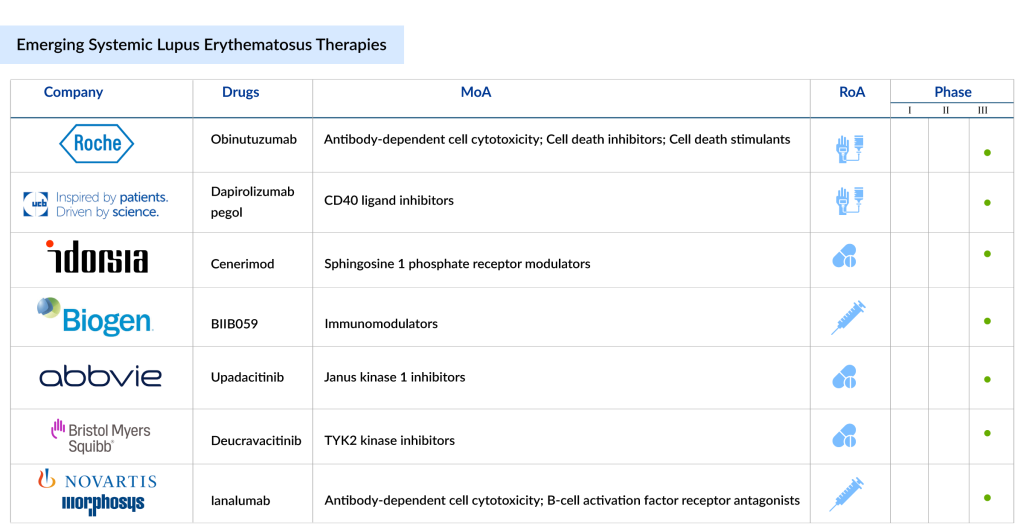
The systemic lupus erythematosus market is undergoing a significant transformation as emerging entrants such as Gilead, J&J, BMS, Roche, Biogen, Cabaletta Bio, Merck, Idorsia Pharmaceuticals, Viatris, UCB Pharma, AbbVie, and others are introducing innovative therapies aimed at improving disease control, reducing flare frequency, and addressing the limitations of conventional immunosuppressive treatments. The evolving systemic lupus erythematosus treatment market is being shaped by next-generation biologics, targeted small molecules, and novel immune-modulating approaches designed to deliver greater efficacy with improved safety profiles.
Several late-stage SLE pipeline candidates targeting pathways such as TYK2, JAK, S1P1, CD40L, and other immune regulators are expected to expand treatment options over the coming years, intensifying competition and driving innovation. The US systemic lupus erythematosus treatment market remains at the forefront of this growth due to its robust clinical development landscape, favorable regulatory environment, and increasing adoption of advanced therapies. As these investigational treatments progress toward commercialization, the systemic lupus erythematosus (SLE) drugs market is expected to witness a shift toward precision medicine, creating new opportunities for pharmaceutical companies while improving long-term outcomes for patients living with this complex autoimmune disorder.
Gilead’s Ambitions: Building a Pipeline in a Market It Doesn’t Yet Own
Here’s where the competitive story gets interesting. Gilead Sciences, long synonymous with HIV and virology, has been aggressively signaling its intent to become a serious player in autoimmune disease, including lupus, even though it doesn’t currently have an approved SLE product on the market. Through licensing deals (such as its NanoDisc immunotherapy collaboration) and acquisitions expanding its inflammation pipeline, Gilead is explicitly building toward a future where it competes head-on in this space, backed by an internal IRAK4 inhibitor (Edecesertib) program already in early clinical development for lupus and rheumatoid arthritis.
That positioning is exactly why so many analysts and consultancies frame their competitive teardown around Gilead competitors systemic lupus erythematosus marketed products, because the real question isn’t whether Gilead will enter the category, but which of today’s incumbents it will have to dislodge once it does. Any credible systemic lupus erythematosus competitors Gilead marketed products analysis has to account for GSK’s BENLYSTA franchise, AstraZeneca’s SAPHNELO, Aurinia/Otsuka’s LUPKYNIS, and the fast-advancing biologics from Roche/Genentech, Biogen, and Johnson & Johnson, all of which have a multi-year head start.
Roche’s Obinutuzumab: Reinforcing Its Position in the Evolving Systemic Lupus Erythematosus Treatment Landscape
Obinutuzumab is a glycoengineered anti-CD20 monoclonal antibody that selectively targets the CD20 antigen expressed on B lymphocytes, including malignant lymphoma and leukemia cells. As a type II anti-CD20 antibody, it is engineered to deliver enhanced antibody-dependent cellular cytotoxicity (ADCC) and more potent direct cell death than first-generation CD20-targeted therapies. By binding to CD20, obinutuzumab depletes B cells through immune cell-mediated cytotoxicity, induction of direct cell death, and complement-dependent cytotoxicity. In Europe, the drug is marketed under the brand name GAZYVARO.
In February 2026, Roche filed regulatory submissions in both the United States and Europe seeking approval of obinutuzumab for the treatment of systemic lupus erythematosus (SLE). In April 2026, the company announced that the U.S. FDA had accepted its supplemental Biologics License Application (sBLA) for review. The submission is supported by positive findings from the Phase III ALLEGORY trial, which demonstrated a statistically significant and clinically meaningful improvement in the study’s primary endpoint. A regulatory decision from the FDA is anticipated by December 2026.
Johnson & Johnson’s Nipocalimab: A Pipeline Threat Turning Real
Among the pipeline stories generating the most buzz, Johnson & Johnson’s nipocalimab, an FcRn (neonatal Fc receptor) blocker, stands out. The Phase 2 JASMINE study met its primary endpoint along with multiple key secondary and exploratory endpoints in adults with SLE, and the program has since been awarded FDA Fast Track designation, a signal regulators see as indicating it is addressing a genuine unmet need.
For anyone building a systemic lupus erythematosus competitors Johnson & Johnson marketed products view of the landscape, nipocalimab is the asset to watch. J&J has been methodically expanding its immunology footprint, and a positive late-stage readout here would give the company a genuine flagship in the autoimmune space well beyond its existing rheumatology and dermatology portfolio.
The TLR8 Story: A New Mechanistic Frontier
If there’s one mechanism generating the most scientific excitement right now, it’s Toll-like receptor 7/8 (TLR7/8) inhibition. TLR7 and TLR8 sit upstream of both interferon signaling and B-cell activation — two of the central drivers of lupus pathology, and genetic studies have directly linked gain-of-function TLR7 mutations to human lupus, giving the mechanism unusually strong biological validation.
The most closely watched TLR8 systemic lupus erythematosus clinical trial data so far comes from enpatoran, an oral, first-in-class TLR7/8 inhibitor being developed by EMD Serono/Merck KGaA. Results from Cohort B of the Phase 2 WILLOW study, conducted across 132 centers in 22 countries, were positive enough to be published in a leading medical journal in 2026, reinforcing TLR7/8 blockade as a credible steroid-sparing approach for moderate-to-severe SLE. Other companies are exploring adjacent TLR biology and interferon-pathway targets, and the growing body of TLR8 systemic lupus erythematosus (clinical or trial or readout or data) reporting suggests this mechanism could produce one of the next genuinely new drug classes for lupus patients, not just another entrant into an already crowded BLyS/BAFF space.
Conclusion
The systemic lupus erythematosus treatment market is no longer defined by a handful of legacy therapies. It’s being reshaped in real time by a wave of well-funded competitors, some, like GSK and AstraZeneca, defending first-mover advantage; others, like Gilead, building toward entry through M&A and internal R&D; and a broader field including J&J, BMS, Roche, Biogen, Cabaletta Bio, Merck, Idorsia Pharmaceuticals, Viatris, UCB Pharma, AbbVie, and others, racing to bring differentiated mechanisms across the finish line.
In 2026, the systemic lupus erythematosus treatment market has delivered milestone data for obinutuzumab (GAZYVA) in Roche/Genentech’s Phase III ALLEGORY trial, positive Phase III subcutaneous results for anifrolumab, and Breakthrough Therapy designation for Biogen’s litifilimab in cutaneous lupus, collectively signaling that this is no longer a one-mechanism race.
With TLR7/8 inhibition emerging as a genuinely novel frontier and steroid-sparing efficacy becoming the new competitive currency, the next few years of readouts, approvals, and launches will determine which companies define the next era of lupus care.

Downloads
Article in PDF
Recent Articles
- Roche’s GAZYVA Extends Indications Into Lupus, Strengthening Immunology Pipeline
- CAR-T Beyond Cancer: Resetting Immunity in Autoimmune Diseases
- Novo Nordisk Seeks FDA Approval for CagriSema; EU Approves Subcutaneous Self-administration of SA...
- BENLYSTA vs GAZYVA: Who Wins the Battle for Lupus Nephritis Treatment?
- Pfizer & Lilly’s JAK Inhibitors Drug; FDA Approves Lilly’s Bebtelovimab; GSKR...