
Bispecifics/BITE Market Summary
- The Bispecifics/BITE Market Size is estimated to grow with a significant CAGR during the study period (2020-2034).
Bispecifics/BITE Market and Epidemiology Analysis
- Bispecific antibodies (BsAbs) have emerged as a transformative class of biologics, offering dual-targeting mechanisms that enhance therapeutic efficacy across oncology, autoimmune disorders, and rare diseases.
- Bispecific antibodies aim to treat multifaceted, complex diseases by engaging two disease targets with one molecule. The majority approved for oncology indications (mainly multiple myeloma and Diffuse Large B-cell Lymphoma). Only two bispecific antibodies, HEMLIBRA and VABYSMO, are authorized for non-oncology indications such as hemophilia A, neovascular (wet) age-related macular degeneration, and diabetic macular edema, and a bispecific molecule named KIMMTRAK, approved for uveal melanoma.
- Based on pipeline activities, most of the bispecific antibodies were developed in multiple myeloma, followed by NSCLC.
- The world’s first approved bispecific, REMOVAB, aimed to tackle malignant ascites in solid tumors and gained the nod from the EMA; however, it was later withdrawn in 2017 for commercial reasons.
- Three main bispecific antibody fragment include Bispecific T-cell engager (BiTE), Dual-affinity re-targeting proteins (DARTs), and Tandem diabodies (TandAbs).
- In May 2024, the FDA granted accelerated approval to IMDELLTRA (tarlatamab-dlle) for the treatment of patients with SCLC that has progressed on or after platinum-based chemotherapy, making it the first BiTE approved for a major solid tumor and the first therapeutic option for the treatment of extensive-stage SCLC.
- Odronextamab monotherapy delivered strong efficacy with a manageable safety profile, positioning it as a promising off-the-shelf option for patients who progress after CAR-T therapy.
- In June 2025, BioNTech and Bristol Myers Squibb entered into an agreement for the global co-development and co-commercialization of BioNTech’s investigational bispecific antibody BNT327 across numerous solid tumor types. Under the agreement, BioNTech and BMS will work jointly to broaden and accelerate the development of this clinical candidate.
According to Zenas BioPharma’s Q1 2025 report published in May 2025, the company anticipates reporting topline Phase III results for Obexelimab in IgG4-related disease by the end of 2025, 12-week primary endpoint data in RMS in the third quarter of 2025, and 24-week primary endpoint data in Systemic Lupus Erythematosus in the first half of 2026. - In February 2025, Regeneron Pharmaceuticals announced that the US FDA the resubmission of the Biologics License Application (BLA) for linvoseltamab accepted for review for the treatment of adult patients with Relapsed/Refractory multiple myeloma who have received at least four prior lines of therapy or those who received three prior lines of therapy and are refractory to the last line of therapy. The target action date for the FDA decision is July 10, 2025.
- Johnson & Johnson Innovative Medicine is the leading player, with three approved bispecific antibodies: RYBERVANT, TECVAYLI, and TALVEY, followed by other established players such as AbbVie/Genmab, Roche/Biogen, Pfizer, Amgen and, Akeso Biopharma.
- Bambusa Therapeutics has successfully completed initial dosing in healthy volunteers with BBT002 — a novel, half-life–extended bispecific antibody designed as a versatile “platform in a molecule” for respiratory, dermatology, and gastroenterology disorders. Interim safety and PK data from the BBT002-01 study are expected in Q1 2026.
- Key Late-stage (Registered, Phase III, and II/III) emerging bispecific players include AstraZeneca, Zenas BioPharma, Merus, Regeneron Pharmaceuticals, Sichuan Baili Pharmaceutical, Alphamab, SystImmune, BioNTech (Biotheus), and others.
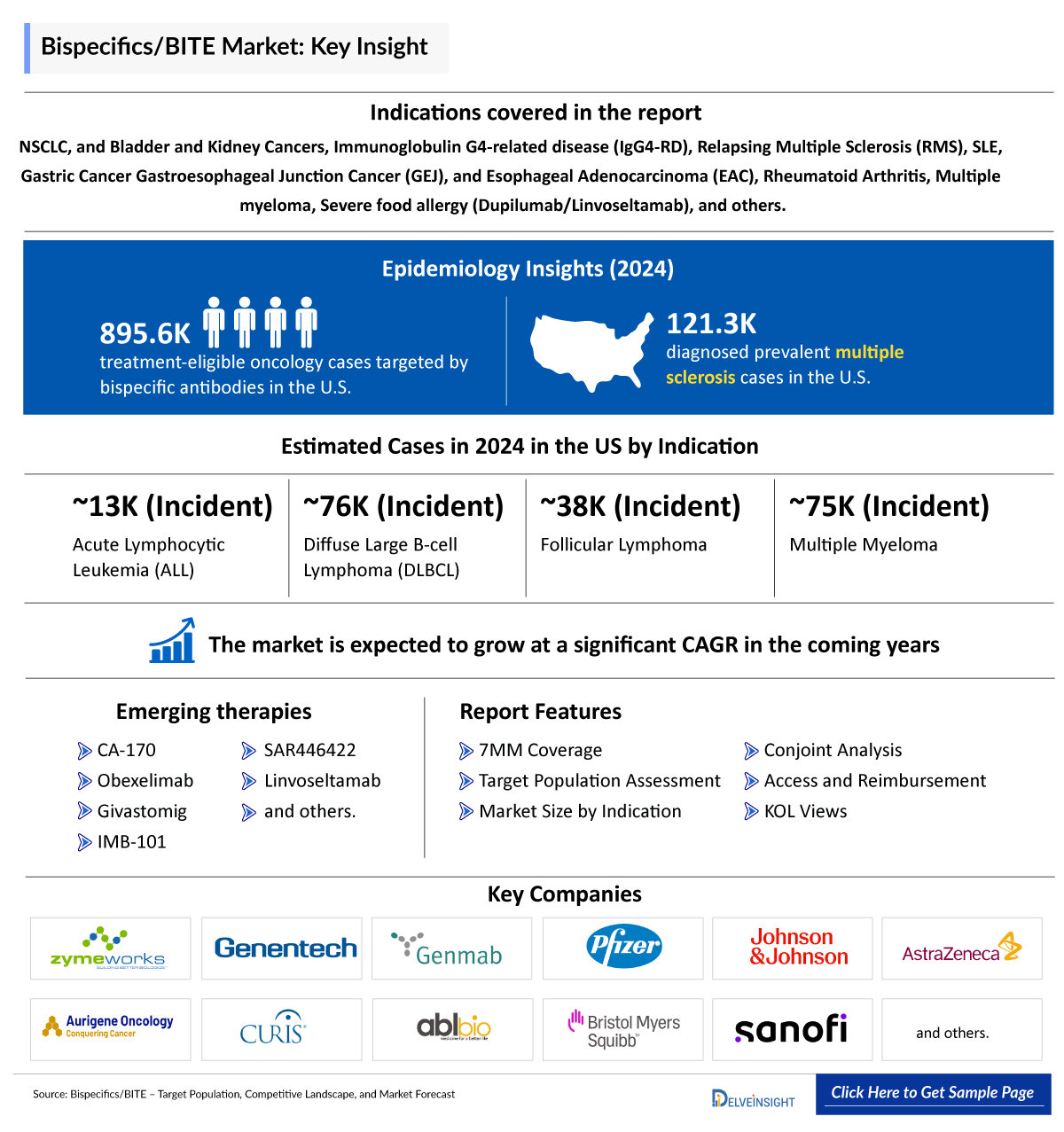
DelveInsight’s “Bispecifics/BITE Target Population, Competitive Landscape, and Market Forecast – 2034” report delivers an in-depth understanding of the Bispecific T-cell engager, historical and Competitive Landscape as well as the Bispecific T-cell engager therapeutics market trends in the United States, EU4 (Germany, France, Italy, and Spain) and the United Kingdom, and Japan.
The Bispecific T-cell engager market report provides current treatment practices, emerging drugs, market share of individual therapies, and current and forecasted Bispecific T-cell engager market size across 7MM from 2020 to 2034. The report also covers current Bispecific T-cell engager treatment practices/algorithms and unmet medical needs to curate the best opportunities and assess the market’s potential.
|
Study Period |
2020–2034 |
|
Forecast Period |
2025–2034 |
|
Geographies Covered |
US, EU4 (Germany, France, Italy, and Spain) the UK, and Japan |
|
Bispecific T-cell Engager Epidemiology |
Segmented by:
|
|
Bispecific T-cell Engager Companies |
|
|
Bispecific T-cell Engager Therapies |
|
|
Bispecific T-cell Engager Market Segmentation |
Segmented by:
|
|
Bispecific T-cell Engager Market Analysis |
|
Bispecific T-cell engaged Understanding
Bispecifics/BITE Overview
Bispecific antibodies (also known as T cell engagers) are a type of immunotherapy that help the immune system to recognise and kill cancer cells. There are several bispecific antibodies for myeloma at different stages of development. Bispecific antibodies are produced in a laboratory and they are specifically created to bind to proteins on two different types of cells – myeloma cells and a person’s own T cells.
Further details related to country-based variations are provided in the report...
Bispecific T-cell engager Epidemiology
The Bispecifics/BITE epidemiology chapter in the report provides historical as well as forecasted epidemiology segmented as total cases in selected indications for bispecifics/BITE, total eligible Bispecific T-cell engager patient pool in selected indications, and total treated cases in selected indications for Bispecific T-cell engager in the 7MM covering the US, EU4 (Germany, France, Italy, and Spain), and the UK, and Japan from 2020 to 2034.
- Among EU4 and the UK, the multiple myeloma incident cases were maximum in Germany and France, with approximately 24% of the total cases in 2024. While the lowest number of cases was in Spain.
- The treatment-eligible population targeted by bispecific antibodies in oncology in the US was estimated to be approximately 895,600 cases.
- As per the analysis, the total multiple sclerosis diagnosed prevalent cases in the US comprised approximately 121,250 cases in 2024 and is projected to increase during the forecast period.
- Among EU4 and the UK, the diagnosed prevalent cases of multiple sclerosis were maximum in Germany, with approximately 35,250 cases in 2024. While the lowest number of cases was in France.
- As per DelveInsight's analysis, in Japan, females accounted for the highest number of multiple sclerosis cases in 2024, with approximately 700 cases reported among females compared to around 350 cases among males.
Epidemiology of Top Indications | |
|
Indication |
Estimated Cases in 2024 in the US |
|
Acute Lymphocytic Leukemia (ALL) |
~12,900 (Incident) |
|
Diffuse Large B-cell Lymphoma (DLBCL) |
~76,500 (Incident) |
|
Follicular Lymphoma |
~37,700 (Incident) |
|
Multiple Myeloma |
~74,900 (Incident) |
|
Non-small-cell Lung Cancer (NSCLC) |
~204,814 (Incident) |
|
Small-cell Lung Cancer (SCLC) |
~94,700 (Incident) |
|
Biliary Tract Cancer (BTC) |
~46,800 (Incident) |
|
Psoriasis |
~8,000,500 (Prevalent) |
|
Rheumatoid Arthritis |
~1,453,200 (Prevalent) |
|
Multiple Sclerosis |
~121,250 (Prevalent) |
|
Systemic Lupus Erythematosus (SLE) |
~529,400 (Prevalent) |
|
Wet Age-related Macular Degeneration (AMD) |
~1,383,000 (Prevalent) |
Bispecific T-cell Engager Drug Chapters
The drug chapter segment of the Bispecifics/BITE reports encloses a detailed analysis of approved as well as emerging drugs in late and early-stage (Phase III, Phase II, and Phase I) Bispecifics/BITE pipeline drugs. It also helps understand the Bispecific T-cell engager clinical trial details, expressive pharmacological action, agreements and collaborations, approval and patent details, advantages and disadvantages of each included drug, and the latest news and press releases.
Bispecific T-cell Engager Marketed Drugs
ZIIHERA (zanidatamab): Zymeworks, Jazz Pharmaceuticals, and BeiGene
ZIIHERA is a bispecific HER2-directed antibody that binds to two extracellular sites on HER2. In November 2024, the US FDA granted accelerated approval of ZIIHERA 50 mg/mL for injection for IV use for the treatment of adults with previously treated, unresectable, or metastatic HER2-positive Biliary Tract Cancer.
Zanidatamab is also being investigated in multiple other clinical trials as a targeted treatment option for patients with solid tumors (Phase III for Gastroesophageal Adenocarcinoma and metastatic breast cancer and Phase II for colorectal cancer and Breast Cancer). Zanidatamab is being developed by Jazz and BeiGene under license agreements from Zymeworks, which first developed the molecule. Jazz has rights to commercialize zanidatamab in the US, Europe, Japan, and all other territories except for those Asia/Pacific territories that Zymeworks previously licensed to BeiGene, [which are Asia (excluding Japan), Australia, and New Zealand].
In April 2025, Zymeworks partner Jazz announced their participation at the ASCO annual meeting with three zanidatamab abstracts accepted for presentation. Additionally, Jazz Pharmaceuticals announced that the Committee for Medicinal Products for Human Use (CHMP) of the European Medicines Agency (EMA) adopted a positive opinion recommending the conditional marketing authorization of zanidatamab, an investigational dual HER2-targeted bispecific antibody, as monotherapy for the treatment of adults with unresectable locally advanced or metastatic HER2-positive (IHC 3+)† BTC previously treated with at least one prior line of systemic therapy.
COLUMVI (glofitamab-gxbm): Genentech
COLUMVI is a CD20 x CD3 T-cell engaging bispecific antibody designed with a novel 2:1 structural format. COLUMVI targets both T cells and B cells, which are cancerous in DLBCL. In June 2023, the US FDA granted accelerated approval to COLUMVI for relapsed or refractory DLBCL, not otherwise specified (DLBCL, NOS) or Large B-cell Lymphoma (LBCL) arising from follicular lymphoma, after two or more lines of systemic therapy.
Bispecific T-cell Engager Emerging Drugs
CA-170: Aurigene Oncology and Curis
CA-170 is a first-in-class, potent, and orally available small molecule. CA-170 selectively targets PD-L1 and VISTA, both of which function as negative checkpoint regulators of immune activation. Currently, CA-170 is in Phase III clinical trials for NSCLC treatment, and Bladder cancer and Kidney Cancers.
In February 2020, Curis amended its collaboration, license, and option agreement with Aurigene Discovery Technologies. Under the terms of the amended agreement, Aurigene obtained the rights to develop and commercialize CA-170 in Asia, in addition to its existing rights in India and Russia as outlined in the original agreement. Curis retains the rights to CA-170 in the US, Europe, and the rest of the world, and is entitled to receive royalty payments on potential future sales of CA-170 in Asia. Earlier, in 2015, Curis entered into a collaboration with Aurigene.
Givastomig: I-MAB Biopharma, ABL Bio, and Bristol Myers Squibb
Givastomig, also known as TJ-CD4B/ABL111 or TJ033721, is a bispecific antibody designed to bind to Claudin 18.2 (CLDN18.2) as a tumor engager and 4-1BB as a conditional T-Cell activator. Givastomig uniquely binds to tumor cells expressing various levels of CLDN18.2, including gastric cancer and pancreatic cancer cells, and conditionally activates intra-tumoral T-cells at the tumor site through 4-1BB.
In September 2024, I-Mab Biopharma presented data from the Phase I study of givastomig in claudin 18.2-positive advanced gastroesophageal carcinoma. The drug was well tolerated at doses up to 15 mg/kg every two weeks and demonstrated encouraging activity in heavily pre-treated gastroesophageal carcinoma patients, exhibiting a broad range of CLDN18.2 expression.
In March 2022, the US FDA granted Orphan Drug Designation for givastomig for the treatment of gastric cancer, including cancer of the gastroesophageal junction.
Comparison of Key Emerging Bispecific T-cell Engager | |||||
|
Product |
Company |
Molecule type |
RoA |
Phase |
Indication |
|
CA-170 |
Aurigene Oncology and Curis |
Small molecule |
Oral |
III |
NSCLC, and Bladder and Kidney Cancers |
|
Obexelimab |
Zenas BioPharma |
Bifunctional monoclonal antibody |
SC |
III |
Immunoglobulin G4-related disease (IgG4-RD) |
|
II |
Relapsing Multiple Sclerosis (RMS) | ||||
|
II |
SLE | ||||
|
Givastomig |
I-MAB Biopharma, ABL Bio, and Bristol Myers Squibb |
Bispecific antibody |
IV infusion |
I |
Gastric Cancer Gastroesophageal Junction Cancer (GEJ), and Esophageal Adenocarcinoma (EAC) |
|
IMB-101 |
IMBiologics, Y-Biologics, and HK Innoen |
Bispecific antibody |
IV infusion |
I |
Rheumatoid Arthritis |
|
SAR446422 |
Sanofi |
Bispecific monoclonal antibody |
SC and IV infusion |
I |
Inflammatory indication |
|
Linvoseltamab |
Regeneron Pharmaceuticals |
Bispecific antibody |
IV infusion |
III |
Multiple myeloma |
|
I |
Severe food allergy (Dupilumab/Linvoseltamab) | ||||
Bispecific T-cell Engager Market Outlook
Bispecific antibodies are essentially antibodies bioengineered to contain two distinct antigen-binding domains, which allow these recombinant molecules to bind specifically to more than one target. Bispecific antibodies have gained momentum over the past decade. Despite promising progress in the clinical application field of bispecific immunomodulatory antibodies in part of human tumor types, more prominent anti-tumor efficacy in most solid tumors still needs constant exploration. Furthermore, dozens of bispecific antibodies with different target combinations have exhibited potent anti-tumor effects in preclinical studies, but most of the positive preclinical outcomes could not be further validated in the clinic. With increasingly diverse bispecific antibodies entering preclinical and clinical trials, various challenges have emerged, hampering the development of bispecific antibodies.
While T cell-engaging bispecific antibodies effectively treat hematological malignancies, similar strategies have not been as successful with solid tumors. Several factors are thought to contribute to T cell engagers' lower efficacy in solid tumors, including the reduced availability of ideal tumor-specific targets, the immunosuppressive nature of the tumor microenvironment, and tumor physical barriers reducing antibody access.
Several key Bispecific T-cell Engager companies, including Aurigene Oncology, Curis, I-MAB Biopharma, ABL Bio, Bristol Myers Squibb, IMBiologics, Y-Biologics, HK Innoen, Regeneron Pharmaceuticals, Sanofi, Zenas BioPharma, and others, are involved in Bispecific T-cell Engager drug development for various indications such as NSCLC, Bladder and Kidney Cancers, IgG4-RD, RMS, SLE, multiple sclerosis, and others.
Bispecific T-cell Engager Drugs Uptake
This section focuses on the uptake rate of emerging Bispecific T-cell Engager drugs expected to be launched in the market during 2025–2034.
Bispecific T-cell Engager Pipeline Development Activities
The Bispecific T-cell Engager pipeline report provides insights into different Bispecific T-cell Engager clinical trials within Phase III, Phase II, and Phase I. It also analyzes key players involved in developing targeted therapeutics.
The presence of numerous drugs under different stages is expected to generate immense opportunity for Bispecific T-cell Engager market growth over the forecasted period.
Bispecific T-cell Engager Pipeline development activities
The Bispecific T-cell Engager clinical trials analysis report covers information on collaborations, acquisitions and mergers, licensing, and patent details for Bispecifics/BITE emerging therapies.
The increasing strategic collaborations among major market players to enhance the growth of their pipeline products are anticipated to drive market expansion. For example: In June 2024, I-MAB Biopharma announced that it had entered into a clinical trial collaboration and supply agreement with BMS. The collaboration will evaluate the combination of givastomig, with BMS immune checkpoint inhibitor, nivolumab, and chemotherapy (FOLFOX or CAPOX), as a potential first-line treatment for patients with advanced CLDN18.2-positive gastric and esophageal cancers.
Latest KOL Views on Bispecifics/BITE Market
To keep up with current and future market trends, we take Industry Experts’ opinions working in the domain through primary research to fill the data gaps and validate our secondary research. Industry experts were contacted for insights on Bispecifics/BITEs’ evolving treatment landscape, patient reliance on conventional therapies, patient therapy switching acceptability, drug uptake, along challenges related to accessibility.
DelveInsight’s analysts connected with 25+ KOLs to gather insights; however, interviews were conducted with 10+ KOLs in the 7MM. Centers such as Hackensack University Medical Center, University of Washington, Harvard Cancer Center, etc. were contacted.
Their opinion helps understand and validate current and emerging therapy treatment patterns or Bispecifics/BITE market trends. This will support the clients in potential upcoming novel treatments by identifying the overall scenario of the market and the unmet needs.
|
KOL Views |
|
“I think a lot of institutions are also struggling with that financial piece as to how you incorporate [bispecific therapy] and who’s going to assume the cost of it.… I can tell you that there are different strategies, depending on which bispecific that you’re looking at or utilizing. Some of [the companies behind the drugs] do provide a new technology payment given on the back end where they will be reimbursed better than [with] traditional medications. Another one is providing free product for the inpatient administration, and then once the patient gets to the outpatient setting…you would have to purchase the supply.” |
|
"Bispecific antibodies, clinically, are probably more similar than they are different. The overall response rates [ORRs] for them are relatively similar in the 60% to 75% range. One of the interesting things about bispecific antibodies is that the time to first response is typically between 1 to 2 months for everybody. In my experience, you can rapidly differentiate patients who are having a response because they have good T cells and the antigens being expressed and are blocking it.” |
Bispecifics/BITE Market Qualitative Analysis
We perform Qualitative and market Intelligence analysis using various approaches, such as SWOT analysis and Conjoint Analysis. In the SWOT analysis, strengths, weaknesses, opportunities, and threats in terms of gaps in disease diagnosis, patient awareness, physician acceptability, competitive landscape, cost-effectiveness, and geographical accessibility of therapies are provided.
Conjoint Analysis analyzes multiple approved and emerging therapies based on relevant attributes such as safety, efficacy, frequency of administration, route of administration, and order of entry. Scoring is given based on these parameters to analyze the effectiveness of therapy. In efficacy, the trial’s primary and secondary outcome measures are evaluated; for instance, in event-free survival, one of the most important primary outcome measures is event-free survival and overall survival.
Further, the therapies’ safety is evaluated, wherein the acceptability, tolerability, and adverse events are majorly observed, and it sets a clear understanding of the side effects posed by the drug in the trials. In addition, the scoring is also based on the probability of success, and the addressable patient pool for each therapy. According to these parameters, the final weightage score and the ranking of the emerging therapies are decided.
Market Access and Reimbursement
Reimbursement may be referred to as the negotiation of a price between a manufacturer and a payer that allows the manufacturer access to the market. It is provided to reduce the high costs and make the essential drugs affordable. Health technology assessment (HTA) plays an important role in reimbursement decision-making and recommending the use of a drug. These recommendations vary widely throughout the seven major markets, even for the same drug. In the US healthcare system, both Public and Private health insurance coverage are included. Also, Medicare and Medicaid are the largest government-funded programs in the US. The major healthcare programs including Medicare, Medicaid, the Children's Health Insurance Program (CHIP), and the state and federal health insurance marketplaces are overseen by the Centers for Medicare & Medicaid Services (CMS). Other than these, Pharmacy Benefit Managers (PBMs), and third-party organizations that provide services, and educational programs to aid patients are also present.
The report further provides detailed insights on the country-wise accessibility and reimbursement scenarios, cost-effectiveness scenario of approved therapies, programs making accessibility easier and out-of-pocket costs more affordable, insights on patients insured under federal or state government prescription drug programs, etc.
Bispecific T-cell Engager Market Key Updates
- In June 2025, BioNTech and Bristol Myers Squibb entered into an agreement for the global co-development and co-commercialization of BioNTech’s investigational bispecific antibody BNT327 across numerous solid tumor types. Under the agreement, BioNTech and BMS will work jointly to broaden and accelerate the development of this clinical candidate.
- According to Zenas BioPharma’s Q1 2025 report published in May 2025, the company anticipates reporting topline Phase III results for Obexelimab in IgG4-related disease by the end of 2025, 12-week primary endpoint data in RMS in the third quarter of 2025, and 24-week primary endpoint data in Systemic Lupus Erythematosus in the first half of 2026.
- In February 2025, Regeneron Pharmaceuticals announced that the US FDA the resubmission of the Biologics License Application (BLA) for linvoseltamab accepted for review for the treatment of adult patients with Relapsed/Refractory multiple myeloma who have received at least four prior lines of therapy or those who received three prior lines of therapy and are refractory to the last line of therapy. The target action date for the FDA decision is July 10, 2025.
- According to I-MAB Biopharma’s Q1 2025 report published in May 2025, the company anticipates presenting data from the givastomig dose expansion cohorts (n = 40) in the first half of 2026, with further development initiatives and data readouts from the Phase Ib study expected through 2027. Additionally, new data from the givastomig dose escalation combination study in US patients will be presented at the European Society of Medical Oncology Gastrointestinal (ESMO GI) Cancers Congress 2025, scheduled for July 2–5 in Barcelona, Spain.
- In May 2025, Genentech announced two-year follow-up data from the Phase III STARGLO study. The updated data continue to demonstrate the statistically significant and clinically meaningful survival benefit of this off-the-shelf, fixed-duration Columvi combination for people with R/ DLBCL who have received at least one prior line of therapy and are not candidates for autologous stem cell transplant (ASCT).
Scope of the Bispecific T-cell Engager Market Report
- The report covers a segment of key events, an executive summary, and a descriptive overview of Bispecifics/BITE, explaining its mechanism, and emerging pipeline.
- Comprehensive insight into the Competitive Landscape, and forecasts, the future growth potential of treatment rate, drug uptake, and drug information have been provided.
- Additionally, an all-inclusive account of emerging therapies and the elaborative profiles of late-stage and prominent therapies will impact the current landscape.
- A detailed review of the Bispecifics/BITE market, historical and forecasted market size, market share by therapies, detailed assumptions, and rationale behind our approach is included in the report, covering the 7MM drug outreach.
- The report provides an edge while developing business strategies, by understanding trends, through SWOT analysis expert insights/KOL views, and treatment preferences that help shape and drive the 7MM Bispecifics/BITE market.
Bispecifics/BITE Market Report Insights
- Bispecific T-cell Engager Targeted Patient Pool
- Bispecific T-cell Engager Therapeutic Approaches
- Bispecific T-cell Engager Pipeline Analysis
- Bispecific T-cell Engager Market Size and Trends
- Existing and future Market Opportunity
Bispecifics/BITE Market Report Key Strengths
- Ten-Year Forecast
- The 7MM Coverage
- Key Cross Competition
- Bispecific T-cell Engager Drugs Uptake
- Key Bispecific T-cell Engager Market Forecast Assumptions
Bispecifics/BITE Market Report Assessment
- Current Bispecific T-cell Engager Treatment Practices
- Bispecific T-cell Engager Unmet Needs
- Bispecific T-cell Engager Pipeline Product Profiles
- Bispecific T-cell Engager Market Attractiveness
- Qualitative Analysis (SWOT and Conjoint Analysis)
- Bispecific T-cell Engager Market Drivers
- Bispecific T-cell Engager Market Barriers
Key Questions Answered In The Bispecific T-cell Engager Market Report:
- What was the Bispecifics/BITE total market size, the market size by therapies, market share (%) distribution, and what would it look like in 2034? What are the contributing factors for this growth?
- Which drug is going to be the largest contributor in 2034?
- What is the most lucrative market for Bispecifics/BITE?
- Which drug type segment accounts for the maximum Bispecifics/BITE sales?
- What are the pricing variations among different geographies?
- What are the risks, burdens, and unmet needs of treatment with Bispecifics/BITE? What will be the growth opportunities across the 7MM for the patient population of Bispecifics/BITE?
- What are the key factors hampering the growth of the Bispecifics/BITE market?
- What are the indications for which recent novel therapies and technologies have been developed to overcome the limitations of existing treatments?
- What key designations have been granted to the therapies for Bispecifics/BITE?
- What is the cost burden of approved therapies on the patient?
- Patient acceptability in terms of preferred therapy options as per real-world scenarios?
Reasons to buy Bispecific T-cell Engager Market Forecast Report
- The report will help develop business strategies by understanding the latest trends and changing dynamics driving the Bispecifics/BITE Market.
- Understand the existing market opportunities in varying geographies and the growth potential over the coming years.
- Distribution of historical and current patient share based on real-world prescription data along with reported sales of approved products in the US, EU4 (Germany, France, Italy, and Spain) the United Kingdom, and Japan.
- Identifying strong upcoming players in the market will help devise strategies to help get ahead of competitors.
- Detailed analysis and ranking of indication-wise current and emerging therapies under the conjoint analysis section to provide visibility around leading indications.
- Highlights of Access and Reimbursement policies of approved therapies, barriers to accessibility of expensive off-label therapies, and patient assistance programs.
- To understand Key Opinion Leaders’ perspectives around the accessibility, acceptability, and compliance-related challenges of existing treatment to overcome barriers in the future.
- Detailed insights on the unmet needs of the existing market so that the upcoming players can strengthen their development and launch strategy.

