The Regenerative Medicine Revolution: Opportunities Shaping the Next Decade
Jul 22, 2026
Table of Contents
For most of modern medical history, treatment has meant managing disease, controlling symptoms, slowing progression, and buying time. Regenerative medicine flips that model on its head. Instead of managing damage, it aims to repair it: regrowing tissue, replacing diseased cells, and in some cases, reversing conditions once considered permanent. What was once confined to research labs and speculative science fiction is now a fast-moving commercial reality. Cell therapies are curing certain blood cancers. Gene therapies are restoring vision and correcting inherited disorders with a single infusion. Tissue-engineered scaffolds are helping patients regrow cartilage instead of replacing joints. And the pipeline behind these breakthroughs is only getting deeper.
Over the next ten years, regenerative medicine is expected to move from a niche, high-cost specialty into a mainstream pillar of healthcare, reshaping how diseases are treated, how care is priced, and how pharma, biotech, and investors allocate resources.
Downloads
Click Here To Get the Article in PDF

Recent Articles
- Cell and Gene Therapies for Diabetes Treatment: A Permanent Cure for Patients?
- Inozyme Raises $67M; Shanghai Miracogen partners with Synaffix; EdiGENE raises $15M; Antengene an...
- Business Cocktail
- Plasma Proteins Therapeutics: Transforming Treatment in Hematology and Beyond
- Vertex & CRISPR Therapeutics Make History: FDA Approves exa-cel, the First CRISPR Gene Therap...
What is Driving the Regenerative Medicine Boom?
Regenerative medicine isn’t new; stem cell research and tissue engineering have been around for decades. What’s changed is the convergence of science, technology, and capital that’s finally letting these therapies scale.
Breakthroughs in cell and gene therapy science. CRISPR-based gene editing, CAR-T cell engineering, and induced pluripotent stem cells (iPSCs) have matured from experimental concepts into validated, repeatable platforms. Scientists can now edit, expand, and reprogram cells with a level of precision that wasn’t possible even five years ago.
A wave of regulatory approvals is building investor confidence. Health authorities across the US, EU, Japan, and China have approved a growing list of cell and gene therapies, and expedited pathways, like the FDA’s Regenerative Medicine Advanced Therapy (RMAT) designation, are shortening the road from lab to clinic.
Manufacturing is catching up to science. Producing living cell therapies at scale used to be prohibitively complex and expensive. Advances in bioprocessing, automation, and closed-system manufacturing are bringing costs down and making commercial-scale production realistic.
Rising burden of chronic and degenerative disease. Aging populations worldwide are driving demand for therapies that address osteoarthritis, neurodegeneration, cardiovascular damage, and cancers that don’t respond well to conventional treatment, exactly the conditions regenerative medicine is best suited to target.
Capital is flowing in. Venture funding, pharma M&A, and licensing deals in cell and gene therapy have surged, with large pharmaceutical companies acquiring or partnering with regenerative medicine innovators to secure a foothold in the space before it matures further.
Key Therapeutic Areas Transforming Healthcare
Regenerative medicine isn’t a single therapy category; it’s a toolkit being applied across nearly every major disease area. Here’s where the impact is most visible today.
Oncology
Cell-based immunotherapies, particularly CAR-T and emerging CAR-NK therapies, have already transformed treatment for certain blood cancers, delivering durable remissions in patients who had exhausted other options. The next frontier is extending these engineered-cell approaches to solid tumors, which present tougher biological barriers but represent a far larger patient population and a far larger commercial opportunity.
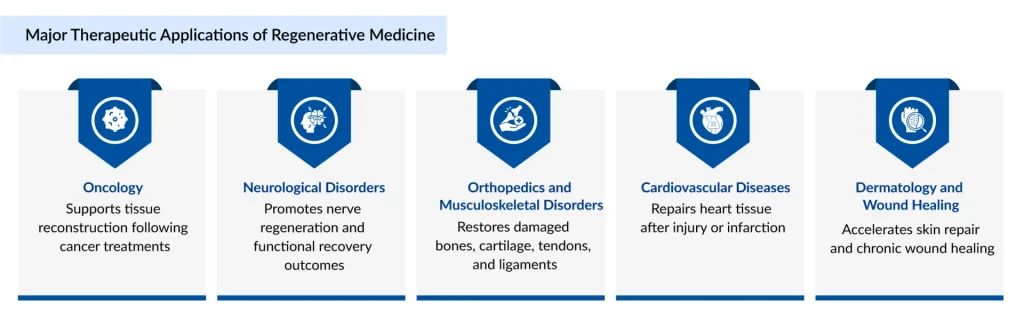
Orthopedics
Cartilage and bone don’t regenerate well on their own, which is why joint replacement has long been the default for severe damage. Regenerative approaches, including autologous chondrocyte implantation, mesenchymal stem cell injections, and bioengineered scaffolds, are giving patients an alternative that restores function without a permanent implant, particularly appealing for younger, more active patients.
Neurology
Neurodegenerative diseases like Parkinson’s and ALS, along with spinal cord injuries, have historically been treated with symptom management alone because damaged neural tissue doesn’t regenerate naturally. Stem cell-derived neuron replacement and gene therapies targeting the underlying genetic drivers of neurodegeneration are now in active clinical development, offering the first real hope of disease modification rather than just symptom control.
Cardiovascular Diseases
Heart tissue damaged by a heart attack doesn’t heal the way skin or bone does; scar tissue forms instead of functional muscle. Regenerative approaches using cardiac stem cells, engineered heart tissue patches, and gene therapies designed to stimulate the heart’s own repair mechanisms are working to change that, aiming to restore contractile function rather than simply prevent further decline.
Dermatology and Wound Care
Chronic wounds, severe burns, and diabetic ulcers represent a significant and often under-discussed clinical burden. Bioengineered skin substitutes, growth factor therapies, and stem cell-based grafts are accelerating healing in wounds that don’t respond to conventional care, reducing amputation risk and improving quality of life for patients with non-healing injuries.
Commercial Opportunities and Market Growth in Regenerative Medicine
The regenerative medicine market is emerging as one of the fastest-growing segments of the global healthcare industry, driven by advances in stem cell therapy, gene therapy, tissue engineering, and biomaterials. Unlike conventional treatments that primarily manage symptoms, regenerative medicine aims to restore or replace damaged tissues and organs, creating significant long-term commercial value. According to DelveInsight, the global regenerative medicine market is projected to grow from USD 41.36 billion in 2025 to USD 161.99 billion by 2034, expanding at a robust CAGR of 16.46% during 2026–2034. The increasing prevalence of chronic diseases, aging populations, rising investments in advanced therapeutics, and favorable regulatory support are expected to sustain this strong growth trajectory.
Commercial opportunities are expanding across multiple therapeutic areas, including oncology, cardiovascular diseases, orthopedics, neurology, wound care, and rare genetic disorders. The growing clinical success of cell and gene therapies is encouraging pharmaceutical and biotechnology companies to accelerate product development, strategic collaborations, and manufacturing investments. North America currently leads the market owing to its advanced healthcare infrastructure, strong research ecosystem, and supportive reimbursement environment, while Asia-Pacific is anticipated to witness the fastest growth due to increasing healthcare expenditure, expanding biotechnology capabilities, and government initiatives promoting regenerative medicine innovation.
The competitive landscape is characterized by the presence of both established pharmaceutical companies and specialized regenerative medicine developers. Major players such as Novartis AG, Gilead Sciences, Bristol Myers Squibb, Johnson & Johnson, Vertex Pharmaceuticals, Takeda Pharmaceutical, and bluebird bio continue to strengthen the market through investments in cell and gene therapy platforms. At the same time, regenerative medicine specialists, including Vericel Corporation, Organogenesis Holdings, Mesoblast, MiMedx Group, Zimmer Biomet, Stryker, and Smith & Nephew, are advancing innovative solutions in tissue engineering, wound healing, cartilage repair, and orthopedic regeneration. Their expanding product portfolios, clinical pipelines, and strategic partnerships are expected to drive commercialization and broaden patient access to next-generation regenerative therapies.
Looking ahead, regenerative medicine is expected to reshape the treatment landscape by shifting healthcare toward curative and restorative approaches rather than symptom management. Continuous advances in stem cell technologies, gene editing, biomaterials, and personalized regenerative therapies are likely to unlock new revenue streams across both developed and emerging markets. As clinical evidence strengthens and manufacturing capabilities improve, the industry is well-positioned to attract sustained investments, accelerate product approvals, and create substantial commercial opportunities for innovators across the regenerative medicine value chain.
Challenges Reshaping the Regenerative Medicine Landscape
The regenerative medicine landscape is undergoing a period of rapid scientific advancement, yet several challenges continue to influence its pace of commercialization and clinical adoption. One of the most significant hurdles is the complexity of developing safe, durable, and reproducible therapies. Cell- and gene-based products often require intricate manufacturing processes, stringent quality control, and specialized storage and distribution systems, making large-scale production both technically demanding and costly. In addition, variability in patient responses, long-term safety monitoring requirements, and the need for robust clinical evidence further extend development timelines and increase investment risks for developers.
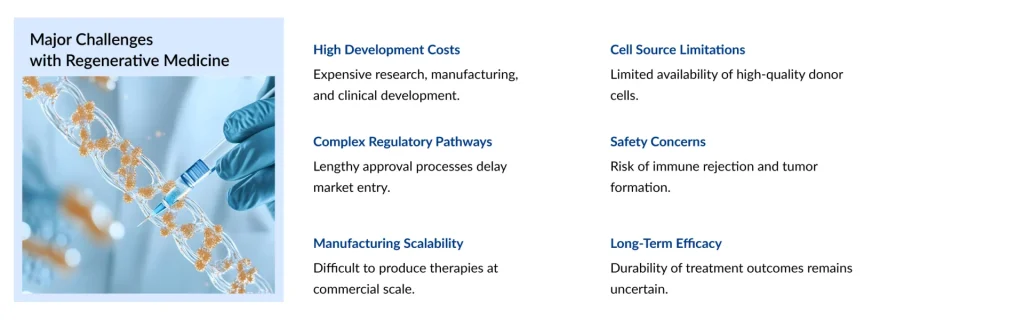
Regulatory and reimbursement uncertainties also remain critical barriers to broader market expansion. Given the novel mechanisms of regenerative therapies, regulatory agencies frequently require extensive evidence on efficacy, durability, and long-term safety before granting approvals. At the same time, the high upfront costs associated with many regenerative medicine products pose challenges for healthcare systems and payers, necessitating innovative reimbursement models that balance affordability with continued innovation. Limited manufacturing capacity, supply chain constraints, and the shortage of specialized infrastructure and trained healthcare professionals further complicate the widespread delivery of these advanced therapies.
Despite these challenges, the regenerative medicine industry continues to evolve through technological innovation and strategic collaboration. Advances in automation, artificial intelligence-driven manufacturing optimization, gene editing, biomaterials, and scalable cell-processing technologies are helping improve product consistency and reduce production costs. Meanwhile, partnerships among biotechnology companies, pharmaceutical firms, academic institutions, contract manufacturing organizations (CMOs), and regulatory bodies are accelerating research, streamlining development pathways, and expanding global manufacturing capabilities. As these scientific, regulatory, and commercial challenges are progressively addressed, regenerative medicine is expected to move closer to becoming a mainstream therapeutic approach for a broad range of chronic, degenerative, and rare diseases.
What the Next Decade Holds
Regenerative medicine is at the inflection point that many transformative technologies pass through; the science has been validated, the early commercial wins are real, and the infrastructure needed to scale is finally being built. What happens next will be shaped by execution as much as innovation.
Expect to see broader approval of off-the-shelf cell therapies that don’t require patient-specific manufacturing, making treatment faster and more scalable. Expect gene editing to move beyond rare diseases into more prevalent conditions as delivery methods improve. Expect manufacturing costs to gradually decline as the industry matures, platform technologies standardize, and CDMO capacity expands. And expect payers, regulators, and manufacturers to keep negotiating new pricing models built specifically for one-time curative treatments.
The companies and investors who understand where the science, the regulatory environment, and the commercial model are heading, not just where they are today, will be the ones positioned to lead as regenerative medicine moves from breakthrough to standard of care.

Downloads
Article in PDF
Recent Articles
- Social Behavior Loss Observed in Gene-edited ants through CRISPR
- Ipsen’s Cabometyx Rejected by NICE; Vertex and CRISPR Therapeutics’s Submit BLA to the FDA for ex...
- Break the Gene Therapy Barrier with DelveInsight’s Gene Therapy Reports
- Notizia
- WASKYRA Wins FDA Approval, Marking a Historic Leap for Rare Disease Gene Therapies