The Evolution of Systemic Lupus Erythematosus Treatment: From Symptom Control to Targeted Therapies
Jul 22, 2026
Table of Contents
Summary
- SLE is a chronic autoimmune disease affecting multiple organs, with ~936K diagnosed cases across the 7MM in 2025 and expected growth by 2036.
- BENLYSTA (belimumab, GSK) remains the cornerstone biologic, targeting BLyS to reduce autoreactive B cells; it expanded into lupus nephritis, pediatrics, and multiple formulations (IV and SC).
- SAPHNELO (anifrolumab, AstraZeneca), approved in 2021, is the second biologic targeting the interferon pathway.
- The SLE pipeline is highly active, with 140+ therapies across 120+ companies, including biologics, oral small molecules, and advanced modalities like CAR-T therapies.
- Promising drugs under development include Ianalumab (Novartis), Nipocalimab (IMAAVY) (Johnson & Johnson Innovative Medicine), Deucravacitinib (SOTYKTU) (Bristol Mayer Squibb), CABA-201 (Cabaletta Bio), Enpatoran (M5049) (Merck), Litifilimab (Biogen), Upadacitinib (RINVOQ) (AbbVie), and others.
For nearly five decades, physicians treating systemic lupus erythematosus (SLE) had almost nothing new to reach for. Corticosteroids, antimalarials, and broad-spectrum immunosuppressants, the same blunt instruments used since the 1950s, remained the backbone of care well into the 2000s. That changed in 2011, and the systemic lupus erythematosus market has been in a state of accelerating transformation ever since. SLE is a chronic, relapsing-remitting autoimmune disease in which the body’s own immune system attacks healthy tissue across the skin, joints, kidneys, blood, and central nervous system.
Downloads
Click Here To Get the Article in PDF

Recent Articles
- 5 Upcoming Bispecific & Trispecific Antibodies Beyond Oncology
- Aelis Farma pockets $30M; Alcyone unveils $23M for AAV gene therapies; Progentec and GSK collabor...
- Horizon, Viela Deal; Concert Schizo Drug Flop; Gilead Deals with Arcus and Gritstone
- Novo Nordisk Seeks FDA Approval for CagriSema; EU Approves Subcutaneous Self-administration of SA...
- Systemic Lupus Erythematosus: Mapping the Burden of a Complex Autoimmune Disease
According to CDC-funded National Lupus Registry data, an estimated 204,295 Americans live with SLE under strict ACR diagnostic criteria, while broader claims-based analyses put prevalence as high as 150 to 253 per 100,000 people depending on insurance type, translating to roughly 345,000–404,000 privately and Medicare-insured patients plus close to 99,000 Medicaid patients in the US alone.
According to DelveInsight’s estimates, the total diagnosed prevalent cases of SLE in the 7MM were approximately 936K in 2025. In 2025, among the severity of SLE in the US, moderate SLE was the most prevalent subtype (~261K cases), followed by mild SLE cases. Due to increased disease awareness and standardized diagnostic criteria, this number is projected to increase by 2036, highlighting a continuing trend in diagnosed prevalence. This heavy, unevenly distributed disease burden is exactly why the systemic lupus erythematosus treatment market has become one of immunology’s most closely watched spaces.
GSK’s BENLYSTA: First Targeted Biological Treatment for SLE
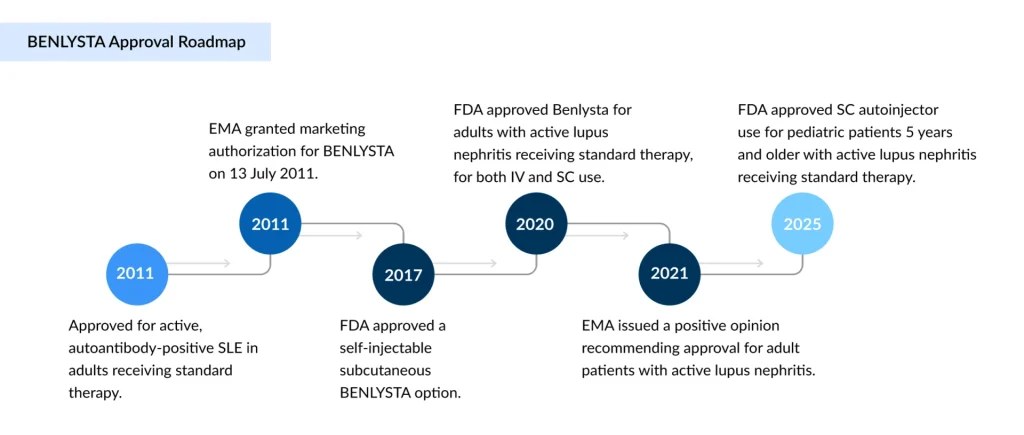
Every conversation about modern SLE care starts with BENLYSTA (belimumab). Developed by Human Genome Sciences and commercialized by GSK, belimumab was approved by the FDA in March 2011 as the first biologic therapy specifically indicated for active, autoantibody-positive SLE in patients on standard therapy, the first genuinely new lupus therapy in over 50 years. Belimumab works by inhibiting B-lymphocyte stimulator (BLyS), a protein that promotes the survival of autoreactive B cells that drive lupus flares.
Belimumab’s label has expanded meaningfully since that first approval. It became the first and, for years, the only FDA-approved biologic covering both SLE and lupus nephritis after its nephritis indication was cleared, and it has since picked up recommendations from European regulators for active lupus nephritis as well. Both intravenous and subcutaneous formulations are now available, giving GSK meaningful flexibility across hospital and home-infusion settings, and pediatric approvals have further broadened the eligible population. Among systemic lupus erythematosus marketed drugs, BENLYSTA remains the reference standard against which every newer entrant is measured, and it anchors most competitive teardowns of the systemic lupus erythematosus (SLE) drugs market.
BENLYSTA Sales and Annual Cost of Therapy (ACOT)
Belimumab’s commercial trajectory tells its own story about how quickly the systemic lupus erythematosus treatment market can move once a credible biologic option exists. Sales climbed from roughly $119 million in 2017 to $657 million in 2018, a more than fivefold jump in a single year, largely on the back of the subcutaneous formulation’s launch and expanding physician confidence in biologic therapy for lupus. That growth has continued: GSK reported FY2025 BENLYSTA sales of $1.8 billion, up 22% year-over-year, citing BENLYSTA and NUCALA as the primary drivers of double-digit growth in its immunology portfolio.
Annual cost of therapy (ACOT) for belimumab typically runs into the tens of thousands of dollars per patient per year in the US, varying by formulation (IV versus subcutaneous), dosing weight, site-of-care markup, and payer negotiations, a cost structure broadly consistent with the biologic class as a whole. High per-patient ACOT, combined with a large diagnosed-but-undertreated population, is precisely what makes the systemic lupus erythematosus market size so attractive to new entrants, and why payer formulary coverage (BENLYSTA now sits on over 85% of US commercial formularies) has become as important a competitive lever as clinical efficacy itself.
One structural headwind is worth flagging for anyone tracking systemic lupus erythematosus marketed drugs: BENLYSTA’s US patent protection is approaching expiration around 2025, with European exclusivity following roughly a year later. That timeline is already shaping how GSK, and its would-be biosimilar challengers, think about lifecycle management heading into the back half of this decade.
SAPHNELO: AstraZeneca’s Challenge to BENLYSTA’s Dominance
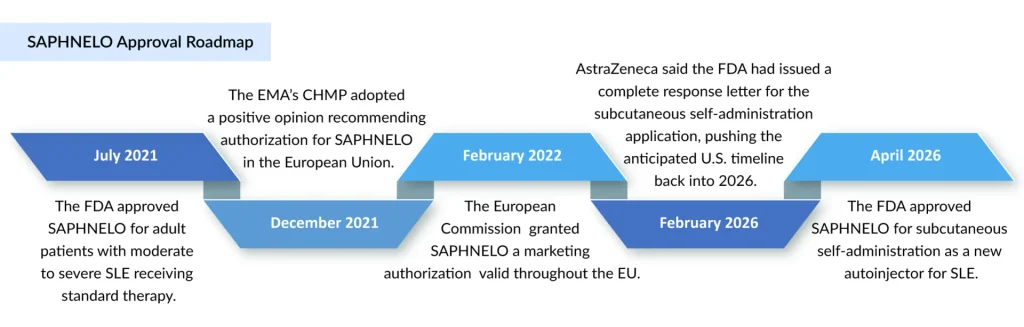
For a full decade, belimumab had the targeted-biologic segment of the systemic lupus erythematosus market essentially to itself. That changed in August 2021, when the FDA approved AstraZeneca’s SAPHNELO (anifrolumab) as an add-on therapy for adults with moderate-to-severe SLE, only the second targeted biologic ever cleared for the disease, and the first to work through an entirely different mechanism. Rather than starving autoreactive B cells of survival signals the way belimumab does, anifrolumab is a type I interferon receptor antagonist: it blocks the receptor that all type I interferons (IFN-α, IFN-β, and others) signal through, shutting down a pathway that drives disease activity in a large subset of lupus patients who carry a high “interferon signature.”
Commercially, AstraZeneca has closed the gap without yet overtaking GSK outright. FY2025 SAPHNELO revenue reached $686 million, up 45% year-over-year, on the back of strong US demand growth and continuing launches across Europe and the rest of the world, a trajectory GSK’s own $1.8 billion, +22% BENLYSTA print in the same year shows it is still comfortably outpacing in absolute dollars, even as anifrolumab compounds faster off a smaller base. AstraZeneca has also been actively removing structural friction from the franchise: in Q4 2025 it paid Bristol Myers Squibb $170 million to zero out royalties owed on SAPHNELO sales outside the US (a mid-teens royalty on US sales remains), improving margin economics as volume scales. The subcutaneous autoinjector version of SAPHNELO, intended to match BENLYSTA’s convenience advantage and expand use beyond infusion-center settings, hit a regulatory snag with an FDA complete response letter in late 2025, but was approved in the US in April 2026, removing one of the last differentiators that had favored BENLYSTA on administration convenience.
With head-to-head evidence syntheses finding the two drugs broadly comparable in efficacy (one indirect comparison gave belimumab only a modest edge, 58% versus 42% probability of superiority), the real battle for share in the us systemic lupus erythematosus treatment market is increasingly being fought on steroid-sparing perception, route of administration, and organ-specific positioning, nephritis for BENLYSTA, cutaneous and interferon-high disease for SAPHNELO, rather than on a single superior drug. AstraZeneca is not finished pressing that advantage either: multiple pivotal SAPHNELO readouts are expected in 2027 across additional autoimmune indications, positioning it as one of the more consequential systemic lupus erythematosus competitors Gilead marketed products and other newcomers will have to plan around
A Pipeline Deeper Than It’s Ever Been
Beyond the household pharma names, the systemic lupus erythematosus drugs pipeline now includes well over 120 companies and 140-plus therapies in active development, spanning monoclonal antibodies, CAR-T and cell therapies, oral small molecules, and next-generation BLyS/APRIL dual inhibitors. Monoclonal antibodies, including Obinutuzumab (GAZYVA/GAZYVARO; Genentech), a TSLP inhibitor, and Dapirolizumab Pegol (UCB Pharma/Biogen), a CD40L Inhibitor, are enhancing disease control while offering distinct efficacy and safety profiles.
Oral small-molecule therapies such as cenerimod (an S1P1 modulator; Idorsia Pharmaceuticals/Viatris), deucravacitinib (a TYK2 inhibitor; Bristol Myers Squibb), and upadacitinib (a JAK1 inhibitor; AbbVie) act on multiple immune pathways, highlighting the growing shift toward oral, multi-pathway immune modulation in SLE management.
Aparna Thakur, Project Manager of Forecasting at DelveInsight, stated that oral small molecules are designed to target multiple immune pathways in systemic lupus erythematosus, highlighting a growing shift toward oral therapies that offer multi-pathway immune modulation.
In addition, CAR T-cell therapies are emerging as a potentially transformative treatment strategy for SLE by enabling targeted B-cell depletion and immune system reprogramming, with the potential to achieve durable, drug-free remission in patients with refractory disease. CD19-directed CAR T-cell candidates, including rapcabtagene autoleucel (Novartis), zolacabtagene autoleucel (Bristol Myers Squibb), and resecabtagene autoleucel (Cabaletta Bio), have demonstrated promising potential to induce profound B-cell depletion and sustained remission. However, their clinical use requires careful monitoring because of serious adverse events such as cytokine release syndrome (CRS) and immune effector cell-associated neurotoxicity syndrome (ICANS).
Thakur highlighted the potential of CD19-directed CAR-T therapies in SLE, citing their ability to induce deep B-cell depletion and long-lasting remission. Despite this promise, effective management of safety risks such as CRS and ICANS remains critical.
Smaller biotechs and Chinese pharmaceutical companies, including names like Kangpu Biopharmaceuticals, Boston Pharmaceuticals, and Ascentage Pharma, are contributing an increasingly diverse set of mechanisms, from S1P1 modulators to CAR-T cell approaches for refractory lupus nephritis treatment.
This depth matters because SLE is not one disease so much as a cluster of related presentations. A therapy that works well for cutaneous manifestations may do little for lupus nephritis, and vice versa, which is exactly why market leaders are diversifying their portfolios rather than betting everything on a single mechanism.
Market Potential of the Upcoming Systemic Lupus Erythematosus Therapies
Several late-stage assets stand out as the ones most likely to reshape the competitive map over the next three to five years.
Roche’s Obinutuzumab (GAZYVA/GAZYVARO)
Roche/Genentech’s anti-CD20 antibody, long established in oncology, produced a statistically significant and clinically meaningful benefit in the Phase 3 ALLEGORY trial in adults with active lupus nephritis, with detailed results published in the New England Journal of Medicine in 2026.
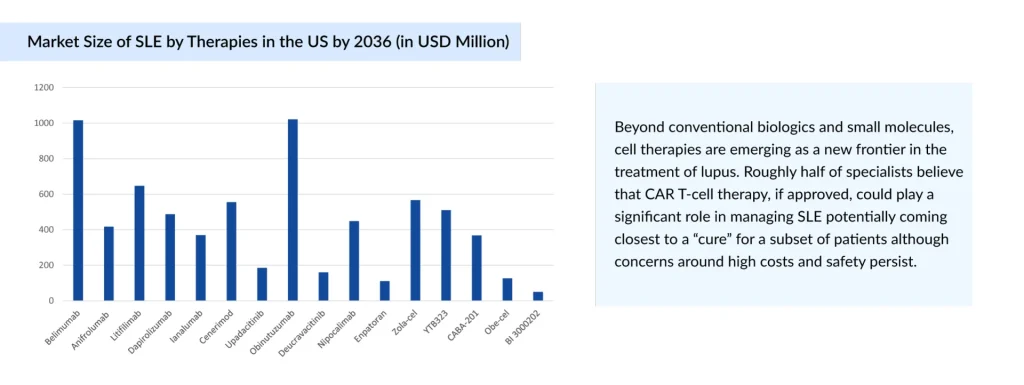
Sadaf Javed, Functional Head of Forecasting & Analytics at DelveInsight, said that Obinutuzumab’s deeper B-cell depletion profile relative to older anti-CD20 agents positions it as a potential best-in-class option for the renal-involvement subgroup that remains poorly served by belimumab and anifrolumab alone. Obinutuzumab is expected to cross USD 1 billion by 2036.
Johnson & Johnson’s Nipocalimab (IMAAVY)
J&J’s FcRn blocker lowers pathogenic circulating IgG antibodies while sparing other immune functions, a mechanism already validated commercially in myasthenia gravis. Backed by positive Phase 2b JASMINE data and FDA Fast Track designation (its fifth) granted in early 2026, nipocalimab is now enrolling the Phase 3 GARDENIA study.
As per Javed, J&J’s existing autoimmune commercial footprint gives nipocalimab a credible shot at rapidly capturing share once approved, even against entrenched systemic lupus erythematosus competitors Johnson & Johnson would otherwise be racing to catch. The drug is anticipated to cross USD 400 million by 2036.
Biogen and Royalty Pharma’s Litifilimab
Biogen’s first-in-class BDCA2 antagonist targets plasmacytoid dendritic cells directly, cutting off type I interferon production at its source. Beyond its Breakthrough Therapy designation in cutaneous lupus, litifilimab has shown reductions in swollen and tender joints in systemic disease, and Phase 3 programs across both CLE and SLE (with roughly 548 patients enrolled across 15 countries in one ongoing trial) are expected to read out through 2026–2027. Litifilimab is projected to reach USD 647 million by 2036, as per DelveInsight’s analyst Sharad Chandra Vinayak.
AbbVie’s RINVOQ (upadacitinib)
AbbVie’s oral JAK1 inhibitor met its primary endpoint (SRI-4 response with steroid dose ≤10 mg prednisone-equivalent) in the Phase 2 SLEek study, both as monotherapy and in combination with the BTK inhibitor elsubrutinib, and has since advanced into Phase 3 lupus trials in partnership with Lupus Therapeutics’ clinical trial network. As an already-approved, orally administered franchise across rheumatoid arthritis, psoriatic arthritis, and several other indications, upadacitinib brings an existing commercial infrastructure and physician familiarity that few pure-play biologics can match, a real threat to the injectable-dominated status quo among systemic lupus erythematosus marketed drugs. As per the DelveInsight analysis, the upadacitinib market size is estimated to be approximately USD 185 million by 2036.
Novartis’ Ianalumab
Novartis’s dual-action anti-BAFF-receptor antibody both blocks BAFF signaling and depletes B cells via antibody-dependent cellular cytotoxicity, a mechanistic combination distinct from belimumab’s soluble-BLyS-only approach. The SIRIUS-SLE 1 and SIRIUS-SLE 2 Phase 3 trials, alongside a long-term extension study, are evaluating monthly and quarterly subcutaneous dosing regimens, a convenience angle that could matter significantly for market uptake.
Way Ahead in the Systemic Lupus Erythematosus Treatment
The systemic lupus erythematosus market has crossed an inflection point. For fifty years, the disease was managed, not treated, controlled with steroids and antimalarials that dulled symptoms while doing little to alter the underlying autoimmune process. Belimumab broke that pattern in 2011, anifrolumab followed in 2021, and the five years ahead look set to bring the most crowded, mechanistically diverse launch window this disease has ever seen.
The systemic lupus erythematosus market size is roughly USD 3 billion in the 7MM across the 7MM and it is projected to grow at a CAGR of 10.4% by 2036. This growth is driven by long-term outcome focus, a shift toward personalized early intervention, and rising adoption of biologics and pipeline innovations such as CAR‑T and BDCA2 therapies.
What comes next will be won on precision as much as efficacy. Renal involvement, cutaneous-dominant disease, interferon-high versus interferon-low biology, steroid-sparing potential, and route of administration are all becoming meaningful axes of differentiation rather than footnotes, and payers, physicians, and patients will increasingly expect new entrants to prove superiority on one of these axes, not just non-inferiority to BENLYSTA. Biosimilar pressure on belimumab as its patents lapse, combined with a genuinely deep late-stage pipeline spanning key players in the systemic lupus erythematosus treatment market, including AbbVie, Roche, Biogen, Novartis, Johnson & Johnson (J&J), AstraZeneca, and others, means the competitive landscape of systemic lupus erythematosus drugs will look fundamentally different by the early 2030s than it does today.
For an SLE population that has waited decades for options beyond steroids, that is unambiguously good news, and for every company tracking the systemic lupus erythematosus market size and its underlying competitive dynamics, the way ahead has rarely looked more consequential.

FAQs
The prevalence of SLE varies by region, with higher rates observed in the United States compared to the EU5 and Japan.
The primary treatment for SLE includes corticosteroids and immunosuppressive drugs. Belimumab (BENLYSTA) and Anifrolumab (SAPHNELO) are the only FDA-approved biologic therapies specifically for SLE.
Major pharmaceutical companies involved in SLE R&D include Gilead, J&J, BMS, Roche, Biogen, Cabaletta Bio, Merck, Idorsia Pharmaceuticals, Viatris, UCB Pharma, AbbVie, and others.
As per DelveInsight analysis, the SLE market size was USD 3 billion in the 7MM in 2025, which is expected to increase at 10.4% CAGR by 2036, driven by a long-term outcome focus, a shift toward personalized early intervention, and rising adoption of biologics and pipeline innovations such as CAR‑T and BDCA2 therapies.
Downloads
Article in PDF
Recent Articles
- Systemic Lupus Erythematosus: Mapping the Burden of a Complex Autoimmune Disease
- Horizon, Viela Deal; Concert Schizo Drug Flop; Gilead Deals with Arcus and Gritstone
- Roche’s GAZYVA Extends Indications Into Lupus, Strengthening Immunology Pipeline
- BENLYSTA vs GAZYVA: Who Wins the Battle for Lupus Nephritis Treatment?
- Aurinia’s Lupkynis for Lupus; FDA Fast Track Designation for Toripalimab; Wren Therapeutics...