The Patent Cliff Countdown: 8 Pharma Giants With the Most Revenue on the Line
Nov 11, 2026
Table of Contents
Summary
- More than $300 billion of annual revenue, about one-sixth of the industry, loses exclusivity between 2025 and 2030, roughly three times the 2012 cliff.
- Branded sales can fall 80–90% within 12 to 18 months of generic or biosimilar entry, and US Medicare price negotiation can cut net prices even earlier
- The risk is particularly high for companies with significant dependence on key products, including Merck’s KEYTRUDA and BMS’s ELIQUIS and OPDIVO, with 2028 emerging as a critical year for patent expirations and generic entry.
- Companies such as Novartis and AbbVie are demonstrating progress in offsetting losses through newer products; others are prioritizing reformulations, indication expansions, acquisitions, and next-generation therapies, including cell therapies, bispecific antibodies, and ADCs.
- Merck, BMS, and Pfizer face particularly significant challenges in developing and scaling replacement products to bridge their anticipated revenue gaps.
Every blockbuster drug has an expiry date. When a patent lapses, generic or biosimilar rivals arrive, prices fall, and revenue drops. Analysts call this a “patent cliff,” and it is a normal part of the industry’s cycle. This time, though, the scale is unusual. Between 2026 and 2030, more than $300 billion in prescription drug revenue will lose patent exclusivity, about one-sixth of the industry’s annual revenue. The estimates vary by source and time window. Several data sources put the figure at more than $500 billion in worldwide prescription sales potentially exposed to generic competition between 2026 and 2032.
Downloads
Click Here To Get the Article in PDF

Recent Articles
- Novel Mutation-Targeting Therapies in the Horizon to Relieve the Global Healthcare Burden NSCLC P...
- Analyzing the Growth of the Biosimilar Market Through Years
- A Market Space Beyond Lucentis and Eylea for Retinal Vein Occlusion Treatment
- PD-1 Inhibitors: Which Companies Are Winning the Immunotherapy Race?
- Virus, the Cancer Therapy of the Future
The cliff also affects companies very unevenly. Eli Lilly and Novo Nordisk appear poised to sail through, with limited patent exposure and huge earnings from GLP-1 weight loss drugs. Other companies are close to the edge.
Eight Giants on the Edge: Company-by-Company Exposure
Each company below faces a different mix of timing, product type, and competitive threat. Figures are the latest available, and exclusivity dates are estimates that can shift with litigation and settlements.
Merck & Co.: KEYTRUDA, the $31 Billion Question
KEYTRUDA (pembrolizumab) is the anti-PD-1 immunotherapy behind Merck’s oncology franchise, approved across dozens of cancers, from lung and melanoma to bladder and breast. The KEYTRUDA family earned $31.68 billion in 2025, up 7% from 2024, and accounted for 48.7% of Merck’s FY2025 sales.
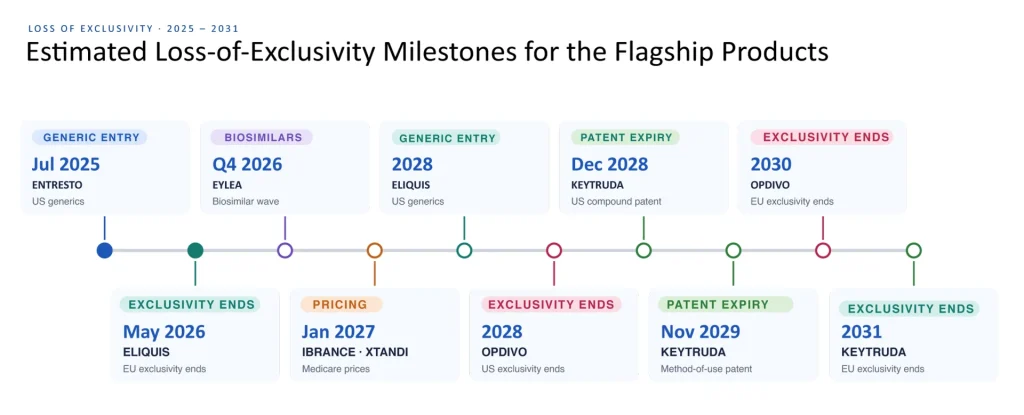
The US compound patent expires in December 2028. CEO Rob Davis has noted that a method-of-making patent runs to May 2029 and a method-of-use patent to November 2029. Europe follows in 2031, Japan in 2032 to 2033, and China in 2028. Medicare price setting is also expected from January 2029. Biosimilar developers are already working on pembrolizumab.
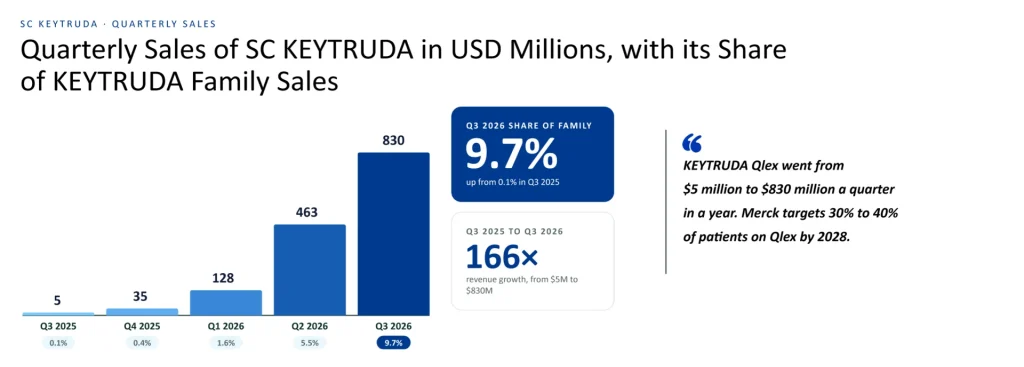
Before Merck’s subcutaneous shot gained traction, the average analyst forecast saw KEYTRUDA sales sliding to just over $7 billion by 2032. That is the scale of the exposure: roughly $24 billion of annual revenue at risk from one molecule. Merck’s defense is KEYTRUDA QLEX, the subcutaneous version approved in September 2025. In Q3 2026, it sold $830 million, or 9.7% of the KEYTRUDA family, up from 1.6% in Q1, and its own US patent runs to 2031. Merck hopes 30% to 40% of patients will switch by 2028. It has also committed about $26.5 billion to acquisitions (Verona, Cidara and Terns) and is leaning on newer launches such as WINREVAIR. The competitive threats are biosimilar pembrolizumab in 2028–2029 and rivals such as Bristol’s subcutaneous OPDIVO QVANTIG.
Bristol Myers Squibb: ELIQUIS and OPDIVO, a Double Cliff
BMS has the most concentrated exposure of the group. ELIQUIS (apixaban), an oral anticoagulant for stroke prevention in atrial fibrillation and for treating blood clots, is co-marketed with Pfizer and generated about $14.4 billion globally in 2025. OPDIVO (nivolumab) is a PD-1 immunotherapy used across many solid tumors and blood cancers. Together with other legacy products, they produce more than half of BMS’s 2025 revenue.
ELIQUIS lost European exclusivity on May 19, 2026, and US generic entry is expected in 2028. Analysts forecast a 98.6% global decline, to about $205 million by 2031, with a near-50% single-year US drop at generic entry. The Inflation Reduction Act is front-loading the damage, because the Medicare price took effect in January 2026, two years before generics. OPDIVO follows with estimated minimum exclusivity dates of 2028 in the US, 2030 in the EU and 2031 in Japan.
OPDIVO is already softening: in Q3 2026 intravenous sales fell 6.2% to $2.37 billion as patients moved to subcutaneous OPDIVO QVANTIG, which sold $334 million. BMS responded with the $14 billion Karuna deal (the schizophrenia drug COBENFY), the $4.1 billion RayzeBio radiopharmaceutical acquisition, and oncology additions such as OPDUALAG, BREYANZI, and KRAZATI. The risk is simple arithmetic: no pipeline replaces roughly $14 billion of ELIQUIS in six years.
Pfizer: Five Franchises, One Rolling Cliff
Pfizer’s exposure is the broadest, spanning cardiovascular, oncology, vaccines and immunology. Its 10-Q warns of a significant revenue reduction from expiries across 2026 through 2030, with the pace accelerating. For 2026, it expects an unfavorable impact of about $1.1 billion, down from an earlier estimate near $1.5 billion.
ELIQUIS, which is marketed by Pfizer and Bristol Myers Squibb (BMS), follows the same timeline outlined above for BMS, with Pfizer’s alliance-related revenue share also expected to decline accordingly. In oncology, IBRANCE, indicated for HR-positive/HER2-negative breast cancer, and XTANDI, marketed in collaboration with Astellas for prostate cancer, are both subject to Medicare price negotiations effective 2027, while their U.S. patent protection is generally expected to expire around the same period, although these timelines are approximate. In immunology, XELJANZ is excluded from Medicare price negotiations, as CMS has determined that bona fide generic marketing exists, preventing a negotiated price from taking effect. Meanwhile, Pfizer’s pediatric PREVNAR franchise has matured, with the company transitioning toward Prevnar 20, while Merck’s CAPVAXIVE, which generated approximately USD 480 million in revenue during the first nine months of 2025, adds competitive pressure in the adult pneumococcal vaccine market.
Pfizer’s 2025 revenue was $62.6 billion, with 2026 guidance of $59.5 to $62.5 billion. The offset is a $43 billion Seagen acquisition (ADCETRIS, PADCEV, TUKYSA), roughly $9 billion of 2025 deals including the Metsera acquisition and a PD-1/VEGF bispecific licensed from 3SBio, and a Vyndamax patent settlement that extends its effective US expiry to June 2031. Management is targeting high-single-digit revenue growth for five years from 2029. The bridge years, 2026 to 2028, are the hard part.
Amgen: ENBREL, PROLIA/XGEVA and OTEZLA Under Pressure
Amgen leans on established immunology and bone-health franchises. In 2025, ENBREL (rheumatoid and psoriatic arthritis, psoriasis) sold $2.23 billion, down 33%. XGEVA (skeletal events in cancer patients) sold $2.08 billion, down 6%. OTEZLA (psoriasis and psoriatic arthritis) grew 7% to $2.27 billion. PROLIA, the osteoporosis drug that shares denosumab with XGEVA, faced multiple US biosimilar launches in 2025, and Amgen’s 2025 annual report expects accelerated erosion in 2026. Total 2025 product sales were $35.1 billion.
The exclusivity picture differs by product. PROLIA and XGEVA are already competing with biosimilars. ENBREL’s decline so far is driven mainly by pricing and benefit-design changes, with US patent protection generally expected to last until around 2029 (approximate). Otezla was selected for Medicare price setting beginning in 2027, which Amgen expects to push net prices lower.
The cushion is diversification. REPATHA grew 33% in the first nine months of 2025, and EVENITY, TEZSPIRE, IMDELLTRA, and the Horizon portfolio (TEPEZZA, KRYSTEXXA) add breadth. Amgen also turns biosimilars to its advantage, selling AMJEVITA (HUMIRA biosimilar), WEZLANA (STELARA), and PAVBLU, the EYLEA biosimilar that took share from Regeneron. It is hedged on both sides of the cliff.
Novartis: ENTRESTO, PROMACTA and TASIGNA, Already Over the Edge
Novartis is the clearest case of a company already absorbing the fall. CEO Vas Narasimhan has called it the “largest patent expiry” in company history. ENTRESTO (heart failure) sold $7.7 billion in 2025, PROMACTA (a platelet-boosting drug for immune thrombocytopenia) $1.6 billion, and TASIGNA (chronic myeloid leukemia) $1.1 billion, according to Novartis’s FY2025 results.
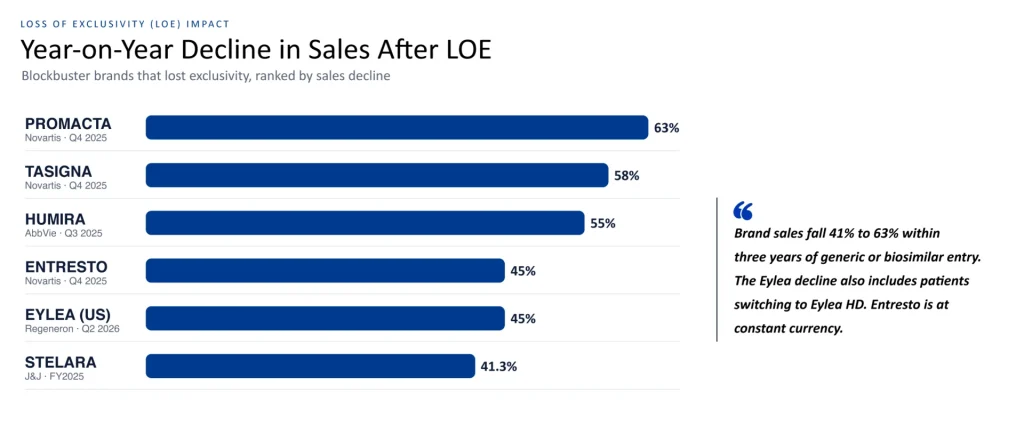
US generics arrived for PROMACTA and TASIGNA in May 2025 and for ENTRESTO in the third quarter of 2025. In Q4 2025, ENTRESTO fell 45% to about $1.2 billion, PROMACTA fell 63%, and TASIGNA fell 58%. The three drugs contributed more than $6 billion to US sales in 2024, and Novartis expects a $4 billion revenue gap in 2026 versus 2025. ENTRESTO still grows outside the US, and Novartis is litigating to protect its IP rights.
The transition is working so far. Novartis grew 2025 sales 8% to $54.5 billion on KISQALI, PLUVICTO, SCEMBLIX, KESIMPTA, LEQVIO, AND COSENTYX ($6.7 billion), and guides to 5% to 6% annual growth through 2030. It also expects low-single-digit sales growth in 2026 even through the cliff. Few peers can say that.
Johnson & Johnson: STELARA’s Fall and the Growth Franchises Behind It
J&J spans immunology, oncology, and hematology, and its 2025 results show both sides of the cliff. STELARA (psoriasis, Crohn’s disease, ulcerative colitis) fell 41.3% to $6.08 billion after US biosimilars launched in 2025, cutting Innovative Medicine segment growth by roughly 11 percentage points, per J&J’s 10-K. IMBRUVICA (blood cancers, co-marketed with AbbVie) slipped 7.1% to $2.82 billion under oral competition and Medicare Part D redesign. ZYTIGA and REMICADE already face generic and biosimilar pressure, and J&J’s 10-K flags that SIMPONI biosimilars would likely mean a significant sales reduction.
DARZALEX, the multiple myeloma antibody, grew 23% to $14.35 billion and is J&J’s largest product, so it will be the one to watch as its protection eventually ends later this decade (timing approximate). TREMFYA, the IL-23 inhibitor, grew 40.5% to $5.16 billion and is now the designated heir to STELARA in immunology.
The transition is visible in the numbers. Innovative Medicine sales passed $60 billion in 2025 and grew about 4% to 5% even with STELARA’s drop, powered by CARVYKTI, TECVAYLI, TALVEY, RYBREVANT/LAZCLUZE, ERLEADA, SPRAVATO, and the newly acquired CAPLYTA. J&J is the best demonstration that a diversified pipeline can absorb a major LOE.
AbbVie: SKYRIZI and RINVOQ, the Cliff Survivors
AbbVie’s story is the reference case for how to survive a patent cliff. HUMIRA lost US exclusivity in January 2023 and once supplied more than half of the company’s revenue. By Q3 2025, its quarterly sales had fallen 55% to $993 million, the first quarter since 2007 below $1 billion. HUMIRA biosimilars are also available in the psoriatic arthritis treatment market.
SKYRIZI (an IL-23 antibody for psoriasis, Crohn’s disease and ulcerative colitis) and RINVOQ (an oral JAK inhibitor for arthritis, atopic dermatitis and bowel disease) filled the gap. In Q3 2025, they sold $4.7 billion and $2.2 billion, a combined $6.9 billion that exceeds the best quarter HUMIRA ever had ($5.6 billion). AbbVie guided to about $24.7 billion combined in 2025 and more than $31 billion by 2027.
The exposure now is the replacements themselves. Their patent protection is generally expected to last into the early-to-mid 2030s (approximately), so AbbVie has a window, but not an indefinite one. It is also racing to build the next wave through the ImmunoGen and Cerevel acquisitions, obesity, and neuroscience, because IMBRUVICA has already been hit by Medicare negotiation, including a $2.1 billion write-down.
Regeneron: EYLEA and the Race to EYLEA HD
EYLEA (aflibercept) treats wet age-related macular degeneration, diabetic macular edema, and diabetic retinopathy, and it long anchored Regeneron’s ophthalmology franchise. Since US exclusivity lapsed in 2024, Amgen’s PAVBLU has taken share, and EYLEA’s US sales fell 42% in FY2025. Combined EYLEA and EYLEA HD sales were down 16% to just under $6 billion in the first nine months of 2025.
More competition is scheduled. Settlements allow biosimilars from Sandoz, Alvotech/Teva and Formycon in Q4 2026 (or earlier in some circumstances), Biocon in the second half of 2026 and Celltrion from December 31, 2026. Roche’s VABYSMO adds a branded rival, with 2025 sales of CHF 4.1 billion.
EYLEA HD, the higher-dose version that stays under patent, is the defense. Its US sales rose 36% to $1.6 billion in 2025 and 52% to $596 million in Q2 2026, when legacy Eylea fell 45%. In April 2026, the FDA approved dosing intervals of up to 20 weeks, though the prefilled syringe is delayed. Regeneron’s wider health is good: revenue grew 17% in Q2 2026, with DUPIXENT at $6.0 billion for the quarter and LIBTAYO at $1.4 billion in 2025. The ophthalmology franchise is shrinking; the company is not.
The Verdict: Who Is Ready for the Fall?
The patent cliff is not one event but a decade-long reshuffling of who earns pharma’s profits. Roughly $300 billion of annual revenue is in play, erosion after generic or biosimilar entry is fast, and the world’s most valuable drugs sit inside a handful of companies. Pipeline innovation, portfolio diversification, and well-timed acquisitions are the three levers that decide who keeps growing. Based on progress to date, the eight companies can be classified into three groups. Among those furthest along in managing the impact of patent expirations, AbbVie has already successfully replaced HUMIRA, while Novartis is navigating an estimated $4 billion revenue gap in 2026 but continues to project growth. Similarly, Johnson & Johnson is offsetting the decline in STELARA sales through its broad oncology and immunology portfolio.
Companies in the transition phase include Regeneron, which is shifting patients to EYLEA HD while relying on DUPIXENT and LIBTAYO to sustain growth, and Amgen, which benefits from portfolio diversification and its own biosimilar business. Meanwhile, Merck, Bristol Myers Squibb (BMS), and Pfizer face the most significant challenges. Merck’s heavy reliance on KEYTRUDA represents the largest single-product concentration risk, with Qlex offering a potentially meaningful but yet unproven buffer. BMS must simultaneously manage the erosion of ELIQUIS and OPDIVO revenues, while Pfizer faces the challenge of bridging the 2026–2028 period until the growth contributions from its acquisitions fully materialize.
None of this is a forecast of failure. Subcutaneous reformulations, new modalities and a record deal cycle give these companies real tools, and history suggests that the well-prepared get through the cliff with a smaller, more focused portfolio. The ones to watch are those that wait: because exclusivity dates are firm and pipelines take years, time is the one asset that cannot be acquired.

Downloads
Article in PDF
Recent Articles
- FDA Approves STELARA; Novartis announces AMG 334; AbbVie’s HCV Regimen; PaizaBio Gains CFDA...
- R&D and Upcoming therapies Paving the Way for a Potential and Better Cure for Immune Thrombo...
- Malignant Pleural Mesothelioma Upcoming Therapies
- PD-1 and PD-L1 Inhibitors: Will They Dominate Over Conventional Cancer Therapies?
- OPDIVO Approved for Resectable NSCLC; Palvella Gets $2.6M FDA Grant; First Patient Dosed in UGN-1...